In an open letter, The Emory Wheel published on Oct. 30, almost 100 members of Emory University’s faculty expressed their concern over the firing of former Medical School Professor Anna Kenney. The faculty alleged that Kenney’s termination in September, which followed comments she made online about the murder of Charlie Kirk, violated the University’s Open Expression policy. While the Wheel Editorial Board strongly condemns celebrations of political violence, we also recognize the complexity in evaluating free speech issues — something the University fails to do time and time again.
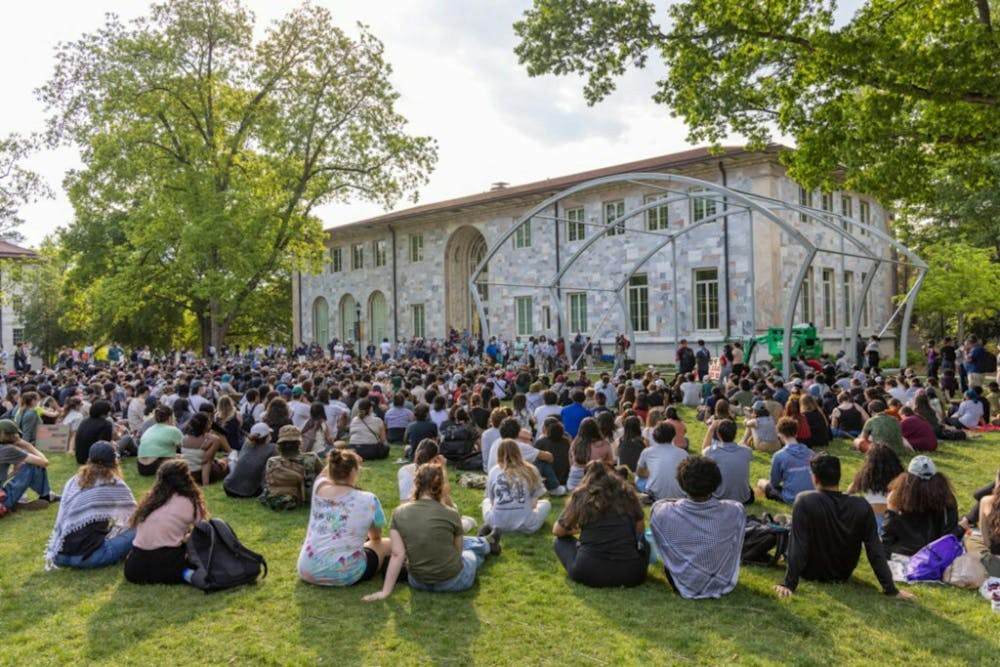
The Kenney case is not an isolated issue, but rather reflects a frightening pattern. On April 25, 2024, the Emory Police Department, Atlanta Police Department and Georgia State Patrol surrounded a pro-Palestinian encampment on the University Quadrangle. Law enforcement arrested 28 demonstrators, 20 of whom were Emory community members. From national news coverage to a vote of “no confidence” in the former University President Gregory Fenves from Emory undergraduate students, the arrests made Emory subject to internal and external backlash. The University introduced a new Open Expression Policy this March, pledging to use a content-neutral approach to address open expression issues and policy violations. Yet, no less than a year later, the Committee for Open Expression found that Emory violated its own mission. As the University publicly pledges to promote free speech and consider infringements with care, Emory must respect its own Open Expression policy — not ignore it. Only when the University proves itself committed to the policy will the administration allot free speech issues the time and space they deserve to foster a free and productive campus.
The University first implemented an Open Expression Policy in 2013 and demonstrated commitment to its principles. For example, in 2014, more than 200 Emory students staged a “die-in” outside the Candler School of Theology to protest police brutality and racial injustice with no disruption from the University. In 2015, the University created a class on the “Ferguson Movement,” responding to a police officer shooting of Michael Brown, an unarmed black teenager. The class created "another way for the conversation to happen,” Samuel Candler Dobbs Professor of Women’s, Gender and Sexuality Studies and African Studies Pamela Scully said. A decade ago, the University leadership supported dissent and celebrated expressive movements within its academics.
However, as discourse and dissent begins to fill Emory’s campus again, the University simply feigns care. The University markets institutional structures like the Open Expression policy as protection for community members’ rights, but it turns against those very members when facing backlash. U.S. Rep. Buddy Carter (R-Ga.) later publicly denounced Kenney’s post and warned that the government could reconsider Emory’s federal research funding; when coupled with the University’s response to Kenney’s post, the future of open expression at Emory appears grim. Instead of defending its stated values of open dialogue, Emory dismissed Kenney, signaling that its commitment to expression extends only as far as it remains politically convenient.
The University’s reactionary tendencies hinder important discussion and debate that can serve to educate and help the University heal and move forward in difficult situations. The Open Expression Policy defines itself as “[embodying] a reasonable balance between the free-speech interests of faculty, staff, and students, and the significant interests of the university,” allowing for “the freedom to debate and the freedom of expression.” Supporting free speech means giving complex issues the time and space that they deserve — which the University failed to do with Kenney, given the Committee for Open Expression’s claim that the University must give “substantial consideration” to First Amendment protections before administering disciplinary action.
When the University fails to follow its own guidelines, it forsakes its role as mediator and assumes the role of liability manager. Although we cannot speak for every student, in our current campus environment, students may internalize that protest leads to arrest, dissent leads to punishment and inquiry leads to jeopardization of visas and careers. This perspective on advocacy and expression stems from the University’s rapid disciplinary responses and risk-averse decisions, which stand at odds with its own commitments to protecting free speech and all forms of expression. The inconsistency between the policy’s guarantees and administration's conduct raises questions about whether open expression is upheld as a principle or applied selectively to the institution’s advantage.
If the University hopes to foster essential dialogues, it must respect its own alleged mission. There is no use for a policy if it is forsaken in the face of complexity and controversy. If the University continues to ignore its own policies and procedures, free speech at Emory will exist only in name.
The above editorial represents the majority opinion of The Emory Wheel’s Editorial Board. The Editorial Board is composed of Editorial Board Editor Carly Aikens, Shreyal Aithal, Ananya Jain, Mira Krichavsky, Wayne Liang, Pierce McDade, Meiya Weeks and Crystal Zhang.