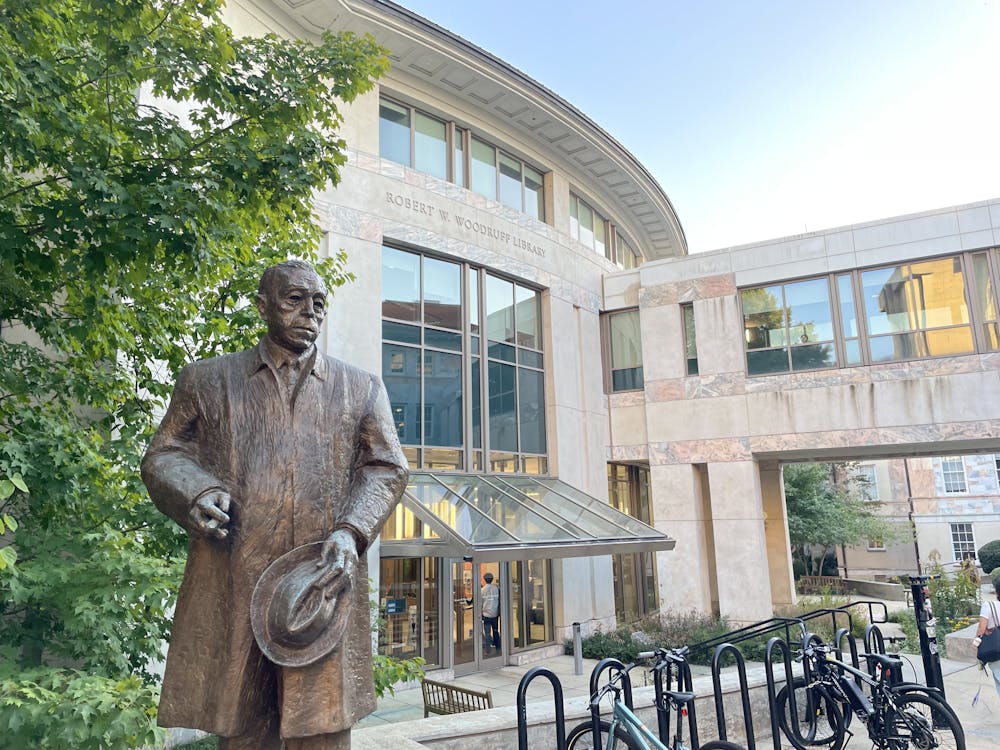
Recent federal funding cuts have impacted universities nationwide, with decreased funds for academic programs reaching all the way into the classroom — and even the libraries. At Emory University, librarians annually reevaluate academic journal subscription fees. Assistant Dean of Education for Data Science Education at the Nell Hodgson Woodruff School of Nursing Roy Simpson said this process included noting any increases in fees and other changes to the library budget.
This year, Emory’s libraries had to reduce access to Elsevier, a major academic publisher with over 3,000 journals that specialize in science and healthcare, because Emory did not receive additional funding to cover the subscription fee increases, according to Associate Vice Provost and University Librarian Lisa Macklin.
“Emory, much like other institutions of higher education, is in a period of budget austerities, and the way that library collections work is that for subscriptions, we have market increases every year,” Macklin said. “This year, we did not receive any additional funding to cover those market increases, so in order to balance our budget, we have to cancel something.”
Emory’s libraries have saved approximately $655,000 from reducing Emory’s access to Elsevier’s collection, according to Macklin.
Macklin explained that the Emory librarians decided to decrease Elsevier access after reviewing data on journal costs and usage that the library collected from publishers. Subject librarians and informationists reviewed and further narrowed down the list before they asked the Emory community and faculty to provide input. The negotiation yielded a condensed collection of 590 journals from Elsevier that is better suited to Emory’s research and teaching needs, according to a statement released by Emory Libraries to faculty members.
Former Dean of the School of Nursing Linda McCauley (79N) also noted that rising subscription costs have been a consistent issue in academia.
“Subscription services have gone up, and [Emory libraries] are constantly evaluating usage and the balance between making sure that for large programs of study, there’s sufficient resources available for the large number of users, and in smaller areas, that there is some coverage,” McCauley said.
The Elsevier reduction is not the University’s first time ending subscriptions to major journals. In 2024, the library discontinued Wiley journals services to reduce costs. However, the content from those journals remains available to the Emory community through an expedited article delivery service.
Macklin explained that expedited article delivery allows Emory community members to access journal articles without a full subscription, reducing some of the impact of ending the journal services. Expedited article delivery allows the library to pay a flat fee of $30 per article, which can sometimes be more cost-effective than purchasing a full journal subscription and is faster than interlibrary loan.
“It’s still a much faster way of getting the articles and a much less expensive way of getting the articles,” Macklin said. “That ability to make that request for an article will appear in menus for the journals that we’ve canceled.”
McCauley also highlighted how rapid technological development increased the availability of academic resources.
“Technology actually is allowing us to have greater access than we’ve ever had before,” McCauley said.
Furthermore, Simpson predicted that the increase of generative artificial intelligence (AI) in academia will change future access to academic scholarships.
“It is very important that students and faculty seek that knowledge of understanding how the world is changing with the AI models for access to knowledge,” Simpson said. “It makes me anxious … to see all this just change right before my eyes.”
Similarly, Macklin mentioned how generative AI has been integrated into academic publishing.
“Large publishers are licensing their content … to generative AI companies because it is a good, robust data set,” Macklin said. “We may be seeing over time more generative AI responses that are relying on that published journal literature.”
However, Simpson emphasized that human knowledge will always be necessary to create journal content.
“Generative AI comes out of data,” Simpson said. “It produces information, but it’s not knowledge … It will never think as beyond the human mind.
Correction (1/21/2026 at 12:59 p.m.): A previous version of this article incorrectly stated that Lisa Macklin was the former vice provost and university librarian. In fact, Lisa Macklin is the current vice provost and university librarian.