Across the nation, including at Emory, people have taken to the streets to protest the Immigration and Customs Enforcement (ICE) agency’s killings of Renée Good and Alex Pretti in Minneapolis. In the past seven months, ICE has expanded its presence in multiple U.S. cities, including Atlanta.
Professor of Political Science Jeffrey Staton noted that recently, hostility toward ICE’s approach to immigration enforcement has increased since Trump’s inauguration.
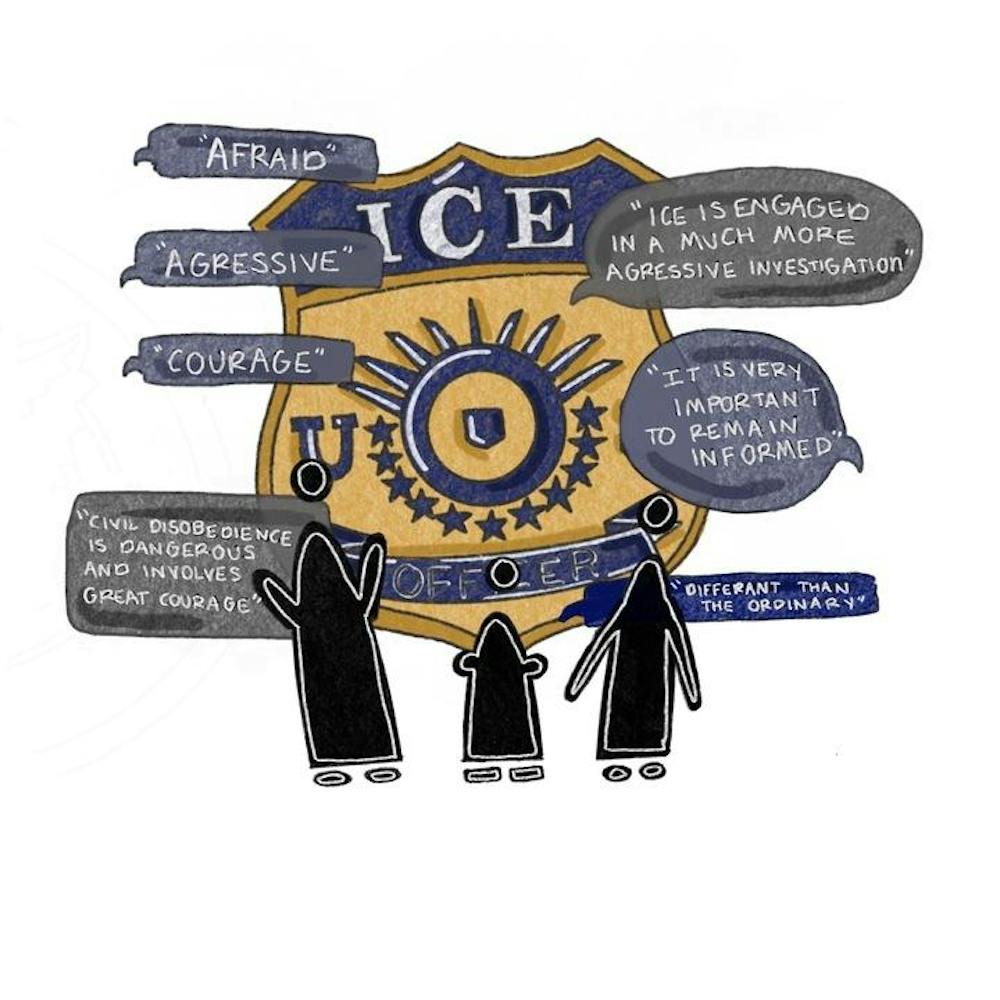
“What has happened in the last year is that a series of cities across the United States, including Los Angeles, Chicago and Minneapolis, most recently, [is that] ICE is engaged in a much more aggressive investigation of communities to identify people who may not have legal status in the United States,” Staton said.
Immigration has been a “divisive” issue for Americans throughout history, according to Staton. He added that ICE has recently employed more militaristic technologies and tactics.
“What is absolutely strange are the things like the ICE officers wearing masks and more frequently showing up with large weapons and military gear,” Staton said. “That is very different than the ordinary.”
Assistant Professor of Political Science Kiela Crabtree cited a Supreme Court decision from September 2025 that allows ICE to consider indicators of race and ethnicity when making arrests.
“It’s become very clear that these phenotypical markers of race and also markers of ethnicity, so perhaps how people are speaking, what language they’re speaking, these types of things have become used for ICE to make raids,” Crabtree said.
For Crabtree, these factors draw on Americans’ broader fears about ICE’s recent expansion and its implication on public safety.
“I’ve certainly heard from people and read stories about folks who are afraid to leave their homes, afraid to go about their daily lives because of the threat of ICE in their communities,” Crabtree said.
Minnesotan Will Barrett (28C) expressed concern about potential violence from protestors and ICE agents during demonstrations against the agency’s actions. He attributed his fear to the fact that ICE agents now receive less training than in previous years, due to manpower concerns. Barrett connected the violence currently unfolding in Minneapolis to protests that took place in 2020, in the aftermath of George Floyd’s death.
“We have a lot of people in the city right now who aren’t trained in de-escalation,” Barrett said. “Even in 2020, police got training in de-escalation that’s greater than that of an ICE agent, and we still saw that continue to escalate for about a month before everything calmed down.”
Crabtree urged students, researchers and universities to stay up to date on this issue and reflect on how it may impact their communities.
“It’s very important to remain informed about what is happening, and I say particularly as perhaps we may face similar challenges in our own community,” Crabtree said. “We can’t assume that this is an issue that won’t concern us, regardless of where you stand on the issue.”