Since returning to office last year, U.S. President Donald Trump has made it a priority to increase transparency regarding “foreign influence” within higher education institutions. In April 2025, Trump signed an executive order to stop the “secrecy surrounding foreign funds in American educational institutions,” emphasizing the importance of protecting American ideals and security.
Nearly eight months later, on Jan. 2, the Department of Education (DOE) released a dashboard reporting universities’ foreign contracts and donations. Universities are required to report contracts and gifts from foreign entities exceeding $250,000 under Section 117 of the Higher Education Act of 1965.
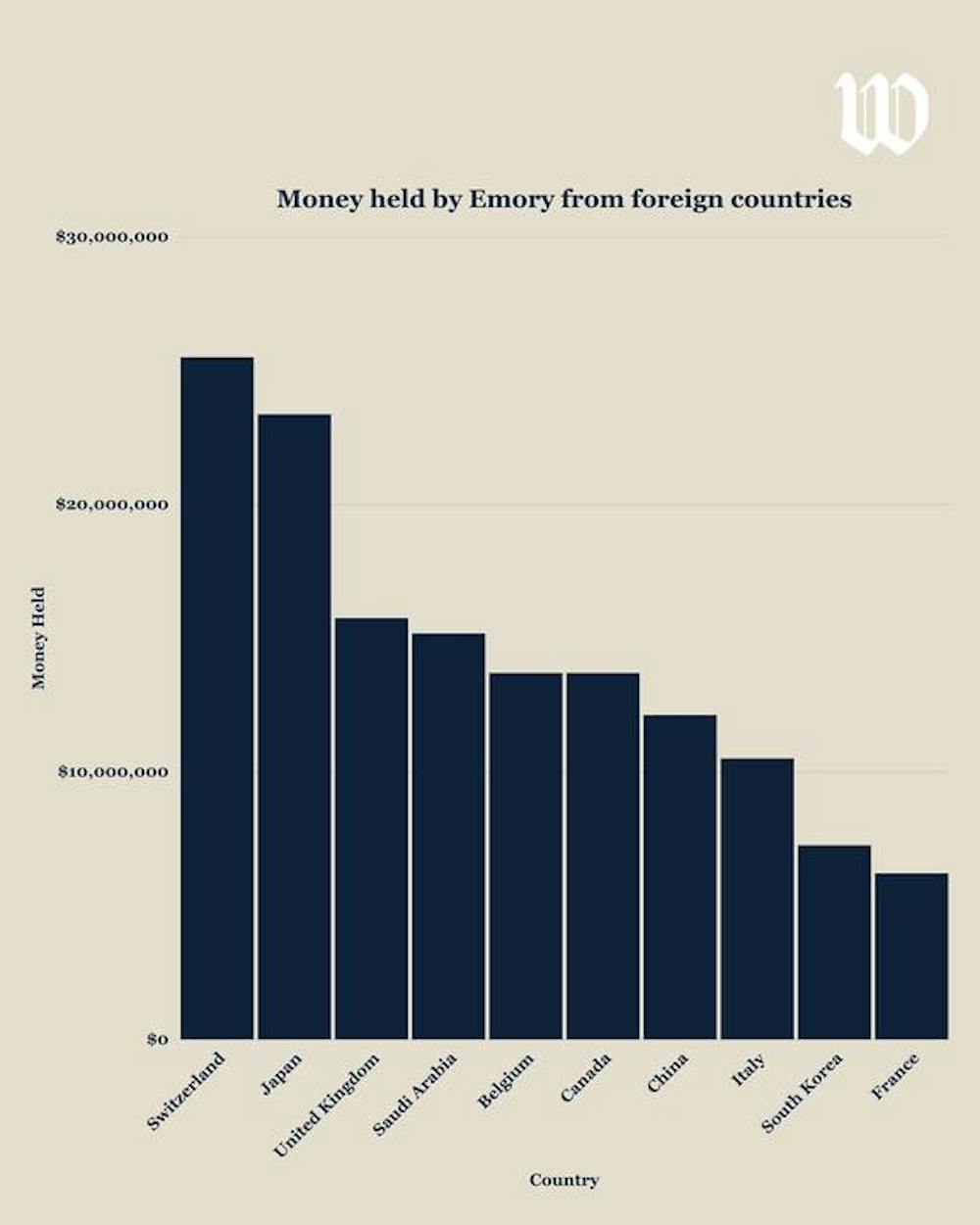
According to the dashboard, Emory University has received nearly $182.4 million in foreign funds from contracts and gifts as of Jan. 31, 2025. Assistant Vice President of University Communications Laura Diamond explained in an email to The Emory Wheel that “gifts” to the University can be charitable donations from foreign entities or individuals, while contracts are typically research grants.
Emory has received over $20 million each in contracts from Swiss and Japanese sources, making these countries rank highest and second-highest in gifts and contracts on the dashboard summary. Entities in the United Kingdom and Saudi Arabia have also separately contributed nearly $15 million in contracts to the University. Emory also holds a little over $4 million in contracts with Israeli entities.
Over the past few years, pro-Palestine protesters have called on Emory to cut its ties to Israeli entities due to the ongoing conflict in the Middle East. The Georgia chapter of the Council on American-Islamic Relations has also called on Emory to disclose all its ties to Israel and to divest endowments from Israel.
In addition to contracts, Emory has received over $2 million in gifts from Italy, Malaysia, Canada and Switzerland.
While Qatar is the top foreign funder of U.S. universities, contributing over $6.5 billion nationwide, Emory holds only $256,750 from sources associated with the Gulf state.
Compared with peer private universities, Emory has received less total funding from international sources. Carnegie Mellon University (Pa.) has received $2.9 billion in funding from foreign countries, and Johns Hopkins University (Md.), Georgetown University (D.C.), Northwestern University (Ill.) and Duke University (N.C.) all hold over $1 billion in foreign funding.
Additionally, Rice University (Texas) received under $4 million in foreign funding, and Wake Forest University (N.C.) received under $20 million. Tulane University (La.) acquired nearly $50 million from abroad.
Emory holds over $12 million in funding from China, the vast majority of which is held in contracts. In 2019, Emory fired two Emory School of Medicine professors after they failed to disclose grants they received from institutions in China. One of the professors, Li Xiaojiang, was part of the Thousand Talents Program, which the first Trump administration deemed a threat to national security. In 2020, Xiaojiang pleaded guilty to filing a false tax return and was sentenced to one year of probation on a felony charge.
Alexander Cooley, a political science professor at Barnard College (N.Y.), said the new dashboard offers a “crude snapshot” of how gifts and contracts could affect universities in an interview with Inside Higher Ed.
In the April executive order, Trump emphasized the importance of disclosing where universities receive funding to defend higher education institutions from foreign influences.
“It is the policy of my Administration to end the secrecy surrounding foreign funds in American educational institutions, protect the marketplace of ideas from propaganda sponsored by foreign governments, and safeguard America’s students and research from foreign exploitation,” Trump wrote.

Spencer Friedland (26C) is the Editor-in-Chief of The Emory Wheel. He is double majoring in Philosophy and Film. Outside of the Wheel he is a member of Emory's Honor Council and Franklin Fellowship. After college he is planning on attending law school.