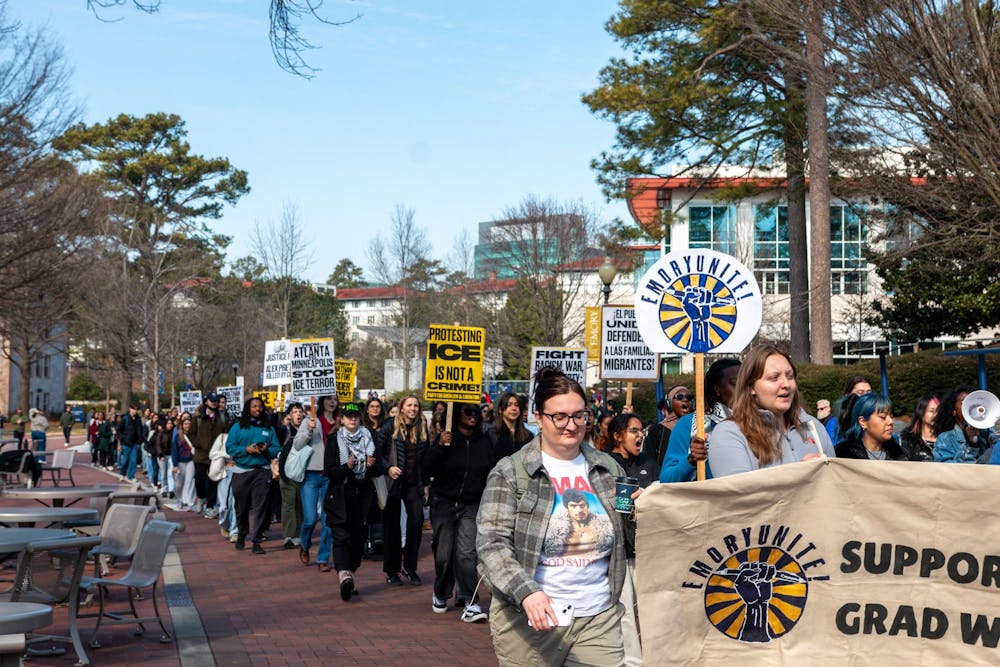
At one of the largest protests at Emory University since pro-Palestine protests in April 2024, around 300 community members rallied on Jan. 30 against U.S. Immigration and Customs Enforcement’s (ICE) recent nationwide actions. The demonstration began with student speakers in Asbury Circle, and after about 30 minutes, organizers led protesters in a march through campus to the Haygood-Hopkins Gate near Emory Village.
Emory Students for Socialism (SFS), EmoryUnite! and Sunrise Emory, among other groups, co-organized the event, which followed a smaller protest last week.
Emory SFS organizer Tasfia Jahangir (23PH, 29G) began the protest by condemning an ICE agent’s killing of Renee Good on Jan. 7 and an ICE agent’s killing of Alex Pretti on Jan. 24, both of which occurred in Minneapolis.
This weekend, hundreds of anti-ICE protests took place across the United States. Alongside Emory’s demonstration, over 100 other Georgia schools held walkouts and protests against ICE on Jan. 30. Additionally, thousands of workers and many businesses participated in a general strike over the weekend. Jahangir said there should be “no business as usual” while ICE raids and killings continue.
Recently, ICE opened a new satellite office in College Park, Ga., about a 30-minute drive from Emory’s Atlanta campus. In addition to the new location, ICE operates another field office in downtown Atlanta. According to WABE, the metro Atlanta affiliate of NPR and PBS, ICE officers have been working out of the College Park space as of Jan. 27, but ICE spokesperson Lindsay Williams declined to disclose the office’s exact location.
Jahangir attributed the high protest turnout partially to the national attention that the deaths of Good and Pretti are receiving. During her speech, Jahangir called these events a “historic moment,” igniting Americans’ willingness to fight for change.
“People are feeling the weight of the situation right now,” Jahangir said. “The killing of Renee Good, Alex Pretti, just shows that under this regime, nobody is safe. ICE is killing, terrorizing people indiscriminately.”
During the protest, eight Emory students spoke. Anayancy Ramos (28G), who is a Deferred Action for Childhood Arrivals recipient, teared up while describing her experience as an undocumented student.
“As far as I know, I’m the only undocumented graduate student at Emory,” Ramos said. “I hope you know and understand what my journey has been like, and whenever I do try to speak out, I’m met with, ‘You don’t have to worry about that, you’re at Emory.’”
Protesters cheered on Ramos, whose voice wobbled as she told her story, with the crowd exclaiming “shame” on the Emory administration as she spoke.
Ramos urged attendees to remember the power of community and emphasized that while international students may not be undocumented, many still fear for their safety at Emory.
“Silence won’t protect the international students sitting in our classrooms, wondering if an algorithm will upend their lives — silence will not protect me,” Ramos said. “When it’s your turn, who will be there? Who will be there to protect you? So, I’m asking you all to be there for me. I’m committing to be there for you too.”
As Ramos finished speaking, the crowd erupted in a chant, responding to her question with a promise of their own: “We’re here for you!”
After several students spoke in Asbury Circle, the organizers began leading the group of about 300 protesters through campus. Community members marched from Cox Hall, through the Emory Quadrangle and to the Haygood-Hopkins Gate.
“Get out the way, ICE, get out the way,” students chanted to a drum beat.
Perched around the marble Emory University sign, the group gathered for the rest of the protest. Emory National Lawyers Guild President Mary Thomas (27L) continued the series of speakers, imploring students to stand up against the “racists” and “fascists” she said make up the U.S. government.
“Y’all know what scares racists and fascists?” Thomas said. “Everyday people like me and like you. … We are making a statement today that enough is enough.”
Attendee Ugonma Chike-Kalu (29C) said she attended the protest because she values civic engagement and supports the movement against ICE.
“There’s power in people, there’s power in demonstration and there’s power in movement,” Chike-Kalu said. “When I saw the protest was happening, I knew that was something I wanted to be a part of, just to instigate change.”
Along with caring about community involvement, Chike-Kalu also called ICE’s recent actions “despicable” and “abhorrent,” stating the agency is targeting marginalized communities and people of color.
Kristara Marshall (28C) compared the arrests of both undocumented people and U.S. citizens by ICE agents to those of Nazi Germany and emphasized that she wants the government to shut the agency down.
“ICE should be abolished,” Marshall said. “It’s our responsibility as college students to use the education that we’re getting to speak out against ICE for others who can’t.”
Like Chike-Kalu and Marshall, EmoryUnite! organizer Abigail McElroy (28G) said she wants Emory to do more to support its undocumented and international community members against potential ICE action.
“Emory has been very quiet about everything that’s going on, and I would like them to not, because I don’t want my friends to be deported,” McElroy said. “I don’t think that’s such a crazy thing to say.”
Similar to last week’s protest, participants called for change from both the federal government and the University itself. Chike-Kalu criticized the University for not doing more to support Emory’s substantial international student population, calling their approach to recent ICE actions “callous.”
In Chike-Kalu’s call to action, she was specific that she wanted to see more tangible actions, not just words, from the University.
“I don’t want a statement,” Chike-Kalu said. “We don’t need a resolution. We don’t need an Instagram post. We need action. We need policy change, and we need support.”
Contributing Writer Maxine Podgainy (29C) contributed to this reporting.

Ellie Fivas (she/her) (26C) is from Cleveland, Tenn., and is majoring in political science and history on the pre-law track. When she is not working for the Wheel, she works in prison education, leads a human rights club and works at the Emory Writing Center. In her free time, you can find her reading trashy romances and The New York Times, basking on the Quadrangle and doing crossword puzzles.

Amelia Bush (28C) is double-majoring in English and PPL (philosophy, politics and law). She is from Minneapolis, Minnesota, and enjoys walking around its many lakes. Outside of the Wheel, you can find her reading, scrapbooking, or attempting a New York Times crossword.