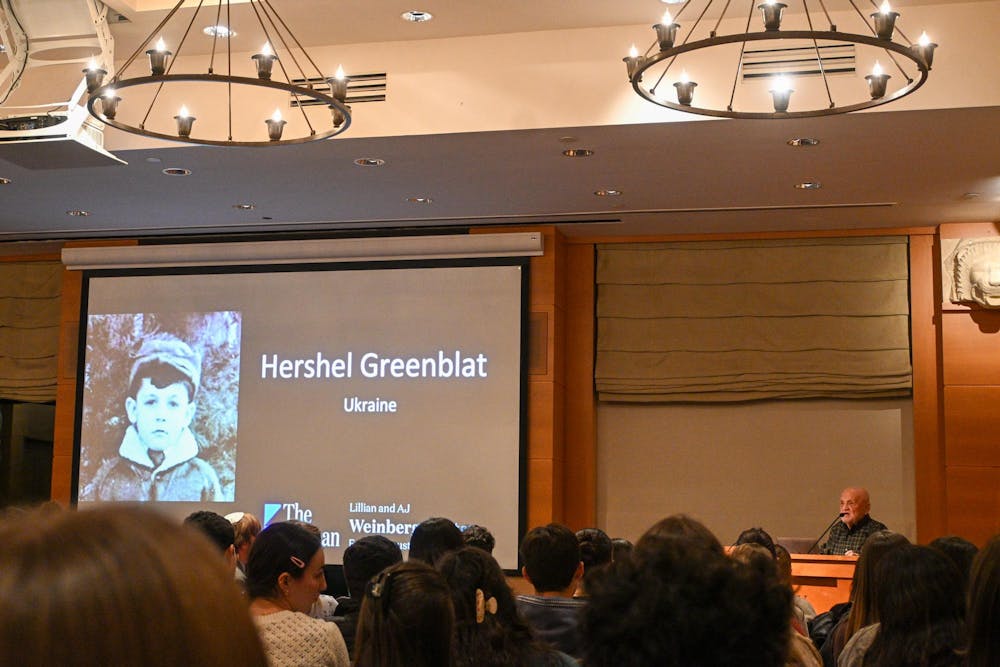
According to the Associated Press, 70% of Holocaust survivors are expected to pass away in the next decade. On Holocaust Remembrance Day, around 150 students, faculty and members of the Emory University community came together to connect with the rapidly fading living history of the Holocaust by listening to the story of Hershel Greenblat, an 84-year-old survivor. The event, sponsored by the Office of Spiritual and Religious Life (OSRL) and the Tam Institute for Jewish Studies and in association with Emory MEOR, Chabad at Emory and Emory Hillel, provided a bridge between Greenblat’s story and a new generation of students responsible for its preservation.
Holocaust Remembrance Day is annually observed on Jan. 27, and commemorates the day of the liberation of the Auschwitz-Birkenau concentration camp in 1945. The day memorializes all victims of the Holocaust.
OSRL Jewish Chaplain Rabbi Jordan Braunig began the night with remarks on the resilience of the Jewish people throughout history, especially in the face of facism during the Holocaust. For Braunig, Jewish history is more than its “lowest point,” but still he recognized the Holocaust as an event inextricable to Jewish identity and collective memory.
“As a people, we have been sustained by our deep commitment to memory,” Braunig said.
Following Braunig’s remarks, Adam Landstein (26C) and Cassidy Moskowitz (26C) shared how their study abroad trip to Poland through the Tam Institute allowed them to come face-to-face with their Jewish heritage, from exploring historic synagogues to visiting former Nazi concentration camps. Moskowitz said these experiences helped them further connect to their Jewish identity.
“We experienced moments of joy, dancing, singing and eating together, held alongside lessons about suffering, loss and survival,” Moskowitz said. “Through learning about the Holocaust and hearing the deeply personal stories of Jews, both those who survived and those who didn't, I left Poland with a clearer sense of how I want to live my own life.”
After Landstein and Moskowitz spoke, Arthur Blank Family Foundation Associate Professor of History and Jewish Studies Ellie Schainker introduced Greenblat. For about ninety minutes, Greenblat detailed his account of his own family’s struggles and trauma during the Holocaust. He also detailed their escape from Nazi-occupied, Soviet Union-controlled territory in modern-day Ukraine to Soviet-controlled modern-day Russia, before they later escaped to the United States in 1950.
In his speech, Greenblat spent time reflecting upon his experience as an immigrant, including how his identity as a Holocaust survivor informed his view and empathy for the experiences of Black people in the United States. Greenblat reminisced about a beloved teacher that helped him adjust to life in Atlanta, allowing him to experience the generosity of his fellow Americans. However, he also saw the conditions that Black Atlantans lived through in the 1960s, which he said were similar to post-war camps.
“If you were Black, you were nobody. You lived in conditions that were worse than we lived in, in the [displaced person] camps, no running water for some part, no electricity,” Greenblat said.
Greenblat concluded by urging the audience to strive for peace and spread love in their communities.
“I want this to be a better world, and you're going to make a better world,” Greenblat said.
Many audience members, including Ben Goldman (26C), found Greenblat’s speech emotionally resonant and politically significant. Goldman, the Emory Israel Public Affairs Committee president, shared that he found Greenblat’s words deeply resembled his own family history, and also praised Greenblat’s support of Israel as a home for the Jewish people.
“When he said, ‘We have no other home but IsraeI,’ I was thinking that during the entire speech, and that was the most powerful part of the speech to me, and resonated with me,” Goldman said.
Heather Kletzky (29C) said that hearing the speech in person and “feeling the emotions” in real time was especially meaningful to her. She said she was moved by Greenblat’s gratitude for his parents, whom he attributed his survival of the Holocaust to.
“I really enjoyed how much time and energy he spent talking about not just his events in the Holocaust, but his life after and how grateful he is for his parents and the people that supported him no matter what,” Kletzsky said.
Similarly, Andrew Schaffer (29C) said he found Greenblat’s emphasis on family relatable and inspiring.
“It taught me how important it is to keep close to my family and value the closeness and always look out for them and have their best interests in mind,” Schaffer said.
MEOR Rabbi Yaakov Fleshel, who helped organize this event, said speeches like Greenblat’s are crucial to teaching and remembering the Holocaust, especially as the number of living survivors continues dwindling. He hopes Greenblat’s words will inspire greater understanding and connection between peoples today.
“Today, because people are becoming more detached, events like this, keep the memory and the connection,” Fleshel said.
Braunig applauded the event for bringing the Jewish community together. He called it a "responsibility" for Jewish people to make sure the horrors of the Holocaust are never forgotten.
“It's possible to feel our pain, grief, loss is our own and that we're the only ones who have to [have] the burden of carrying it,” Braunig said. “An event like this is a reminder that there's a wider community who can help us carry that burden, who can help us with the work of remembering.”