
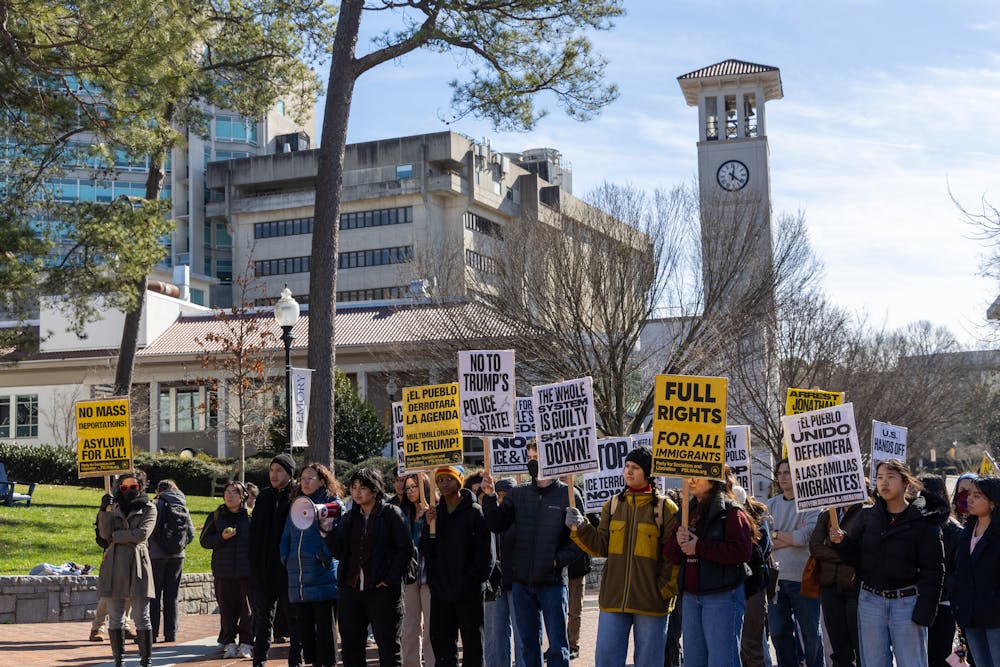
Since the beginning of President Donald Trump’s second term, about one year ago, U.S. Immigration and Customs Enforcement (ICE) agents have increased their presence nationwide. On Jan. 7, an ICE agent shot and killed Renee Good in Minneapolis, sparking nationwide outrage.
This reaction has spread to Emory University, where about 70 community members gathered in Asbury Circle on Tuesday to protest against these recent actions by ICE. Emory Students for Socialism (SFS) organized the event with speakers from Sunrise Emory and the Atlanta branch of the Party for Socialism and Liberation.
Emory SFS organizers Tasfia Jahangir (23PH, 29G) and Tony Torres (29C), introduced the demonstration and said that, in part, Good’s murder motivated the protest, along with other recent nationwide events. The protest on Emory’s campus was one of 12 student demonstrations in the Atlanta area.
“We are living through a moment of profound crisis,” Jahangir said. “Our fundamental rights are under attack on every front, from our workplaces to our neighborhoods, from our schools to our home.”
Jahangir also emphasized the connection between anti-ICE sentiments and Martin Luther King Jr. Day, which was on Jan. 19, highlighting King’s legacy of fighting oppression.
“Dr. King devoted his life to fighting what he called ‘the three evils of society,’ what I call the three evils of capitalism: racism, war and poverty,” Jahangir said. “These same evils define the agenda that we are up against today.”
After Jahangir and Torres kicked off the demonstration, they invited Anayancy Ramos (28G) to share her experience with citizenship status. Ramos is a Deferred Action for Childhood Arrivals (DACA) recipient, which means that, although Ramos’ undocumented immigrant parents brought her to the United States as a young child, she is permitted to stay in the United States through the DACA program. Ramos implored the crowd to stand up for immigrant rights, especially in the context of a heightened presence of federal agents in cities like Atlanta.
“I want to use my voice whenever possible to advocate for those who don’t have my privilege,” Ramos said. “A lot of the people that are in detention centers right now are also people that don’t have a voice, who don’t have people that know how to look for them.”
Ramos said that, although the increased presence of ICE in cities across the United States is daunting, she has pushed through that fear to still take action to support her community.
“I'm scared for my family,” Ramos said. “I'm scared for my community members, but I don't let that fear paralyze me. I use that instead as motivation to do something.”
Sunrise Emory Member Maya Vizuete (28C) also spoke, highlighting the connection between environmental justice and anti-fascism. In addition, Zachary Hammond (23Ox, 25C) commented on the anniversary of U.S. President Donald Trump’s second term inauguration.
“Those things are everything that Trump stands for: racist attacks on immigrant communities, aggression and the kidnapping of Venezuela’s president, as well as aggression against Greenland and Iran, and the Big Beautiful Bill,” Hammond said.
Professional Tutor and Developmental Editor at the Emory Writing Center Robert Birdwell, a member of the Emory chapter of the American Association of University Professors (AAUP), also spoke at the event. Birdwell said the Emory AAUP chapter has been working to support and defend academic freedom, shared governance and Diversity, Equity and Inclusion policies.
“Let’s call on the Emory administration and voters to proceed to take a stand against this illegal violence, this terrorism against Americans profiling people of color and dissenters,” Birdwell said.
Ramos also called on Emory's administration to support community members affected by the rising presence of ICE. According to Ramos, she sought assistance from Emory services as an undocumented student in the past, but she said that she has not been adequately supported by the University.
“I’ve gone to various administrators asking for more help, whether it be mental health resources, legal services,” Ramos said. “And I’ve always been told, ‘No, we can’t do that.’”
Following the protest, attendee Jude Barcik (29C) reflected on the monumental nature of the current U.S. political events. She emphasized the importance of being a part of a community that acknowledges current events and will “stand in support” against violence.
“It’s really scary living through a period of history that you know is going to be referenced in textbooks later as a period of terror,” Barcik said.
Cyrus Ebrahimi (29C) said he decided to join the protest because of his previous experience volunteering and learning about people’s stories in the immigrant communities. Ebrahimi said he wanted others to recognize the importance of being “united” in the fight against “injustice.”
“All this alienation and hostility against immigrants, against refugees, is just unreasonable,” Ebrahimi said. “It’s really just distracting us from the elites who really run everything.”
Throughout all of the speeches at the event, each speaker emphasized the crucial role of community in political organizing. Ramos said she hopes that other Emory community members will become more involved in organizing and lean on their neighbors to make a change.
“You don’t have to do it alone,” Ramos said. “You can do it along with organizations that have systems in place to protect yourself, to protect your neighbors, to do more for your community.”
With the number of ICE agents rising nationally, the protest at Emory was focused on the local impact of federal policies on Atlanta and Emory community members. Birdwell ended his speech with a message to federal agents in Atlanta and nationwide.
“We’re here to say with one voice that the Emory community, this campus, is our state, our pocket of democracy,” Birdwell said. “And ICE isn’t welcome here.”

Ellie Fivas (she/her) (26C) is from Cleveland, Tenn., and is majoring in political science and history on the pre-law track. When she is not working for the Wheel, she works in prison education, leads a human rights club and works at the Emory Writing Center. In her free time, you can find her reading trashy romances and The New York Times, basking on the Quadrangle and doing crossword puzzles.


