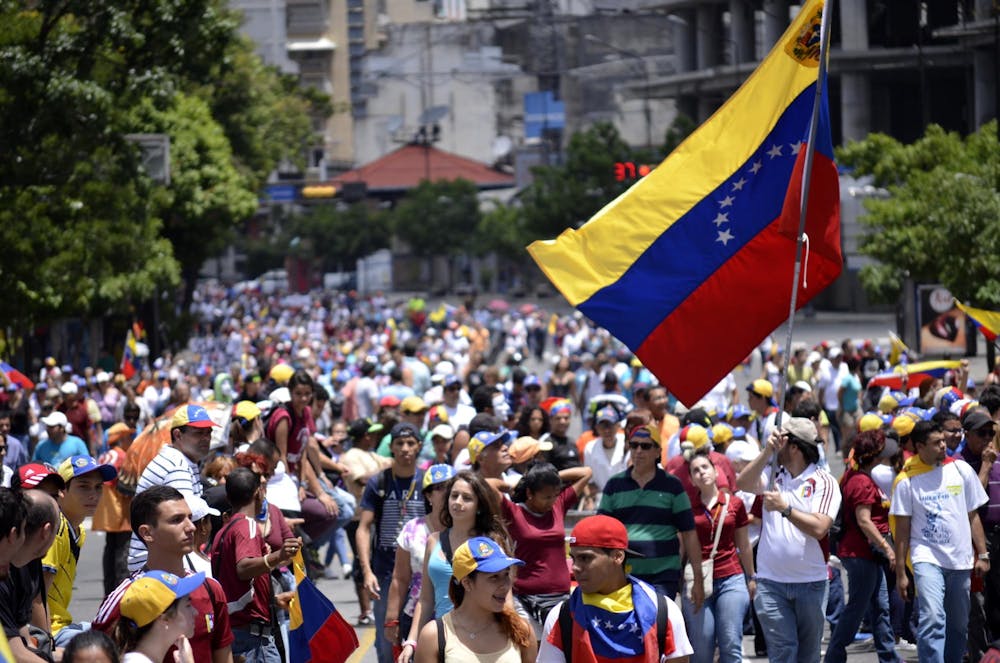
In the middle of the night my crying mother shook me awake, repeating “Lo sacaron,” — they removed him — in between sobs. These were not cries of sadness or pure happiness. They were tears of hope — something my fellow Venezuelans and I had not felt in years.
On Jan. 3, I was shocked by the news that after years of oppression and censorship in Venezuela, U.S. forces captured Venezuelan President Nicolás Maduro, finally removing him from office. It had felt like forever since any movement made progress against toppling the aggressive regime. Many, including teenagers like myself, had died trying. All hope of regime change seemed lost, especially after the rigged election of 2024, when the government barred candidates like Maria Corina Machado — one of the regime’s biggest opponents and 2025 Nobel Peace Prize winner — from running.
But now, nearly 20 years after my mother fled the country for her safety, my mother — along with nearly 8 million Venezuelans scattered across the world in diaspora — finally feel something they have been looking for: hope.
Many critics have condemned U.S. President Donald Trump’s removal of Maduro, believing the President’s true motivation for the military action was his imperial ambition and attempt to tap Venezuela’s oil reserves. But these critics fail to recognize that the Venezuelan people have waited 30 years for the Chávez-Maduro regime to fall. Social media personas, particularly creators on platforms like TikTok and Instagram, have portrayed the removal of Maduro as a black-and-white issue — that either people are against the forced removal of Maduro or supportive of Trump’s actions in Venezuela — without accounting for the genuine experiences of those who survived Chavismo. Led by former President Hugo Chavez, Chavismo is the socialist political project which gradually concentrated power in the state and completely reshaped Venezuelan society.
As a member of the Venezuelan diaspora, I want people to recognize Venezuela’s current situation as a complex, multi-layered situation, capturing the Venezuelan sentiment that this event is both a dangerous precedent for U.S. power and, at the same time, a rare moment of hope for Venezuelans who lived through this repressive regime.
Those who are supportive of Maduro’s capture, like the millions of Venezuelans who fled the country, have faced global backlash on social media. Backlash, including comments that liken Trump to Maduro and claims that one dictator has been traded for another — mischaracterize that our support after Maduro’s ousting from power means an acceptance of Trump and his actions. While there has been a rollback of human rights in America under Trump’s administration, equating his actions with a regime that has devastated Venezuela — persecuting political opponents, kidnapping and repressing human rights — is too extreme. These comparisons are insensitive at best and feel like an attempt to delegitimize the sliver of hope that the removal of Maduro has given Venezuelans. This binary narrative and black-and-white public reaction omits crucial nuance — that Maduro’s removal creates optimism and still fear in the hearts of Venezuelans.
The pundits who reduce Mudaro’s removal to only U.S. interest in Venezuelan oil, do not consider the life-changing implications that the removal of Maduro means for Venezuelans. Despite Trump’s decision to take over Venezuela’s oil industry after capturing Maduro, for many Venezuelans, oil is the least of their concerns. For the past three decades, the country’s oil has been nationalized under state control and sold to Cuba and China for attractive prices, earning corrupt Chavista politicians billions of dollars and offering little economic benefit to ordinary citizens. What many Venezuelans care more about is having their rights restored and protected. So, while this is about oil for Americans, this news is more about reclaiming their country after the Maduro regime destroyed it for Venezuelans.
To be very clear, governments should not be forcibly removing the leader of another nation. Such actions are a clear violation of international law and are morally objectionable. In this case, though, without intervention, it is unlikely that any other international body would have intervened in Venezuela. If it were not for Trump’s operation, the Maduro regime, with its cold-blooded killing and corruption, would have continued. Since the start of the Chavismo movement in 1999, the Venezuelan people have lost all their sovereignty. The removal of Maduro, while illegal, has still provided Venezuelans with hope for political change we otherwise would not have gotten. Our hope does not mean that other Venezuelans and I are supportive of Trump or his actions regarding Venezuela. Just because there is celebration over Maduro’s removal does not mean Venezuelans as a whole praise Trump, which starkly contrasts with the media’s binary interpretation.
The fight for democracy and Venezuelan liberty is not over. Despite major political changes finally occurring in Venezuela, the handling of the aftermath of Maduro’s removal by politicians in Venezuela and Trump has been concerning. Most recently, Trump has praised Delcy Rodríguez, the former vice president of Venezuela and current interim president. Following Maduro’s capture, Trump referred to her as a “terrific person” who will “make Venezuela great again.” These statements ignore the fact that Rodriguez is a long-time follower and supporter of Maduro and will do anything to uphold his regime. While Trump’s removal of Maduro has given some hope to Venezuelans, many of his subsequent actions have been disappointing and have shattered some of the wishes Venezuelans had for meaningful change.
The journey towards a freer, more democratic Venezuela has only just started. But now, Venezuelans have something they did not have before: the possibility for a better future. So, instead of assuming the ideological positions of Venezuelans based on American partisanship, Emory University students must look beyond the two political extremes in the media and try to understand the real Venezuelan perspectives that fill the gaps in between. To hear a wide range of nuanced perspectives, I encourage students to seek out diverse media and to listen to Venezuelan voices online in the coming months as the political situation develops.
Because of safety concerns and travel restrictions, I have not been able to return home to visit my beautiful country and see half of my family since 2016. I have struggled to renew my passport, and I faced xenophobia when living as a Venezuelan in Colombia. I have had to rebuild my life twice, first in Colombia and now in the United States. I have been given a sliver of hope with Maduro's capture. The hope is that one day, I can visit my family without fear or restrictions. Two things can be true at once: I can be happy and hopeful that Maduro is gone, but I can still be concerned over Trump’s blatant violation of international law.
Contact Sabrina Tomei at sabrina.tomei.gonzalez@emory.ed