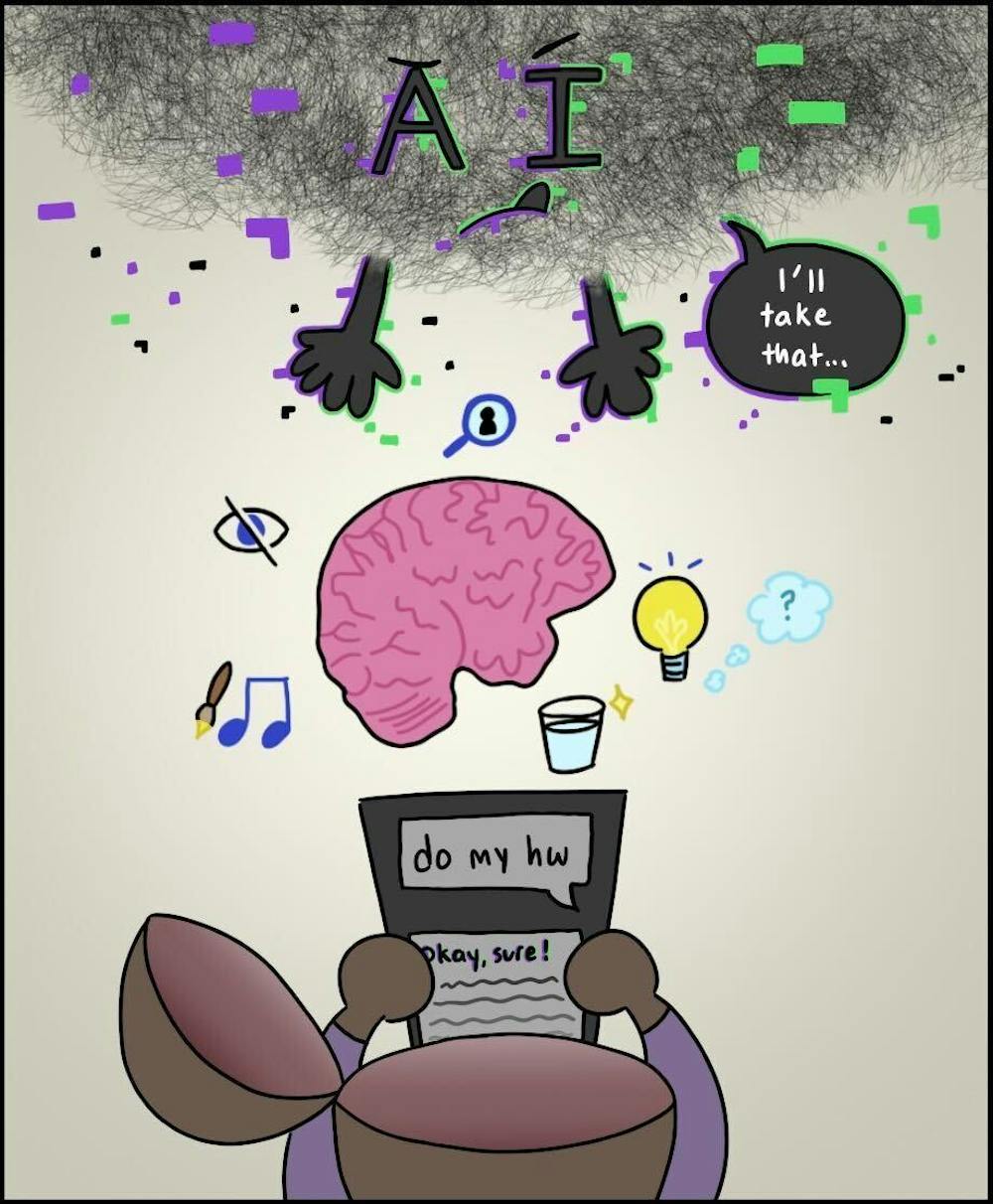
Over the past decade, investment in and use of generative artificial intelligence (GenAI) tools, the exciting new frontier of technological innovation, have skyrocketed. Enterprise AI tools have extraordinary abilities to streamline workflows and complete menial tasks, improving efficiency across industries. However, a large subset of GenAI development has been concentrated on creating consumer-facing features, such as the rapid improvement of picture and video generation capabilities by models like OpenAI’s Sora. These features are superfluous gratification machines with little practical application for increasing our quality of life. In our never-ending quest for convenience, humans have often mechanized processes to improve efficiency. However, AI represents a dangerous tipping point where we are directly trading our autonomy for small conveniences and the improvement in efficiency is no longer worth the innovation.
Consumer GenAI features like media generation are amusing if not particularly useful, and it is easy to believe that they are innocuous. However, GenAI use has already created an incalculable amount of harm across several metrics. The vast majority of AI deepfake media is nonconsensual pornographic content. In fact, Grok, the built-in chatbot on Elon Musk’s platform X, recently generated and posted sexual imagery of children. Beyond the staggering amount of rare earth materials, water and electricity required to build and operate data centers, many rural communities no longer have clean or reliable running water due to sediment buildup caused by nearby data centers. Financial experts are also concerned about the circular financing that is defining AI investment, with the industry becoming increasingly “bubble-like.” We cannot continue to overlook and make light of the countless ways in which GenAI is actively degrading our collective quality of life.
To make matters worse, GenAI models are only able to generate text and media because they are trained on hundreds of thousands of existing books, movies, articles and images — much of it copyrighted, and all of it scraped without permission from the original creators. In many cases, AI parent companies also collect all of your prompts to feed back into their models with almost no privacy policies or regulations available to individual consumers. Therefore, on top of the immense harm GenAI is causing to communities worldwide, it is being built with mountains of stolen human content.
All of these sobering truths about the nature of GenAI should be greatly concerning, but they pale in comparison to the most vital reason to avoid GenAI usage: Tasking a chatbot to write an email, solve a math problem or write an essay results in brain atrophy. The Massachusetts Institute of Technology has conducted an initial study linking the use of GenAI to decreased critical thinking abilities and prefrontal cortex activity. The human brain is like a muscle that we must exercise regularly, but the more we cognitively offload responsibilities to AI, the more we risk losing the ability to manage them ourselves.
I understand how convenient GenAI use is in daily life, and I will not pretend I have not used it. However, we must also recognize the long-term consequences of that convenience. You cannot do well on a test if GenAI did all your homework for the class. You cannot defend your argument if GenAI wrote your paper. You cannot perform your job duties if GenAI aced the classes that earned your degree. We must ask ourselves: What is this convenience even worth? Is it really so arduous to do an assignment for the class you signed up for to earn a degree in the field you chose to study at the school you applied to? We have convinced ourselves that effort is oppressive, but constantly racing to finish our work to have more leisure time robs us of intellectual development and our passion for creation.
GenAI might not appear to be anything new — from developing agricultural practices to industrialization, humans throughout history have strived for heightened efficiency to improve our lives. However, these developments have always been in the service of freeing ourselves from physical labor to allow us to spend more time on intellectual development and human expression. AI is a near-total reversal: chatbots generate writing, art and music while humans get stuck schlepping water in buckets just to be able to flush their toilet. GenAI is not benefiting us — it is placating us like the cheese on a mousetrap.
As students at a premier research institution like Emory University, we are exceptionally privileged to have the opportunity to engage with and learn from some of the greatest minds in various fields. American poet Joseph Fasano questions modern students in “For a Student Who Used AI to Write a Paper,” writing, “what are you trying / to be free of? / The living?” What Fasano inquires about is the defining dilemma of our time: We are trying to make our lives as streamlined and low-effort as possible, but nothing will remain after we have eliminated the need for our intellectual labor, our art, our writing and our conversation. These are not the burdens we have convinced ourselves they are — our lives are enjoyable because we have these activities, not in spite of them. Next time you have an essay you do not want to write, remember that even though making GenAI do your tasks might make your life easier, it is also making it duller. The convenience of passively observing your life is not worth it.
Contact Caitlin Williams at caitlin.williams@emory.edu