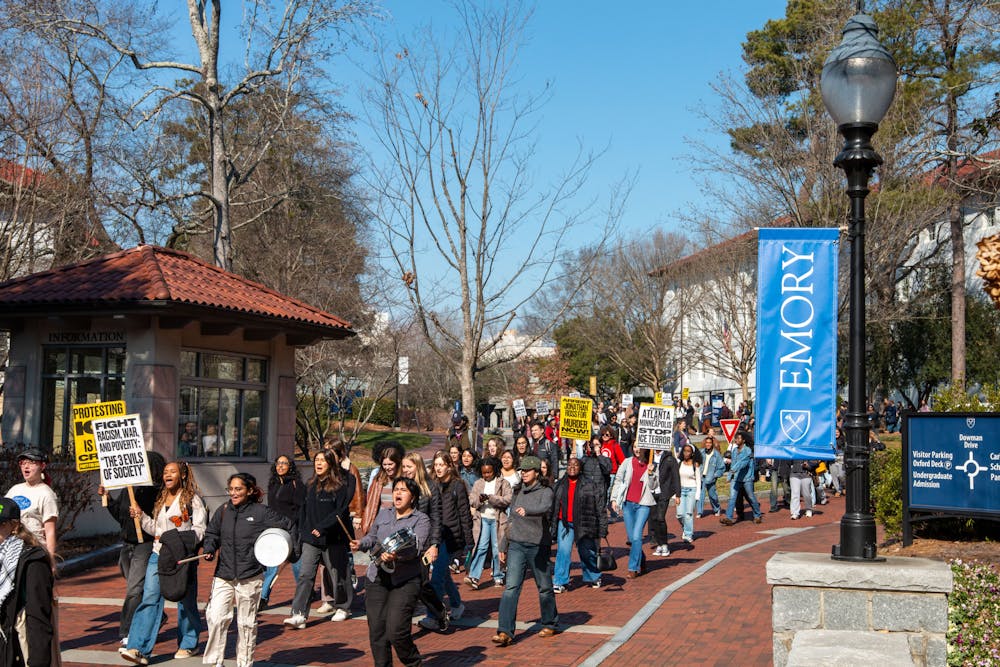
In one of the largest campus protests in recent memory, 300 students marched from Asbury Circle to the Haygood-Hopkins Gate with a clear message: there will be “no business as usual” as long as U.S. Immigration and Customs Enforcement (ICE) continues to raid, detain and kill people with impunity. The protest came days after ICE confirmed the opening of a new satellite office near College Park, just 30 minutes from Emory’s Atlanta campus, indicating the federal government’s intention to continue expanding ICE raids in our backyard.
Georgia holds the fourth most ICE arrests across the nation in 2025, with more than 8,500 individuals arrested in the last year alone, all part of President Donald Trump’s push to deport and detain more immigrants. As ICE’s presence increases in metro Atlanta, Emory’s administration faces a narrowing window to take action to protect its most vulnerable community members. Without immediate, enforceable policy, the University is complicit in attacks on its community members’ rights and safety.
Immigrants, documented or not, are integral parts of metro Atlanta and communities across Georgia. As of November 2025, nearly 500,000 immigrants without legal status live in Georgia. Over 200,000 of these people have lived in the United States for more than 20 years, and 240,000 Georgia children live with at least one undocumented parent. Immigrants, with and without legal status, make up nearly one-fifth of Georgia’s labor force and support industries that power Atlanta’s economic growth — these people are engrained in Georgia communities, the economy and culture. Without them, Atlanta is not the same city. When ICE broadens its reach, it does not “keep our city safe” as Rep. Buddy Carter (R-Ga.) claims. The federal government’s actions are destabilizing families, eroding the workforce and removing people whose lives are already rooted in this state.
ICE is increasingly targeting bystanders, lawful residents and dissenters. In Minneapolis, federal agents fatally shot two U.S. citizens, Renee Good and Alex Pretti, within weeks of each other. While Atlanta has not yet seen coordinated mass operations at the level demonstrated in Minnesota, the new satellite office could be only the beginning of new infrastructure for such enforcement in Atlanta. In May 2024, Governor Brian Kemp signed HB 1105 into law, requiring local police to notify federal authorities when undocumented immigrants are arrested and therefore embedding immigration enforcement into everyday policing. Other state policy furthers the intermingling of ICE and local policing by prohibiting cities and counties from limiting cooperation with ICE, effectively banning sanctuary policies and forcing compliance with federal detainer requests. This means any interaction with local police — a traffic stop, a call for help, a minor violation — could result in deportation, deterring immigrants from reporting crimes or seeking protection.
The Emory administration should be well aware of the threat ICE poses to community members, particularly international students, faculty and staff. In April 2025, ICE terminated visa records for one student and three alumni under Emory’s immigration sponsorship to complete post-graduate training. There was no explanation or appeal by ICE — the students went from legally authorized to deportable overnight.
In December 2025, the University Senate passed a resolution demanding Interim University President Leah Ward Sears (80L) adopt a policy that would prohibit employees from voluntarily sharing information regarding immigration status with federal authorities. The University Senate passed the resolution 33-3, endorsed by the American Civil Liberties Union (ACLU) of Georgia and Georgia National Association for the Advancement of Colored People, with a deadline to implement protections by the end of the 2025-26 academic year. The resolution followed a similar October 2025 Student Government Association (SGA) referendum, where 89.3% of voting students thundered their support for a similar policy. Emory has failed to formally respond to this irrefutable evidence that the student body, faculty and staff oppose ICE’s actions and is imploring the University to do so too.
Emory’s silence does not shelter students: It exposes them. Without policies barring information sharing with federal authorities, students do not know if community members can voluntarily provide their locations, schedules or protest participation history with ICE. Every day, international students face fears of ICE terminating their visas. The threat of ICE forces even U.S. citizen students to weigh advocating for their community against potentially jeopardizing their safety. Students should never have to choose between safety and silence — and Emory should listen to their clear cries for protection.
Emory must act immediately against the threat of ICE on multiple fronts. Sears must enact the policy outlined by the University Senate’s resolution as soon as possible, barring employees from sharing information that could lead to its own community members being deported. Ignoring overwhelming student consensus signals that student safety ranks below institutional convenience.
Students should not live in fear of when they could turn the corner and run into ICE. To combat this, the Emory Police Department (EPD) should publicly provide a clear policy on campus access for ICE — even though the University is mandated to comply with state law, communication with community members can make them feel safer on their own campus. Students, faculty and staff have a right to know what protections exist and what procedures EPD will follow if ICE attempts entry. Columbia University (N.Y.) and other institutions publicized such protocols, requiring ICE to present judicial warrants — not administrative warrants — before accessing residence halls, classrooms or other non-public spaces.
Sustaining pressure and building networks is how students and other community members will get through this uncertain era of federal government surveillance. International students should prioritize Know Your Rights training, which student organizations such as Emory National Lawyers Guild and Emory Students for Justice in Palestine have hosted. Additionally, make use of free resources: Emory Immigrant Legal Assistance provides monthly legal consultations on immigration issues. Those who cannot risk direct action can fund organizations like the International Rescue Committee in Atlanta, ACLU of Georgia or Georgia Latino Alliance for Human Rights and build community networks that make campus safer for everyone.
Students voted for protection. The University Senate passed its resolution. Emory’s administration now faces a simple ultimatum: protect its community or abandon it.
The above editorial represents the majority opinion of The Emory Wheel’s Editorial Board. The Editorial Board is composed of Editorial Board Editor Carly Aikens, Shreyal Aithal, Editorial Board Assistant Editor Mira Krichavsky, Eliana Liporace, Pierce McDade, Niki Rajani, Meiya Weeks and Crystal Zhang.