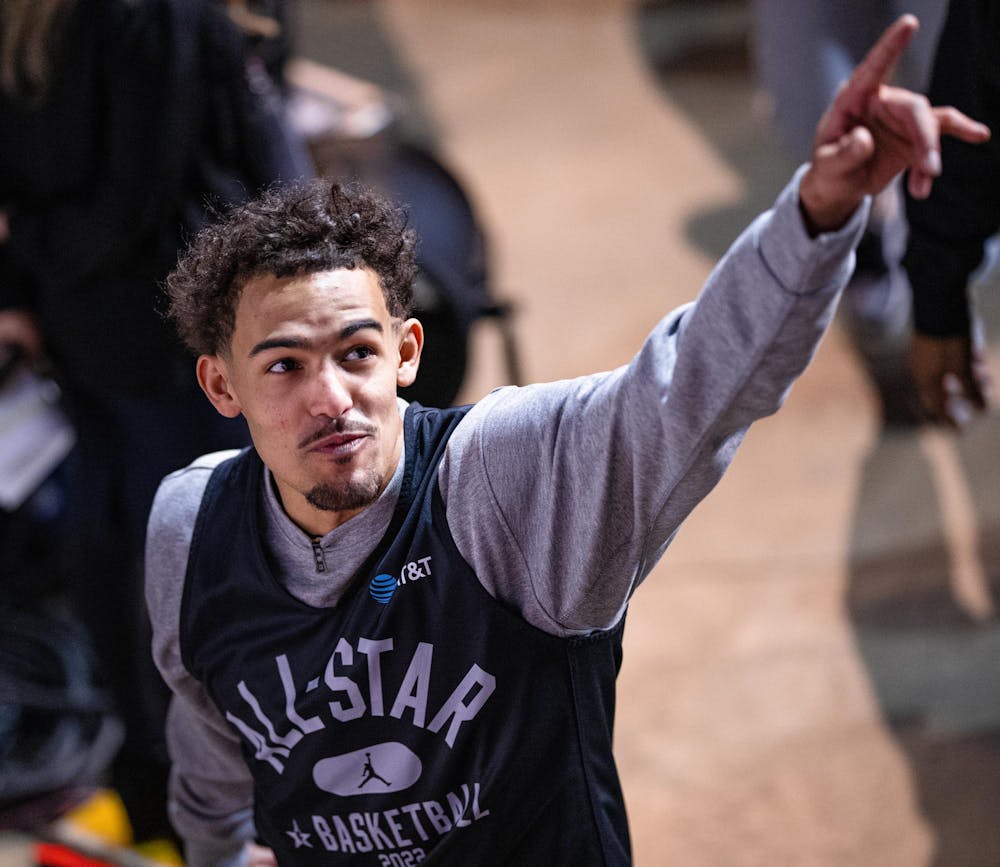
The Atlanta Hawks ushered in a new era on Jan. 7, when the team agreed to trade four-time All-Star Trae Young to the Washington Wizards in exchange for guard CJ McCollum and forward Corey Kispert. The deal marked the end of Young’s eight-year tenure as the face of the Hawks franchise and signaled a decisive shift in how Atlanta plans to build their roster moving forward.
Young’s impact on the Hawks is undeniable. He leaves Atlanta as the franchise’s all-time leader in assists and three-pointers, having helped guide the team to three postseason appearances, including a surprise run to the Eastern Conference Finals in 2021.
Despite his individual achievements, Atlanta has struggled to translate Young’s star power into sustained team success. Over the past couple of seasons, the Hawks have been hovering around the NBA playoffs, largely attributable to their inconsistency, as they come into the midseason ranking 18th offensively and 16th defensively.
Young’s availability has also been a growing concern. He missed significant time before the All-Star break with a right MCL sprain and later a right quad contusion, appearing in just 10 games this season and preventing the Hawks from establishing any continuity with him in the lineup.
While the move surprised many fans, it was not entirely unexpected. Young’s representatives and the Hawks front office had been exploring trade possibilities for weeks before the deal was finalized. Young’s looming contract commitments include a salary that is approaching $49 million annually. That figure poses long-term financial challenges for the Hawks, a team that still requires depth, and this move will allow them to reset their player payroll cap while maintaining a competitive roster in the short term.
With McCollum, the Hawks acquired a veteran scorer and playmaker capable of stabilizing the offense without monopolizing it. Through 35 games with the Wizards, he averaged 18.8 points per game, and has put up 17 points per game in his first five games with the Hawks. Kispert, meanwhile, adds bulk and positional versatility on the wing, currently shooting a career 38.2% from the three-point line.
Unlike Young’s ball-dominant style, McCollum’s ability to play on or off the ball opens the door for a more balanced offensive system. Returns earlier in the season, such as an 18-17 record without Young compared to 2-8 with him, suggest Atlanta may benefit from distributing responsibility more evenly, allowing multiple players to initiate the offense rather than relying on a single star guard.
But perhaps the most significant impact of the trade lies beyond the box score. Moving Young’s heavy contract provides Atlanta with greater financial flexibility, allowing the front office more room to maneuver in future free agency periods.
With McCollum on an expiring contract and Kispert under team-friendly control, the Hawks are better positioned to adjust their roster as younger players with untapped potential, such as guards Dyson Daniels and Nickeil Alexander-Walker, continue to develop. That flexibility could prove crucial as league analysts increasingly warn against teams remaining stuck in the NBA’s “middle class” — competitive enough for the play-in tournament but without a clear path to contention. This move positions the Hawks for a soft reset rather than a full rebuild.
While Atlanta could have demanded more in return for a perennial All-Star, the move was a necessary recalibration away from a top-heavy team.
The post-Young era presents expanded opportunities for Atlanta’s emerging core. Players like forward Jalen Johnson and center Onyeka Okongwu now have a runway to grow into larger roles. Johnson has been showing promise, averaging a team-high 23 points per game. Okongwu has been a star center for the Hawks defensively, also showing consistent offensive improvement across the last six seasons and currently averaging a career-high of 16.1 points per game.
This trade is a reset for the Hawks, not a retreat. Now, the team enters the second half of the 2025-26 season with a more balanced roster, newfound financial flexibility, and clarity on long-term direction. Whether this move pays immediate dividends or lays the groundwork for future success, Atlanta’s basketball identity is evolving, and the end of the Trae Young era, for better or worse, has set up a new chapter.