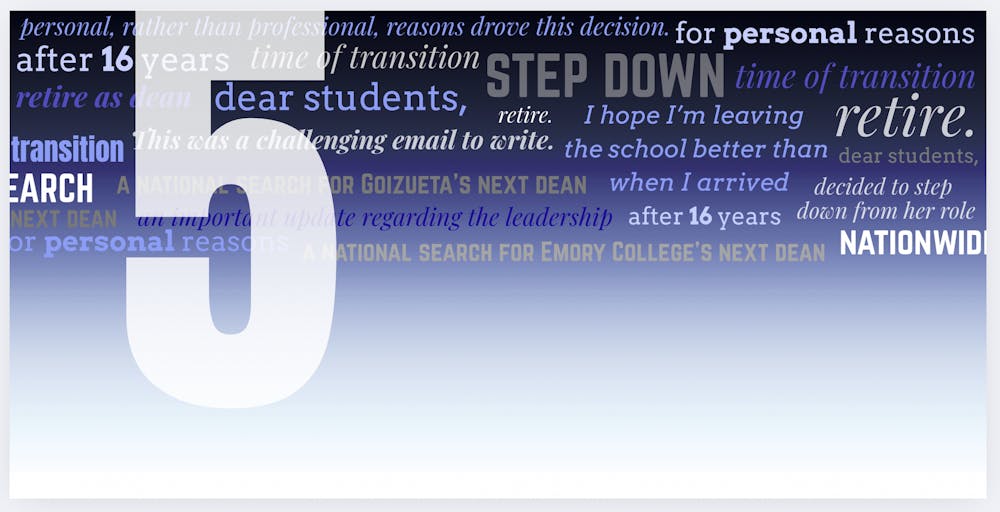
Emory University has experienced significant leadership changes over the past year, with five schools that need to seek permanent deans. During this academic year, three deans have departed from their roles, in addition to the appointment of Leah Ward Sears (80L), who is serving as interim university president.
Across the nation, university administrations are facing funding instability from the federal government. In the past year, U.S. President Donald Trump has moved to freeze federal funding for many universities and colleges, resulting in heightened pressure on administrators and contributing to uncertainty within higher education.
The Emory Wheel compiled data on Emory and its similar peer institutions’ leadership turnover since 2000, based on their status as private universities, class size and their U.S. News and World Report Best National University ranking. Among the universities analyzed, presidents at peer institutions served an average tenure of 11.9 years. Those universities had an average of 2.8 presidents since 2000, with most tenures lasting over a decade.
In comparison, Emory has had four permanent presidents with an average tenure of 7.75 years served. After former University President Gregory Fenves transitioned to the role of chancellor on Sept. 1, 2025, the University will have to find a permanent replacement.
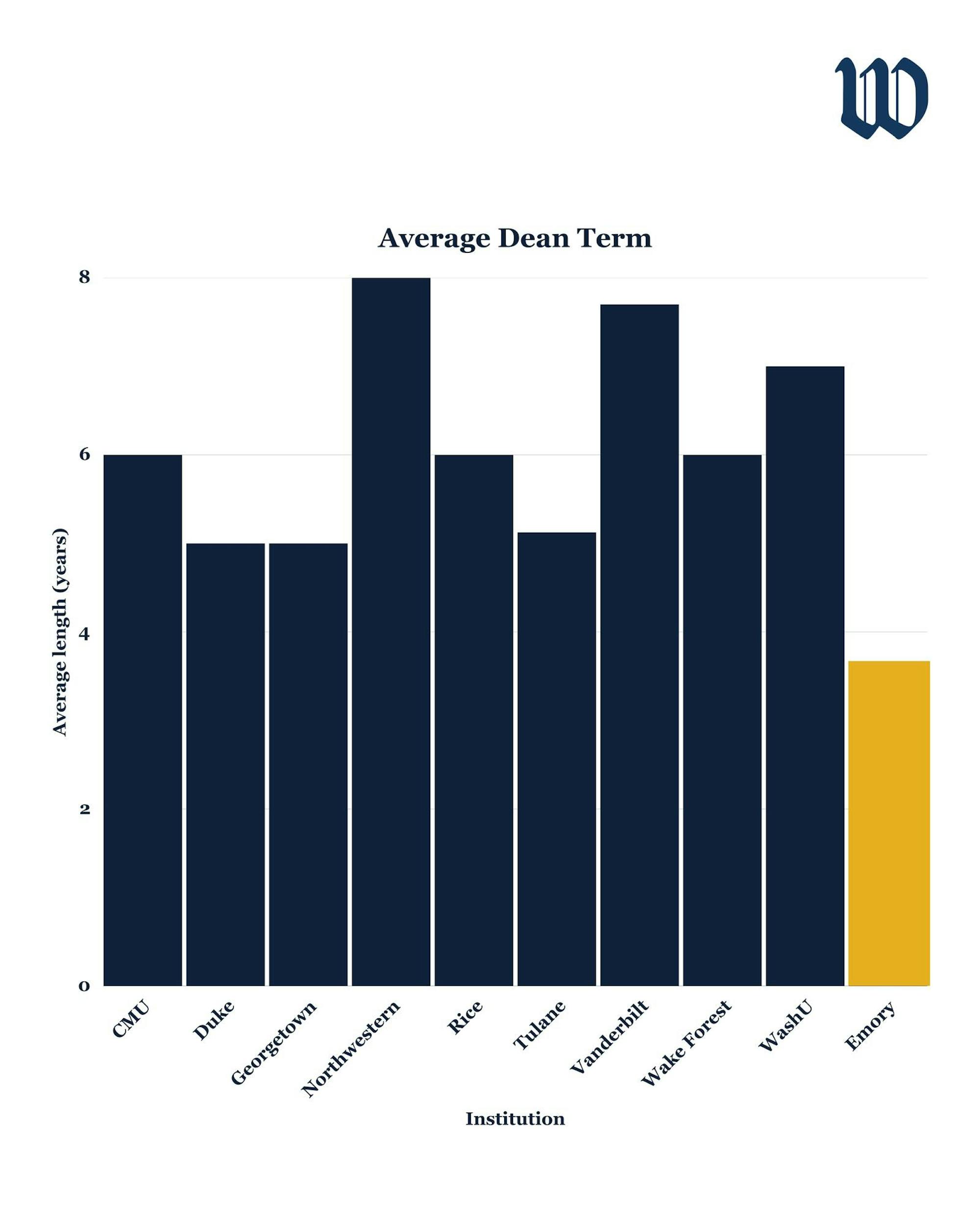
Additionally, several of the University’s schools have cycled through different deans over the past two decades. Emory College of Arts and Sciences (ECAS), Oxford College and Nell Hodgson School of Nursing deans are currently serving in interim positions. Likewise, the Candler School of Theology and the Goizueta Business School will have to find new leaders as Mary Lee Hardin Willard Dean of Candler School of Theology Jonathan Strom and Goizueta Dean Gareth James will be stepping down this summer. The average tenure of current Emory dean appointments, excluding interim positions, across all schools is just under 2 years served when including interim deans and 3.6 years served when excluding them. Among Emory’s 10 peer universities, the average tenure for deans, excluding interims, is 5.89 years served.
Of all universities surveyed, Northwestern University (Ill.) deans, excluding interims, had the longest average tenure of deans at 8.05 years served. In comparison, Duke University (N.C.) had the lowest average tenure outside of Emory at an average of 4.5 years served.
Candler has to find a new dean as Strom is stepping down from his role as his two-year term is expiring this summer. Like Strom, James is stepping down after this semester. James is departing Emory to become the next dean of the University of California, Los Angeles’s Anderson School of Management.
Following Barbara Krauthamer’s resignation from the role of ECAS dean due to “personal reasons” on Jan. 2, Interim Dean Joseph Crespino has been leading ECAS. Crespino joined Emory in 2003. Before Krauthamer, former ECAS Dean Michael Elliot departed in 2022 to become the president of Amherst College (Mass.). Crespino is the sixth person to serve as interim or permanent dean of ECAS since 2000, with the average tenure being five years.
Interim Nursing School Dean Lisa Muirhead took over for former Dean Linda McCauley (79N), who was Emory’s longest-tenured dean. McCauley served since 2009 and retired at the end of 2025. Before McCauley, former Nursing School Dean Marla Salmon held the position from 1999 to 2009, leaving to become the dean of the University of Washington School of Nursing.
Out of the Emory deans currently serving, Emory’s Laney Graduate School’s dean has served the longest, with Dean Kimberly Jacob Arriola (01PH) currently serving her fifth year in the role. She replaced former Laney Dean Lisa Tedesco in 2020, who led Laney for 14 years.
At the Rollins School of Public Health M. Daniele Fallin has served as the James W. Curran Dean since 2022. The next year, Emory University School of Law named Richard Freer as its dean. Freer has been part of the law school faculty since 1983, replacing Mary Anne Bobinski, who completed a five-year term as the law school’s leader in 2024.
More recently, Emory School of Medicine Dean Sandra Wong began her term in March 2024, joining Emory from Dartmouth Hitchcock Medical Center (N.H.). Former School of Medicine Dean Vikas Sukhatme stepped down after serving for five years.
In addition to dean turnover, this November, Emory promoted Badia Ahad to a two-year term as provost and executive vice president for academic affairs, after a national search that “failed,” according to Sears. Ahad formerly served as Oxford College dean before becoming provost, and began in the role in August 2023. Following Ahad’s transition, Senior Associate Dean for Academic Affairs and Professor of English and American Studies Molly McGehee filled the open role of interim Oxford College dean.
In an email to The Emory Wheel, Assistant Vice President of University Communications Laura Diamond wrote that Emory is continuing its search for its next administrative leaders.
“Each leadership transition is unique, and we are taking the time needed to find the best leaders through careful search processes,” Diamond wrote.
The five vacancies in Emory’s dean positions are indicative of the high-pressure environment in the University’s administration, according to Robert Paul, who served as ECAS dean from 2003 to 2010.
“There’s no doubt that there are much greater pressures on university administrators than there was before, coming from the federal government, from funding cutbacks and from increased scrutiny,” Paul said.
Since January 2025, Trump has moved to freeze federal funding for higher education. While these cuts affect universities nationwide, they particularly harm institutions with large medical and research programs like Emory, according to Former Vice Provost for Graduate Studies and Laney Graduate School Dean Donald Stein. The former dean stated that one of the “primary factors” in the hiring process for a dean was how much federal funding a prospective dean could bring in.
“When I started as graduate dean, I had 12 or 14 people on my staff,” Stein said. “The basic criterion and science for being hired is, ‘What's the possibility, or how many grants are you bringing with you?”
Paul also suggested that the University’s reliance on external candidates to fill senior positions may have contributed to a more unstable leadership.
“Even though there were national searches, quite often, the successful candidates were people from within the institution, like me,” Paul said. “That gave them a sense of the history of Emory, of its ethos, of the way things work around here, of traditions.”
Due to its rank within the mid-20s of all U.S. institutions, Emory is often viewed as a “stepping stone” in the hierarchy of higher learning, according to Paul. Without long-standing ties to the university, Paul said external hires may be more inclined to leave.
“If you’ve come in from somewhere else and you're there for a while, there's no reason why you shouldn't go somewhere else and also be there for a little while as you rise through the academic administration ladder,” Paul said.
University Senate President Noëlle McAfee said that the changing landscape of higher education could require more universities to hire from a “finite” pool of candidates, due to “turmoil” in higher education.
“I’m really hoping that a lot of these searches will look and explore who’s here already, that people who’ve been at Emory for a decade, two decades, will apply for those positions, because we really do need some stability,” McAfee said.
Stein stated that long-term leadership stability depends on faculty engagement within administrative decision-making. He cited a trend of decreasing support within University faculty, adding that administrators can “take advantage” of an indifferent faculty and “act accordingly.” According to Stein, when faculty contribute less to University decisions, the administration may act “unilaterally,” without having faculty feedback to base decisions on.
As the University continues its search for its next president and for vacant dean positions, McAfee said the process could serve as a stabilizing opportunity.
“This is a very rocky time,” McAfee said. “It could turn out to be positive if we promote people who are already here at Emory with very strong research portfolios.”
Considering the implications of national changes, Stein emphasized that Emory’s challenges are part of a larger upheaval affecting academia.
“In this day and age, there’s so much instability and changing what constitutes higher education,” Stein said. “This has become much more realistic, much more of a national issue than a local issue. It’s directly affecting Emory, and it’s been a long time in coming.
Correction (1/21/2026 at 10:52 a.m.): A previous version of this article incorrectly attributed the University statement to Associate Director of University Communications Rachel Smith. In fact, the statement is attributed to Assistant Vice President of University Communications Laura Diamond.