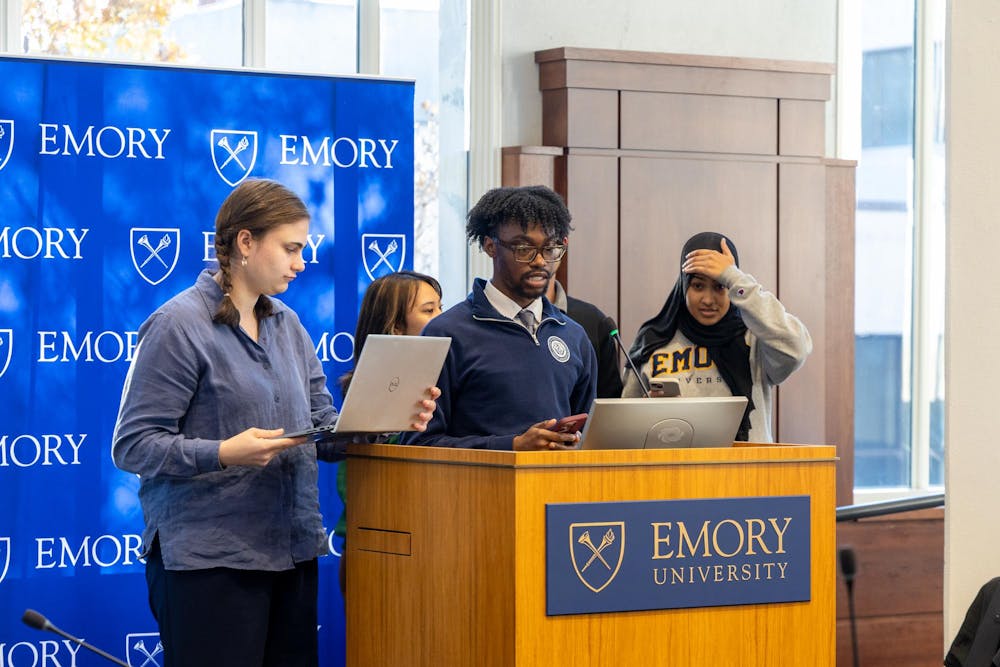
Seeking to increase financial transparency, Emory University’s Student Government Association’s (SGA) Vice President of Finance Grant Lichtman (26B) delivered a financial report on SGA’s yearly funding, accounts and spending during their Nov. 17 legislative session. The report publicized much of SGA’s financial data for the first time in recent years.
This release follows SGA’s Nov. 10 legislative session, during which legislators asked the organization’s executive branch for more information about SGA’s funding and accounts, seeking to increase transparency with the student body. According to the SGA Finance Code, upon the legislature’s request, the vice president of finance must deliver a biannual public report.
The Nov. 17 financial report publicized the amount of money in SGA’s Contingency Account, which funds University-wide programs and events through the SGA supplemental funding process or with SGA legislative approval. As of the report’s publication, SGA anticipates having $546,349.70 in the account for Spring 2026. Each year, unspent Student Activity Fee (SAF) funds are added to the account balance, which carries over from one SGA administration to the next.
Much of SGA’s funding comes from the SAF, a mandatory, semesterly fee that every student pays to help fund SGA and student groups. Currently, students pay $133 semesterly into the SAF.
According to SGA Chief of Staff Elijah Robuck (26C), in recent years, SGA kept the amount of money in the Contingency Account private from students due to “contract negotiations,” but Robuck did not expand. However, the SGA Constitution states that the organization’s papers are public record.
SGA President Tyler Martinez (26C) said the decision to publicize the amount of money in SGA accounts was part of the current administration’s larger initiative to build transparency with the student body.
“We definitely want to make sure that every process within student government is equitable, and it holds every organization that we contribute to accountable,” Martinez said.
Lichtman said this administration is emphasizing transparency in order to increase the student government’s accountability in financial decisions.
“This year, we’re trying to be a lot more transparent and equitable with the money we have and the money we give out,” Lichtman said. “We want to make sure that all of our decisions are data-driven and that we’re not really just doing anything arbitrary.”
Each semester, the Student Accounts and Billing Office collects the SAF from students’ tuition, and SGA then disperses SAF funds to divisional councils and executive agencies, which are responsible for overseeing undergraduate-wide programs and clubs (EAs).
Some of SGA’s other accounts include the Executive Account and Legislative Account, which provide administrative funding to run programs and events. Another SGA account is the Fee Interest Account, which collects interest on SGA accounts and funds permanent programs that benefit every undergraduate student, such as stipends to reduce printing costs and continue managing the Hub.
SGA also allocates funding to the four divisional councils based on enrollment numbers at each college, including the College Council, the Bachelor of Business Administration Council, Oxford Student Government Association and the Emory Student Nurses Association. The SAF split determines the percentage allocated to the division for each student and to SGA.
Additionally, SGA also provides funding to EAs, which include Service Council, Belonging and Community Council, Club Sports, Outdoor Emory and Student Programming Council, among others, based on the annual EA review process. Lichtman said that during the EA review process, each EA presents on past and future initiatives, which the Finance Committee uses to determine how much money they need for the following year.
Martinez highlighted future changes that his administration hopes to make to the EA review process.
“We don’t think that that’s been the most useful way of determining an allocated budget for executive agencies specifically, and we’re looking to enhance that process so that it’s more equitable and just more straightforward and data-driven as well,” Martinez said.
Outside of divisional and EA funding, student groups can also apply for supplemental funding from SGA if their division or EA denies financing or cannot fully fund their request. Supplemental funds come from the SGA Contingency Account, according to the finance code. SGA passed its first round of supplemental funding this year during its Nov. 24 legislative session.
In recent years, SGA has usually allocated supplemental funding monthly, but its suspension earlier this year prevented the legislature from continuing this process, according to Lichtman.
University-wide funding cuts have impacted SGA’s supplemental funding process. Student groups are receiving similar amounts from divisional councils and EAs as the SAF has not been affected. However, Lichtman said that many organizations that previously relied on funding from departments across the school are seeking SGA supplemental funding instead.
“Given the university funding cuts, we might have to handle more supplemental funding requests through SGA, because if clubs can’t go to departments or the administration for funding, we’re probably going to have to take over that,” Lichtman said.
In addition to supplemental funding, Robuck said SGA administration is considering new solutions to ensure student groups receive sufficient funds.
“[SGA’s] hope is to work with donors and alumni, as well as use the money that SGA has, to make up for as much of the loss that they can within reason,” Robuck said.
In light of these funding cuts and “confusion” surrounding the supplemental funding application process, Lichtman mentioned that SGA plans to make changes to the current Finance Code. He outlined his goal to standardize the operational and supplemental funding process, including centralizing applications across divisions and EAs and adding a review by the Finance Committee.
“I don’t want to add a lot of oversight,” Lichtman said. “I still want the divisions and EAs to be able to review funding on their own, but I would just want the final, annual budgets to be run by the Finance Committee, at least before they’re allocated.”
Martinez added that SGA plans to update the Finance Code to account for increased demand for supplemental funding, amid university funding cuts.
“We definitely acknowledge that and also are revising the Finance Code to make sure that level of funding that was once provided, we’re able to take that on,” Martinez said.
To better understand funding needs, SGA is conducting a survey to collect student input on how they would like to see money spent across campus. Lichtman urged students to reach out with questions about SGA finances to increase transparency.
“We want students to know that they can talk to us if they want information about where the SAF’s going, because it’s their money,” Lichtman said.