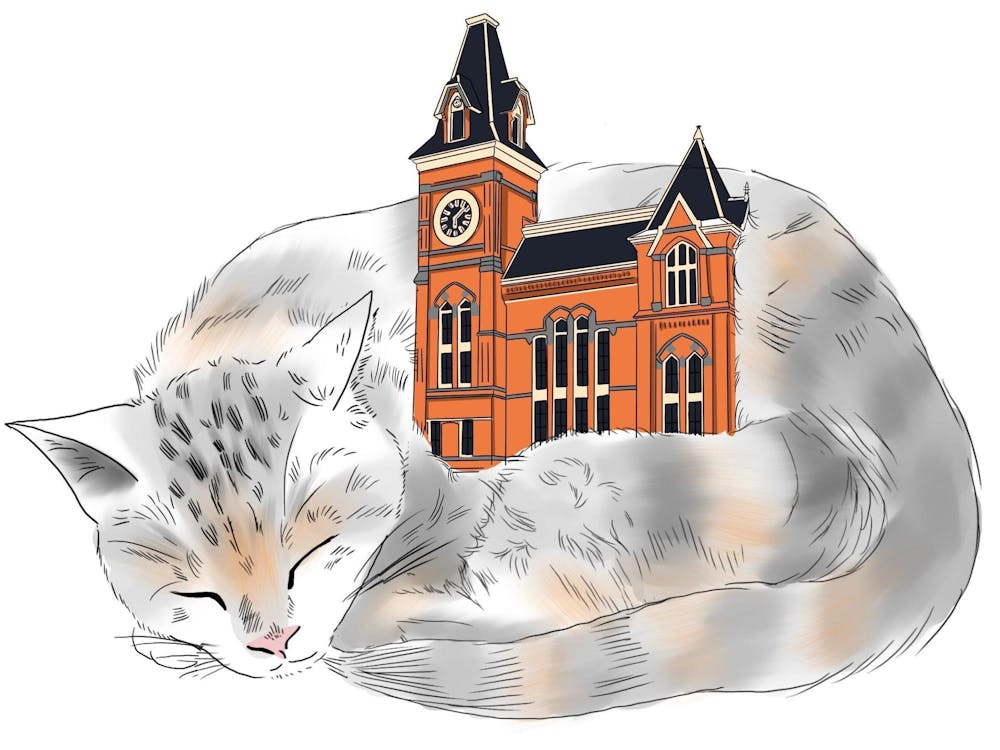
Spotted resting under cars, eating leftover food on the Oxford College Quadrangle and pacing around Melizer Circle, stray cats roam all over Oxford College’s campus. According to an email on Nov. 12 from Oxford Associate Dean and Director of Residential Education and Services (RES) Timothy Leyson to the Oxford Student Government Association (OxSGA), the college aims to relocate the cats that live on Oxford’s campus to a local no-kill shelter by the end of the fall semester.
Amelia Green (27Ox) and two other students run an Instagram page for “Lady Fleming,” one of the cats on campus. Green said relocating the cats may damage morale on campus since many Oxford students have bonded with the animals.
“It’s a bad thing that they don’t want the cats on campus, because I think it’s a big resource for students just to enjoy the company of little creatures,” Green said. “It’s a shame.”
Leyson, who is working with the Facilities Management Office on this project, praised students’ passion for the stray animals in his email to OxSGA, but also said Oxford’s campus is not “equipped to provide” care for the cats.
In a statement to The Emory Wheel, the Facilities Management Office described the University’s process of setting traps for stray cats to “humanely” control their presence on Emory campuses.
“Once a stray cat is discovered, live traps are set for a two-week period,” the office wrote. “During that time, traps are opened and set each afternoon and checked the following morning. If the trap remains clear, the trap is closed until the afternoon, so cats are not kept in the cage throughout the day.”
The University brings captured cats to the LifeLine Animal Project, a nonprofit animal shelter located in both Fulton and DeKalb counties, according to the Facilities Management Office.
“Emory has a history of utilizing Trap-Neuter-Return, a program to humanely manage feral cat populations,” the office wrote. “This involves spaying or neutering cats and then releasing them back into their environment. Emory also works with our pest control contractors to assist with humanely trapping.”
As of press time, the Facilities Management Office has not confirmed whether they have removed any cats from Oxford’s campus.
Newton County, where Oxford College is located, operates Newton County Animal Services, which does not have a no-kill policy and holds stray animals for three business days, according to their website.
In Leyson’s email to OxSGA, he asked students to “refrain from feeding, sheltering, or attempting to care for the stray cats directly.” He noted that students may unintentionally harm the health and safety of both the cats and the Oxford community by providing the animals with food or shelter.
Despite this guidance, many students have expressed concern and taken action to care for the cats. According to OxSGA Speaker of the Senate and Chair of Student Living Aidan O’Sullivan (26Ox), the colder weather in recent months has caused concerns for some in the student body, and a few have attempted to help the animals in different ways.
While several stray cats have traversed the campus over the years — from Lady Fleming to “Sox” — students are concerned about the cats’ well-being as the weather has gotten colder.
OxSGA Vice President Delaney Arnold (26Ox) said she set up bed sheets outside of a dorm hall where stray cats could sleep for a night, but mentioned that an unknown party threw away the sheets. Arnold also said there were two separate instances where students set up cat beds outside, but they were then disposed of, again by an unknown party.
Some students set up an anonymous GoFundMe to help feed Lady Fleming in early September, raising $260 for cat food as of press time. However, in early November, the Office of RES hung up posters asking students not to feed the cats. Green said she would like to see a program to support the stray cats at Oxford, akin to the Georgia Institute of Technology’s Campus Cats organization, whose members provide care for cats on their campus. She said she hoped that OxSGA would “fight” to help create a similar resource for the animals.
Tinghan Wang (26Ox) disagreed with Oxford administration’s attempts to relocate the stray cats, questioning whether there was clear reasoning behind concerns about students interacting with the cats.
“The better solution is just to keep [Lady Fleming] on as a campus cat, because when we put out little shelter boxes for her and scratching posts, she was using them,” Wang said. “RES administration was just like ‘No this is a hazard’ — but a hazard for what and how?”
According to O’Sullivan, he and Leyson discussed potential solutions to safely house the cats during a private meeting on Nov. 10. O’Sullivan proposed adding a shelter for campus cats, following similar measures taken by the Georgia Institute of Technology. Leyson said the idea was not possible, according to O’Sullivan, due to a lack of space and other liability issues.
“It’s largely being handled well,” O’Sullivan said. “Obviously, I want to see, as soon as possible, the cats being brought to a no-kill shelter … This can’t really drag on much longer. It is getting colder, and I’m worried that the cats could die.”
Even with the plan to remove the cats in place, students like Ella Lim (27Ox) worry about how the departure of the animals may affect Oxford’s broader sense of community and student life, as well as the cats’ well-being.
“I feel as though the cats were kind of a part of Oxford’s school spirit and community,” Lim said. “Removing them isn’t the right decision because I think they’ve adjusted to life here.”