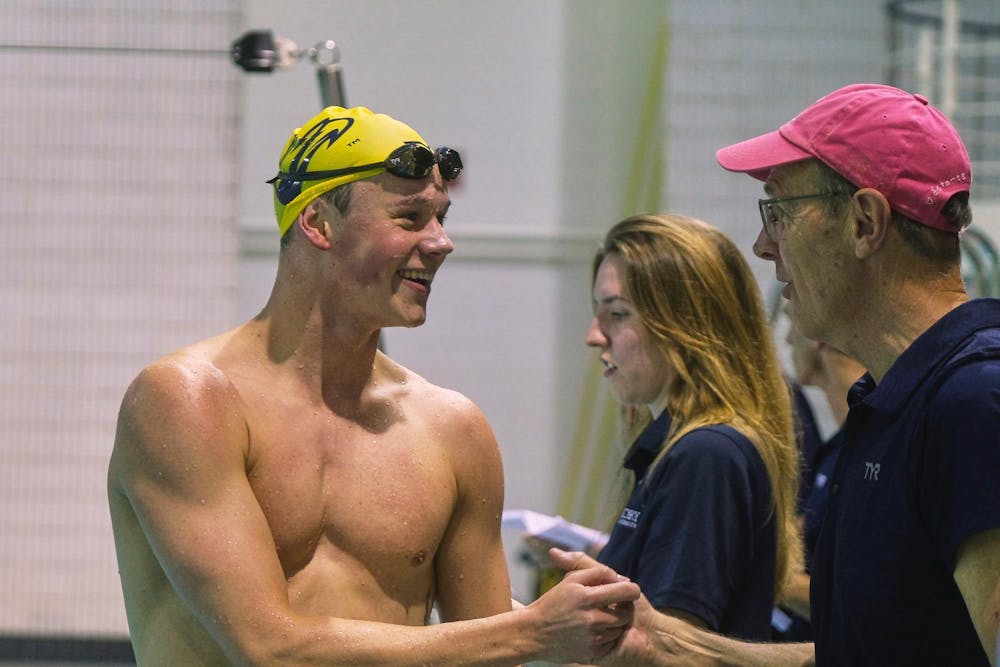
Graduate swimmer Crow Thorsen has always known water. Growing up on the California coast, the Thorsen family lived walking distance from the ocean, where Thorsen learned to swim at just four months old. It was when the family relocated to Asheville, N.C., though, that Thorsen swam his first competitive lap and began his swimming career.
During his collegiate recruiting process, Thorsen’s younger sister Ginny described how the athlete scrawled pages and pages of notes on yellow legal pads with statistics of schools and their swim programs. Through his research, Thorsen learned that athletes on Emory University’s swim team steadily became faster during their time as Eagles. Emory swim and dive head coach Jon Howell recalled Thorsen’s recruiting process, calling him as an “easy match” with the Eagles.
“[Thorsen is] one of the hardest-working people we’ve had, very determined, very goal-oriented,” Howell said. “He’s somebody that lifts up people around him and makes us better as a whole.”
Thorsen became a national champion in his sophomore year in the 800-yard freestyle relay and then his junior year in the 400-yard individual medley. With the momentum from these previous seasons, Thorsen was ready to give senior year his all, especially being one of the elected captains.
On Dec. 27, 2024, Thorsen donned his swimsuit for winter training with his club team and siblings in Athens, Ga. The team was doing all-out sprints when Thorsen noticed something off, and by the second round of sprints, he began swimming slower. Struggling to breathe with increasing pressure on his chest, Thorsen hopped out of the water.
“My club swim coach saved my life and said, ‘Crow, you need to go to the hospital,’” Thorsen said.
On the swim deck, Thorsen’s consciousness began to slip. His father drove him to the emergency room, where an echocardiogram revealed a blockage in his left anterior descending artery. Thorsen had experienced a “widowmaker” heart attack, a kind only 12% of people outside a hospital or advanced care facility survive, according to the American Heart Association.
“I honestly never thought it was a heart attack,” Thorsen said. “I thought it would be a two-hour visit and they would send me on my way. … Until now, it still doesn’t always click to me.”
After he was stabilized in the hospital, Thorsen messaged the Emory team with the news. Senior swimmer Jane Sanderson vividly recalled receiving that message.
“It’s shocking to hear that about anyone in our age group, but especially somebody who is so athletic and just in such great shape,” Sanderson said.
After a night in the intensive care unit and cardiac wing, the hospital discharged Thorsen — but whether or not he would ever swim again remained uncertain. The road to recovery was long, but Thorsen was not afraid of a challenge.
“For a while, it meant doing nothing,” Thorsen said. “My biggest amount of exercise was, I was allowed to walk to classes with a backpack. I would take breaks and sit on benches — I realized there’s lots of benches around Emory’s campus, so that was a new perspective.”
Thorsen continued to find new perspectives during his recovery, especially after he started cardio physical therapy, where he was “the only person there without grandkids.”
“I earned the nickname ‘the inspiration’ from my friends in cardio physical therapy, and learned lots of fun stories and lessons from all of them,” Thorsen said. “They’ve experienced life or death for any situation, as have I, which brought us closer together, but it changes your perspective on life.”
As Thorsen progressed through cardio physical therapy, attending three times a week, he went from becoming winded after a walk to eventually running a 5K.
“After finishing my first 5K, I was so emotionally exhausted, obviously physically exhausted, but I remember coming home and laying on my floor crying, being proud of where I was,” Thorsen said.
After a few months, Thorsen graduated from cardio physical therapy, and passed his stress test. With “the all-clear” from his doctors, Thorsen had a new goal in mind: Getting back in the pool.
“It was really hard not being able to swim, and I realized how much of who I thought I was and what made up ‘Crow’ relied on my love and commitment to swimming,” Thorsen said.
With this roadblock to the water still in place, Thorsen questioned whether or not he was still an athlete. However, he soon realized he wasn’t alone in his self-doubt after speaking with an Olympic-hopeful runner who suffered a stroke and could never run again, yet still always introduces himself as a runner. For Thorsen, this interaction, along with outreach from other athletes, was “crucial” in rebuilding how he saw himself post-heart attack.
“I talked to people that were going through the same thing as me,” Thorsen said. “They found me through my articles or through different connections, and we talked about losing our sport due to medical events, and I leaned on them a lot.”
Only six months after his heart attack, Thorsen took a running dive into the water from the same pool deck in Athens at a July meet. For the first time since December, he swam a competitive lap in a pool post-treatment, without any complications. While Thorsen still worries about something happening in the water, he said he’s doing his best to take each day “one step at a time.”
“I get more confident every single time,” Thorsen said. “There’s always fear, which has been frustrating because swimming has always been a calming safe space. … It still is, it’s just, sometimes I think about my heart a little bit more than I’d like to.”
But the fear has not stopped Thorsen. At the Emory Fall Invitational, he swam two events and won the 400-yard individual medley. Now back in the pool, Thorsen said he feels grateful for the opportunity to contribute to the swim team and beyond graduation from Emory, hopes to continue to be part of similar team environments.
“I want to keep exploring and hopefully sharing my positivity and my positive approach to life, as well as just a general sense of gratefulness and appreciation for what we have,” Thorsen said. “Everyone can sometimes use a reminder of that.”