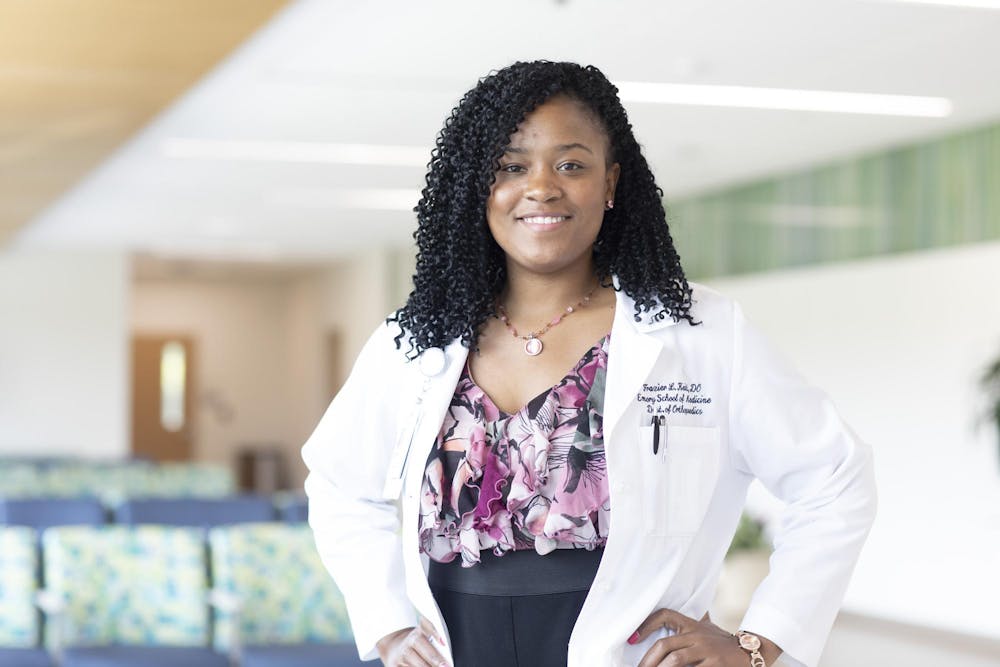
Under the bright lights of the Morehouse College (Ga.) basketball court, Dr. Frazier Keitt is not only watching the game. Rather, she is attuned to players’ every move, ready to tend to any injury she witnesses on the court. A non-operative orthopedics doctor at Emory Healthcare, Keitt works in outpatient care — but she also tends to Atlanta athletes on the sidelines of countless games.
Keitt serves as the head physician for the WNBA’s Atlanta Dream. She also works with the Morehouse College basketball team, the Overtime Elite basketball teams — a professional basketball league for high school-aged students — and several other high schools in the southwest Atlanta area. With Keitt’s on-call help at local high schools, athletes are able to get quicker treatment plans.
“They might get their imaging a little quicker, and then we can figure out the treatment plan quicker, and that helps with health disparity and health equity,” Keitt said. “It’s good that we’re there to provide for that so that we can make an impact.”
Even when she was younger, Keitt knew she wanted to serve people. Growing up, she loved the television show “ER” (1994-2009), which sparked her interest in becoming a doctor herself.
“I was always a helpful kid — my mom talks about this all the time — so I was always wanting to serve,” Keitt said. “That show I gravitated towards, and I was like, ‘Oh, I can be like those people.’”
Keitt did not follow the traditional path to medicine. She graduated with a Bachelor of Arts in Communications from Boston College and then took a year off before beginning her medical career. Keitt joined the biomedical science program at Hampton University (Va.) and eventually met a representative visiting from the Virginia College of Osteopathic Medicine (VCOM) — it was then that she was introduced to osteopathy. Fascinated by the subject, Keitt matriculated into the school.
One of her first involvements at VCOM was a sports medicine club, which Keitt said brought her into research opportunities that caught her interest in pursuing sports medicine.
“I really enjoyed the team physicians because some of them were our professors, so they kind of roped us into some research,” Keitt said. “One of them was doing some helmet research for football, and I thought that that was pretty interesting, and then they were doing pregame muscle manipulation, which I also thought was interesting.”
Keitt then began exploring hands-on experience through the program’s affiliation with Virginia Tech, shadowing football pregames. She joined an internal medicine rotation, which ultimately solidified her choice to become an internist.
“I utilize my medicine quite a bit, because athletes don’t just have musculoskeletal issues,” Keitt said. “They’ve got Graves’ disease, they’ve got whatever else. And so it’s important to understand that pathophysiology, because that affects how they move.”
Following Keitt’s residency at OhioHealth Riverside Methodist Hospital in Columbus, Ohio, where she focused on internal medicine, she began a sports medicine fellowship at Drexel University College of Medicine (Pa.), which included work with the Lincoln University (Pa.) football team. She said this was challenging and a stark difference from what she had known previously, both in moving from mostly inpatient to outpatient work and adjusting to living in a new environment.
“Just the uphill battle of learning and learning quickly and on the fly, because sports medicine, you only get one year to really figure it all out and to gain as much experience as you can,” Keitt said.
Although the fellowship program was challenging, Keitt said an aspect that she fondly remembers from the experience was watching injured athletes rehabilitate and return to their sport.
“Learning how to treat these athletes and seeing how they can get better with what we were offering and recommending, to see an injury turn around, that was certainly a highlight,” Keitt said. “It's always nice to see them get back to what they love doing.”
Now, Keitt balances her time between clinical work at the Grady Health System in the Department of Orthopedics and at Emory Healthcare. She said the difference between her work at Emory and Grady highlights broader disparities within healthcare access, explaining that many of her Emory Healthcare patients are of higher socioeconomic status, whereas at Grady, she works with patients of lower socioeconomic status who may have lower health literacy.
“It keeps me on my toes,” Keitt said. “I enjoy it because it makes me work a little bit harder to help the patients, which keeps me always learning and growing as a provider.”
As a woman in a male-dominated field, Keitt suggested that women take every opportunity to show that they are capable of exceeding in their fields, building trust in women as leaders.
“Whatever opportunity is coming, especially earlier on, just trying to get your foot in the door with anything to show people, ‘No, I can do this too,’” Keitt said. “That over time allows for that trust to build and people think about you first.”
Her advice for Emory students wishing to pursue sports medicine is to research different subspecialties and choose one aligned with their interests and goals. Keitt points out that sports medicine is not all about being on the field: It is also about working with the community in clinics with regular people.
“Being clinical is first, and the sports is the bonus,” Keitt said. “The idea of sports medicine is musculoskeletal care and musculoskeletal health, so that’s also something you gotta understand before you embark on this journey.”