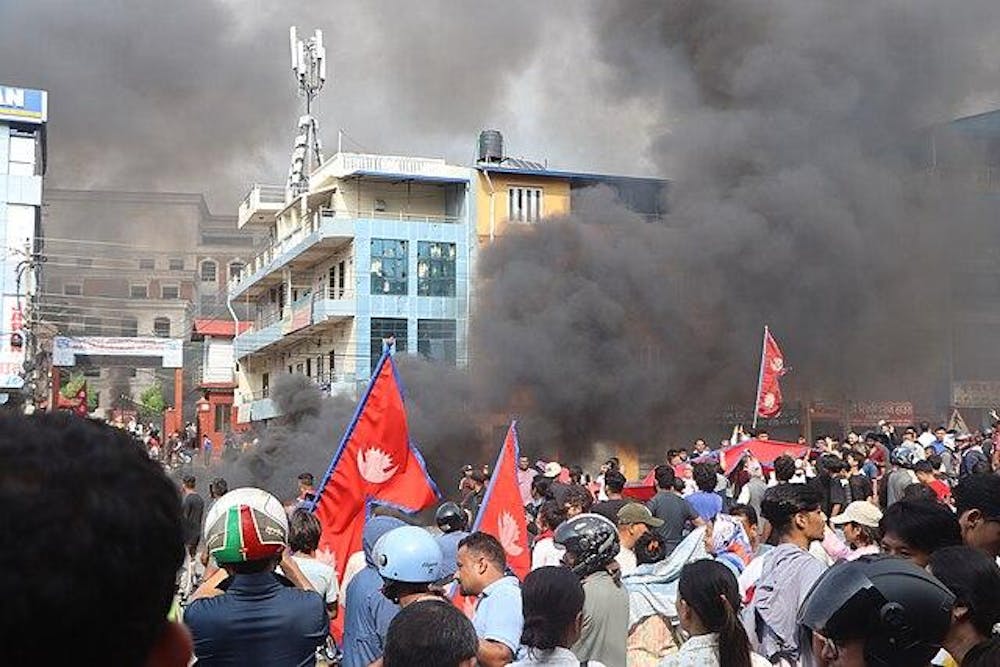
For 48 hours starting on Sept. 8, thousands of people took to the streets of Kathmandu, Nepal, demanding an end to corruption. The protests left 74 dead and 2,100 people injured. On Sept. 9, the former Prime Minister KP Sharma Oli resigned from his position, and Interim Prime Minister Sushila Karki was sworn in, making her the first female prime minister of Nepal. Recently, on Sept. 29, Nepal’s new government imposed travel bans for Sharma Oli and four former senior officers.
Nepali youth led this movement against corruption, citing the lack of job opportunities and social inequalities between average citizens and elites. Even though these protests are all the way across the world, these events are weighing heavily on the minds of Emory University students and faculty from Nepal or with connections there.
Selina Chhantyal (27B) said the Nepali government’s ban on 26 social media platforms, which was lifted on Sept. 9, took away Nepali citizens’ ability to discuss anti-corruption online, partially inciting the demonstrations.
As a transfer student new to Emory, Chhantyal said while she was not aware of the size of the Nepali community here, it is very likely that these protests are a sensitive issue for a lot of people, especially those with family in Nepal.
“I think everybody that is Nepali and first gen and goes to school in the U.S. has family in Nepal,” Chhantyal said. “It’s not very far removed at all. It’s very close to home for a lot of people.”
Assistant Professor of Medicine Abesh Niroula said it has been difficult acquiring information from Nepal about the latest developments since a major media group's headquarters burned down and international media coverage is limited. In addition, he said having family still in Nepal has made this challenge of accessing information a personal issue as well.
“Getting information coming out from ground level has been very challenging, and that has created a little bit of anxiety, even in people living abroad and even within the country,” Niroula said.
For Nepali members of the Emory community, the recent upheaval threatens to impact their work, even 8,150 miles away in Atlanta. With the recent violence, Niroula said these protests will impact timelines on projects, student work and travel.
“The country is going through transition,” Niroula said. “There may be some delay on basic official events like getting a passport on time, getting visas on time, getting flights out.”
Sushma Timalsina (28G) said she has felt anxious in the wake of these protests. Still, Timalsina said she has found a consoling and understanding community at Emory that she might not have had elsewhere.
“Certainly there have been some sleepless nights, but I’m glad to have a friend circle, colleagues at Emory who are very much aware of what is going on at home,” Timalsina said.
Noting the impact these protests can have on a personal level, Niroula said the turmoil should be addressed in the classroom and that Emory has a responsibility to address global events that affect their students. He said that the University should provide support to students here to ensure their well-being during this time.
“People, either the faculty, students who are from Nepal, who have passed through Emory,” Niroula asked. “If it affects them, it affects Emory.”