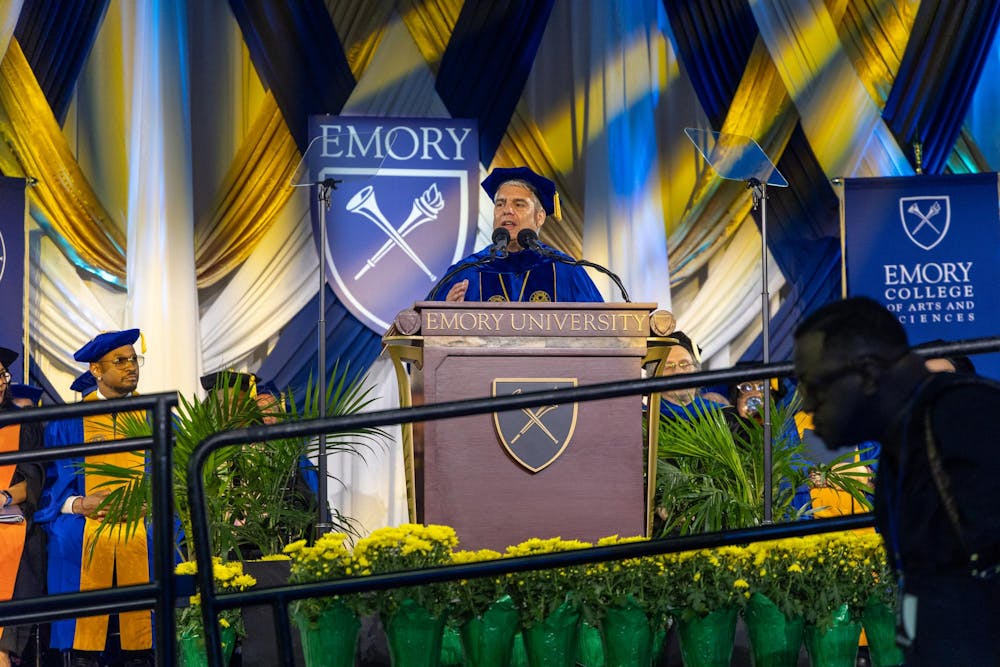
From leading Emory University through the end of COVID-19 to presiding over campus turbulence during the April 2024 pro-Palestine protests, after five years, Gregory Fenves left his position as Emory University president on Sept. 1 and transitioned to the role of chancellor. In the wake of this change, The Emory Wheel compiled a recap of our past coverage of Fenves’ five years as president.
The University of Texas at Austin President Greg Fenves to become next president of Emory
Before assuming his position as president of Emory, Fenves served as president of The University of Texas at Austin for five years.
After former University President Claire Sterk announced that she would retire in August 2020, the Board of Trustees formed a Presidential Selection Committee. In March 2020, Board of Trustees Chairman Robert C. Goddard III announced that Fenves would become the next president of Emory in a University-wide email.
“The Emory University Board of Trustees convened via teleconference this morning in a specially called meeting to elect, by unanimous vote, Gregory L. Fenves as the 21st president of Emory,” Goddard wrote.
Fenves assumed his position at the onset of the COVID-19 pandemic.
Fenves discusses racial justice at Emory, fall contingency plans
In his first interview with the Wheel in August 2020, Fenves discussed calls for change from the Coalition of Black Organizations and Clubs (CBOC) in response to the Black Lives Matter protests of 2020.
Fenves outlined his plans to address CBOC’s concerns, including renaming buildings that were named after slave owners, renovating affinity spaces and working with the Washington, D.C. firm Justice and Sustainability Associates to facilitate community discussions regarding policies in the Emory Police Department (EPD).
“I don’t anticipate defunding and replacing [EPD] because safety is important, and it’s a question of how we define that,” Fenves told the Wheel. “How do we have it so all members of the community feel safe and have trust in officers that we hold responsible for providing safety?”
Fenves also spoke about what he anticipated to be an $84 million financial loss for the University within the fiscal year due to pandemic-related costs. To address the loss, Fenves implemented cost-saving measures, including a four-month 5% salary reduction for faculty and staff making $75,000 or more a year and a temporary suspension of capital projects.
In 2022, Emory renamed multiple buildings and Yerkes National Primate Research Center after a committee convened by Fenves made its recommendations regarding “contested historic names.”
Fenves is ‘very confident’ classes will return in person on Jan. 31
In January 2022, Fenves and other University administrators hosted a virtual town hall addressing the temporary shift to remote learning in light of the COVID-19 Omicron variant.
“I want to emphasize the temporary shift so that we can maintain academic continuity of students amid the Omicron surge,” Fenves said. “I understand your concerns, I hear your concerns and I understand your frustration in this difficult period that is affecting everyone at Emory.”
Fenves acknowledged that although remote teaching and learning differed from the in-person experience, he would prioritize student health and safety.
“While I am confident we will resume on Jan. 31 for the rest of the semester, we have to be aware that the conditions can change in ways we do not even know yet,” Fenves added.
Emory students previously returned to classes at the start of the 2021-2022 school year.
Fenves releases second statement on second day of protests
On April 25, 2024, protestors assembled on the University Quadrangle to display support for Palestine. After Deputy Chief of the EPD Timothy Powers told protesters they had 10 minutes to disperse, EPD, the Atlanta Police Department (APD), Georgia State Patrol (GSP) and the GSP Crime Suppression Unit arrested 28 demonstrators, including 20 Emory community members.
On April 26, 2024, Fenves addressed the impact of these events in a University-wide email.
“I am saddened by what took place at Emory yesterday,” Fenves wrote. “To watch these highly organized, outside protestors arrive on campus in vans, construct an encampment, and overtake the Quad just days after it was vandalized with hateful and threatening messages was deeply disturbing.”
Fenves later retracted his statement that the majority of protestors were not Emory community members. Community members criticized Fenves for stating that the protestors were from outside Emory, saying that it was a trope used to delegitimize the protests.
“It is clear to us now that this information was not fully accurate, and I apologize for that mischaracterization,” he wrote in a University-wide email.
Fenves connected the events at Emory to the ongoing national response to the war in Gaza and the construction of the Atlanta Public Safety Training Center, known as “Cop City.” He also urged members of the Emory community to express their “views and beliefs without diminishing the experiences and accomplishments of others.”
Undergraduate students vote ‘no confidence’ in Fenves in wake of protests
In May 2024, Emory undergraduate students voted that they did not have confidence in Fenves in a referendum initiated by the Student Government Association. 2,499 of the 3,401 students who voted (73.5%) voted ‘no confidence.’
The Emory College of Arts and Sciences (ECAS) faculty voted that they did not have confidence in Fenves on May 3, 2024. Of the 477 ECAS faculty members who voted, 358 (75.05%) voted for the motion of no confidence.
The College Senate approved the motion, which condemned the Emory administration’s decision to call police, “violence” and “use of force,” arrests and “false statements by President Fenves and other members of the administration.”
College Council unanimously voted on a resolution declaring “no confidence” in Fenves on April 29, 2024.
Over 90% of Oxford College faculty members also voted to file a no-confidence motion against Fenves on April 30, 2024. The Oxford Student Government Association also passed a unanimous resolution advocating for Fenves’ removal as president.
“Fenves defended his actions and stated that he would repeat his actions if a similar situation occurred,” the resolution said.
Fenves speaks on DEI programs, research funding
On Feb. 25, Fenves spoke to the University Senate regarding changes due to newly inaugurated U.S. President Donald Trump’s executive orders targeting the education system. Fenves emphasized changes to Emory’s research funding and diversity, equity and inclusion (DEI) programs.
In 2023, the University received almost half its allocated research funding for that year from the National Institutes of Health (NIH). Fenves said he anticipated cuts to NIH funding and an increase in the University’s endowment tax. He added that he planned to work with lawmakers to find solutions.
“We’re working with Congress to make sure that they understand what these impacts are,” Fenves said. “What we’re doing to make sure that we’re providing the best education and the most impactful research — we’re doing it, especially research, efficiently, so that Congress can enact the laws on appropriations.”
Emory spent over $500,000 lobbying the federal government from April to June, advocating for sustained research funding, student aid funding, exemption from the endowment tax, healthcare policy changes and public health investments.
Fenves also stated that alongside the University Senate, he would work to ensure that University policies complied with directives from the Trump administration regarding DEI policies.
“We need to make sure we’re in compliance with the law,” Fenves said.
On Sept. 3, two days after Fenves left his position as University president and began his new role as chancellor, Interim President Leah Ward Sears (80L) announced the discontinuation of Emory’s DEI offices and programs.
Emory announces new Open Expression Policy
On March 20, Emory adopted a new Open Expression Policy. The University developed the new policy after the April 2024 pro-Palestine protests.
Before the 2024-25 academic year, Fenves announced an addendum to Emory’s open expression policy banning encampments on Emory’s campus. This decision provoked backlash from members of the Emory community due to increased protest restrictions. Fenves codified the addendum without the review of the University Senate or its Committee for Open Expression.
Former University Senate President and Professor of Law George Shepherd said that while the University was not required to follow the advice of the Senate and the committee in the creation of addendums, doing so had previously been common practice.
“That’s why we objected to the way that this was just decided unilaterally by the administration, rather than offering an opportunity for consultation with the Senate,” Shepherd said.
The new Open Expression Policy established specific time, place and manner guidelines for protests, including not allowing protests between midnight and 7 a.m., listing restricted areas for protests, and allowing certain temporary structures given that they did not obstruct observation ability.