On an overcast autumn day in October 2018, Alex Dolle (26C) wandered around his hometown of Portland, Ore. Equipped with a camera, Dolle and a friend stopped by the Portland waterfront to take photos — a pastime he enjoys. On his way home, the pair waited at a light rail stop when Dolle saw a man walk across the tracks. He thought the stranger would stop before the train approached, but the man did not. The streetcar struck the man on the tracks right in front of their eyes.
Trying to help the injured stranger, Dolle dialed 911. Speaking with the dispatcher on the phone, his voice faltered, and he struggled to articulate his location despite having been to that area of town “a thousand times.”
“I felt so disempowered and helpless,” Dolle said. “I just wanted to help them, and there’s nothing I could do.”
Soon, the fire department arrived on the scene. Watching the firefighters assess the situation and care for the wounded man inspired Dolle and changed the course of his life. From that day forward, Dolle felt a new calling: to learn the knowledge and emergency medicine expertise required to help those in need.
Stumbling Upon Emergency Medicine
After witnessing the light rail accident, Dolle decided to begin his emergency response journey with the best training he could think of: lifeguarding.
As a lifeguard, Dolle mostly tended to scrapes and cuts, but in one instance, he dove into the pool to save someone from drowning, reinvigorating his dedication to lifesaving work. During the COVID-19 pandemic, the pool Dolle worked at shut down, but still compelled to help save lives, Dolle pivoted, joining the Portland Bureau of Emergency Management to work as a notetaker. At age 16, about a year later, Dolle became deputy chief of vaccine operations for the City of Portland, giving him valuable experience providing health services.
After assisting with COVID-19 relief programs, Dolle interned at the Portland Fire & Rescue’s Emergency Medical Services office, where he earned his Emergency Medical Technician (EMT) license the summer before coming to Emory University.
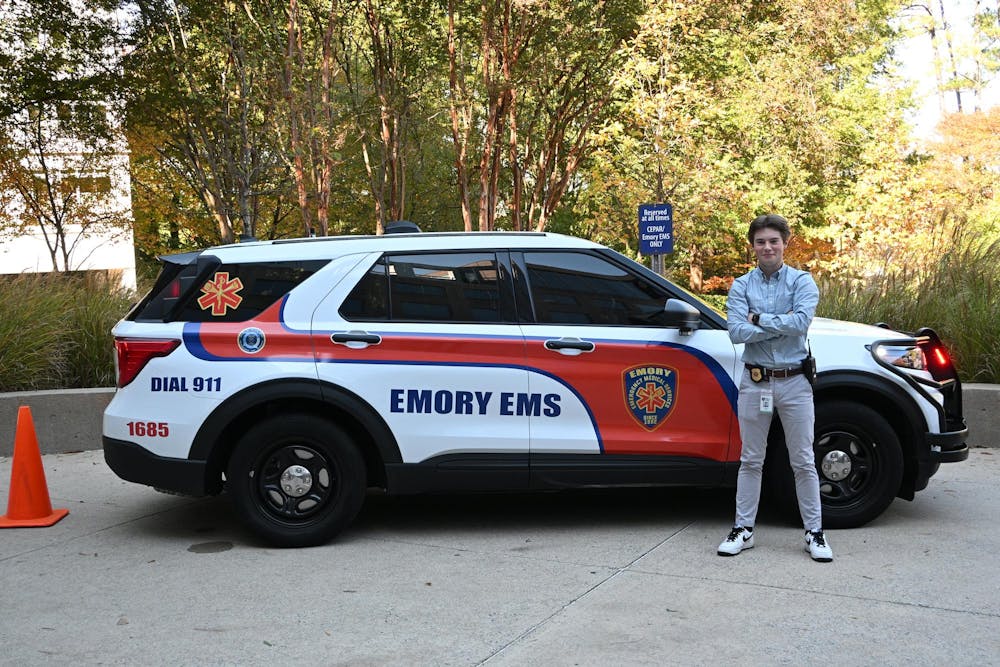
Before moving to Atlanta as a first-year student, Dolle attended an admitted students tour and stayed at the Emory Conference Center Hotel, which sits across the street from the Emory Emergency Medical Service (EEMS) headquarters. Walking up the path to the hotel, Dolle peered into the parking lot, spotting the EEMS trucks — white cars with orange and blue stripes and the Emory medical insignia — that would soon become a major part of his college experience. Dolle’s curiosity was undeniable: He wanted to know more.
After conducting some initial research on the agency, Dolle learned that EEMS was a volunteer emergency medical service (EMS) run by Emory students, with some oversight from Emory’s Office of Critical Event Preparedness and Response.
Dolle discovered that EEMS applications for his freshman year were open to students with an EMT license. The pieces fell into place, and Dolle applied for and joined EEMS before he had even attended his first Emory class. Reflecting on this consequential moment, Dolle said he saved his EEMS acceptance voicemail to his phone.
“This has been such a goal for so long,” Dolle said. “It's cute to have little snapshots of where I was in my trajectory and how I've come to achieve these goals.”
‘Expert After A Call’: How Dolle Leads With Knowledge
While most incoming students occupy their first days in Atlanta with learning where to find the dining hall or how to balance studying and sleep schedules, Dolle threw himself into the deep end of Emory’s emergency response teams during his first year at Emory.
Emory Police Department (EPD) Sergeant Christian Theis noticed the young responder’s potential as soon as he joined the agency. Thesis and Dolle, in their roles at EPD and EEMS, work together to support campus safety, but Thesis also described the two as friends and emphasized his appreciation for Dolle’s presence in his work and life.
“He’s always been a leader from the get-go,” Theis said. “He’s super knowledgeable in the field of emergency medical services, he knows what he’s doing.”
EEMS responds to a wide range of calls from students, faculty, staff, visitors on campus and the surrounding community. Working constantly to improve his medical knowledge, Dolle frequently independently studies treatment options to fill any gaps in his care.
“Knowledge is power for me,” Dolle said. “Anytime I run a call that I don’t feel like I know as much as I’d like to about, I become an expert after a call.”
Emory School of Medicine Research Specialist Kylie Taylor (25C), who was part of EEMS when she was an Emory undergraduate student, said Dolle’s prior emergency response set him apart from other newcomers in his early EEMS responses.
“I remember him coming in on the first skills day of the year and just bringing a lot of enthusiasm,” Taylor said. “I had no idea he was a freshman because he seemed already very passionate, very excited, very comfortable. You could tell that this was his field and his domain from the start.”
Only a week into his time at EEMS, Dolle began serving as a teaching assistant for an EMT certification course. And in his second year at the agency, Dolle became a field training officer, educating the next generation of Emory’s emergency responders.
Dolle joined the EEMS command staff in his junior year as the Division Chief of Training and Education, building on his love for mentorship and education. That same year, the organization won the Georgia Emergency Medical Service of the Year award, honoring EEMS as the top emergency medical service in the state.
EEMS Deputy Division Chief of Field Training Sofie Ragins (26C), whom Dolle trained, said he is an invaluable resource for his trainees and staff.
“He’s always there to support me,” Ragins said. “Even though it’s his first time doing a lot of these things, he always has the right answer, and if he doesn’t, he admits that as well, and we’ll figure it out together.”
Now as senior, Dolle serves as Chief of EEMS, spending 36 hours a week on shift and on call 24/7 to respond to any questions from the 76-member EEMS team. Whenever he needs to make difficult decisions regarding EEMS practices, Dolle uses intuition to guide himself and considers different viewpoints from his staff.
“I want to make the right decisions,” Dolle said. “I don’t need to be right.”
As someone who loved overseeing one-on-one training, Dolle initially worried that his role as chief would be too administrative and removed from the education process. However, Dolle said becoming chief allowed him to give back to the organization he loves.
“I found that [being chief] was an opportunity to, at the very highest of levels, advocate for the agency, for the good work that we do,” Dolle said.
A Day In Dolle’s Life
With so many responsibilities, Dolle manages his days through discipline and a strict schedule. The EEMS chief wakes up each morning around 6 a.m. — or 5:45 a.m. if he is on shift. Within minutes of opening his eyes, he moves through his morning routine: shower, blow-dry his hair, brush his teeth, shave and, eventually, make himself a cup of coffee. Steaming beverage in hand, Dolle then sits on his couch with his iPad to read The New York Times. However, routine, not caffeine, motivates him.
“It's funny, I don’t need coffee, but I really enjoy the ritual of it,” Dolle said.
When he is on shift, Dolle’s morning routine extends beyond his Clairmont Campus apartment. When he arrives at the EEMS office, he rounds up the equipment he needs, checks on his crew, gets the run-down from the outgoing shift, conducts truck examinations and grabs breakfast and coffee around 8 a.m.
Just six hours after he wakes up, Dolle is already preparing for nighttime. He stops drinking caffeine after noon and eats dinner at 4:30 p.m. While Dolle acknowledges that his routine appears rigid, he insists on its flexibility.
“I’m so busy throughout my day that having some consistency of, no matter what’s going on on my plate, wind down time is 8:30 [p.m.],” Dolle said.
The Dualities And Demands Of The Job
Even though Dolle maintains a strict daily routine, he understands the “duality” of EEMS life, where responders serve as both emergency medical providers and students. At one moment, an EEMS student may be in class taking notes, while in the next, they are on call, responding to life-altering situations. Dolle said that EEMS providers are able to make light of the sometimes-stressful responsibilities.
“It’s a running joke now that anytime someone has something they have to get done, they’re just going to have calls all through that,” Dolle said. “That’s just how that works, and it’s just an unlucky fact of life.”
To help reduce the tension of a stressful shift, little things, such as interacting with children, offer small moments of joy. While EEMS students drive around with stuffed animals to give to children, what truly excites kids most is seeing the EEMS trucks themselves. On rare occasions, EEMS calls offer moments of inspiration and celebration, such as assisting childbirth.
“Most people are having an inherently bad day when they call EMS,” Dolle said. “It’s really difficult to shoulder that burden of ‘Well, I’m going to get called to another bad day. My whole day today is gonna be other people's bad days.’”
While Dolle has so much love for his job, he understands being an EEMS student can be stressful, both in terms of time commitment and mental toll, and he takes these stressors seriously.
“Maybe an average person experiences death a couple times in their life, and it’s when it’s someone that they are close to, and as an EMS provider, that’s the type of thing you’re seeing on a very weekly basis,” Dolle said.
Those who work with Dolle attest to his ability to foster meaningful conversations. According to Ragins, Dolle opens up to those around him and always has his phone ringer on for staff to contact him.
“The easiest way to get through burnout and the difficulties is to remember why you’re there,” Ragins said. “He is always one of those people that will either remind you for you, or he will bring that energy when you are having a bad day.”
An Infectious Love For EEMS
After he graduates this spring, Dolle hopes to attend medical school and explore careers in both medicine and public policy. As the first person to serve on the EEMS command staff two years in a row since the COVID-19 pandemic, Dolle will leave a lasting impact on the organization and its people.
For Ragins, Dolle’s enthusiasm for emergency response medicine inspired her to pursue leadership roles within EEMS.
“He brought the best out of me, and he also wasn’t afraid to tell me areas I needed to grow in,” Ragins said. “He inspired a lot in me, and watching him through the journey made me want to do the same.”
Taylor emphasized that Dolle sets an example for effective EEMS education.
“He just has a very genuine passion that translates, at least for me and the people I know in the agency, you can tell that he cares,” Taylor said. “He’s always learning new things, teaching new skills, trying to improve the agency every day.”
As chief, Dolle’s relationships extend beyond the EEMS staff and stretch into EPD as well. Theis said Dolle is “one of the kindest people” he knows, bringing happiness and light to every situation.
From acting as a bridge between EPD and EEMS to being an open leader, Dolle hopes his main impact will be on the people and culture within the organization.
“I want a culture to be my legacy, and I want it to be one of holding people incredibly accountable in a way that is so loving and supportive,” Dolle said. “That's my goal.”
Far off from the scared 14 year-old dialing 911 at the light rail on a damp fall day, Dolle empowers the next generation of young volunteers ready to act whenever an emergency strikes.

Amelia Bush (28C) is double-majoring in English and PPL (philosophy, politics and law). She is from Minneapolis, Minnesota, and enjoys walking around its many lakes. Outside of the Wheel, you can find her reading, scrapbooking, or attempting a New York Times crossword.

Madeline Shapiro (she/her) (26C) is from Stamford, Conn., majoring in creative writing and classic civilizations. She manages the Wheel’s opinion section. Outside of the Wheel, Shapiro can be found playing low-stakes games of soccer, spending time outdoors and watching as many Premier League games as possible.