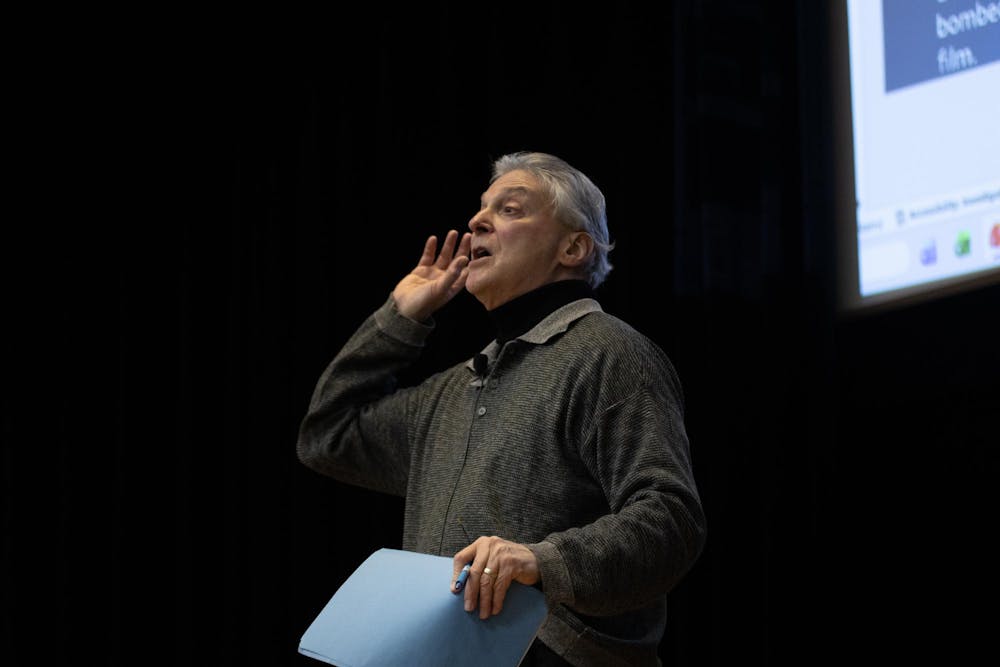
On Wednesday nights in Goodrich C. White Hall, the lights dim as a projector hums and a roomful of Emory University students and Atlanta cinephiles eagerly lean forward in their seats. Figures flicker to life on screen, illuminating the audience. This semester, Goodrich C. White Professor of Film and Media Matthew Bernstein curated the spring selection as part of Emory’s Cinematheque, a free weekly film series hosted by the Department of Film and Media. This spring, the theme is “Farewell Favorites” in honor of Bernstein, who will retire this summer.
After earning his bachelor’s degree from the University of Wisconsin-Madison in 1980, Bernstein returned for his PhD in 1987. Bernstein arrived at Emory in 1989 to teach film history and criticism. In 2006, Bernstein began serving as department chair, a position he held for 15 years.
Growing up on Long Island as a baby boomer, movies were woven into the fabric of everyday life. Two movie theaters stood across from each other on Bernstein’s hometown’s main street. Classic movies often ran on independent New York television. Throughout his childhood, Bernstein cherished watching films with friends and family.
“Movies were always a favorite thing for me to do,” Bernstein said. “There were movies that I would go see three or four times in the theater, because I would get so excited about them and want to experience them.”
What began as a casual hobby soon became something deeper for Bernstein. The repetition of returning to the same stories and scenes trained him to look beyond the surface and into films' broader meanings. That instinct followed him to college, where his path toward film studies became apparent. In 1977, Bernstein took an introductory film course. The most modern film they watched was “Singin’ in the Rain” (1952), over 20 years old at the time. Despite the lack of contemporary movies, he was nonetheless enthralled by every film.
“I was just so passionate about learning how to analyze the visual and audio grammar of film, and then to realize one could teach film on a college level,” Bernstein said.
Although Bernstein majored in English, film studies’ combination of sound, narrative and visuals enticed him. He continued on to earn an MFA in film at Columbia University School of the Arts (N.Y.), where he worked on student films. Through this experience, Bernstein learned he did not want to be a filmmaker.
Soon thereafter, he sought his PhD at the University of Wisconsin-Madison. The professors he studied under left a lasting imprint on his teaching style at Emory.
“They did something that I’ve always taken to be a fundamental principle of teaching, which is understanding where your students are coming from,” Bernstein said. “Understanding what is it students need to know.”
Since arriving at Emory in 1989, Bernstein has taught generations of students to analyze what is on screen — to look beyond the plot and characters into the mechanics and meanings of each film. Films, he teaches, are like artifacts, never isolated from the world that produced them.
"Films are a product of the time in which they’re made,” Bernstein said. “They bear the hallmarks of a society and a culture’s ideas.”
For Bernstein, analyzing film’s cultural context begins with conversation. Inside the classroom, his teaching centers on conversation rather than lecture, creating space for students to test collaborative ideas aloud and become effective communicators.
“My other philosophies of teaching involve creating an environment where students are comfortable speaking up, expressing their ideas and trying to create a constructive dialogue, so that at a certain point, the students are talking to each other, and I’m just refereeing,” Bernstein said.
According to his students, Bernstein brings his philosophy to life through his teaching. Daniel Rosen (26C), a former student of Bernstein’s, praised his professor’s infectious enthusiasm and knowledge in the classroom, highlighting how he continually updates his curriculum to reflect current events in film.
“He continues to be so passionate about it, and he loves it so dearly that he is still as interested in the things that are going on today as the things that were going on in the period that he studies,” Rosen said.
Beyond the classroom, Rosen credits Bernstein with crafting a broader film community at Emory, fostering genuine support within the department.
“He’s created a culture of film at Emory that is really welcoming and warm,” Rosen said.
Siena Lonsdorf (27C), another former student, pointed to Bernstein’s personal impact on her life. After Lonsdorf decided on a career in film, Bernstein provided her professional development coaching.
“He’s opened many doors for me to ask people about their careers and really encouraged me to get in touch with people,” Lonsdorf said.
That encouragement reflects Bernstein’s deep enthusiasm for his profession. He describes that passion as inseparable from the films he studies and teaches.
“I frankly can’t believe I get paid to do this, right?” Bernstein said. “Films are my love. They’re my passion.”
Over his decades at Emory, Bernstein witnessed the film and media department’s dramatic growth, from a small program into a robust department with monumental advances in film studies, media studies and production.
As his retirement looms, Bernstein does not foresee stepping away from film. He plans to continue writing and finishing long-standing book projects. He and his wife will embark on new travels, anticipating attending film festivals in California and Colorado. He will give guest lectures, introduce films to the curious and continue to remain active in local film organizations. What Bernstein will miss most, however, is not the syllabi or the screenings, but the students.