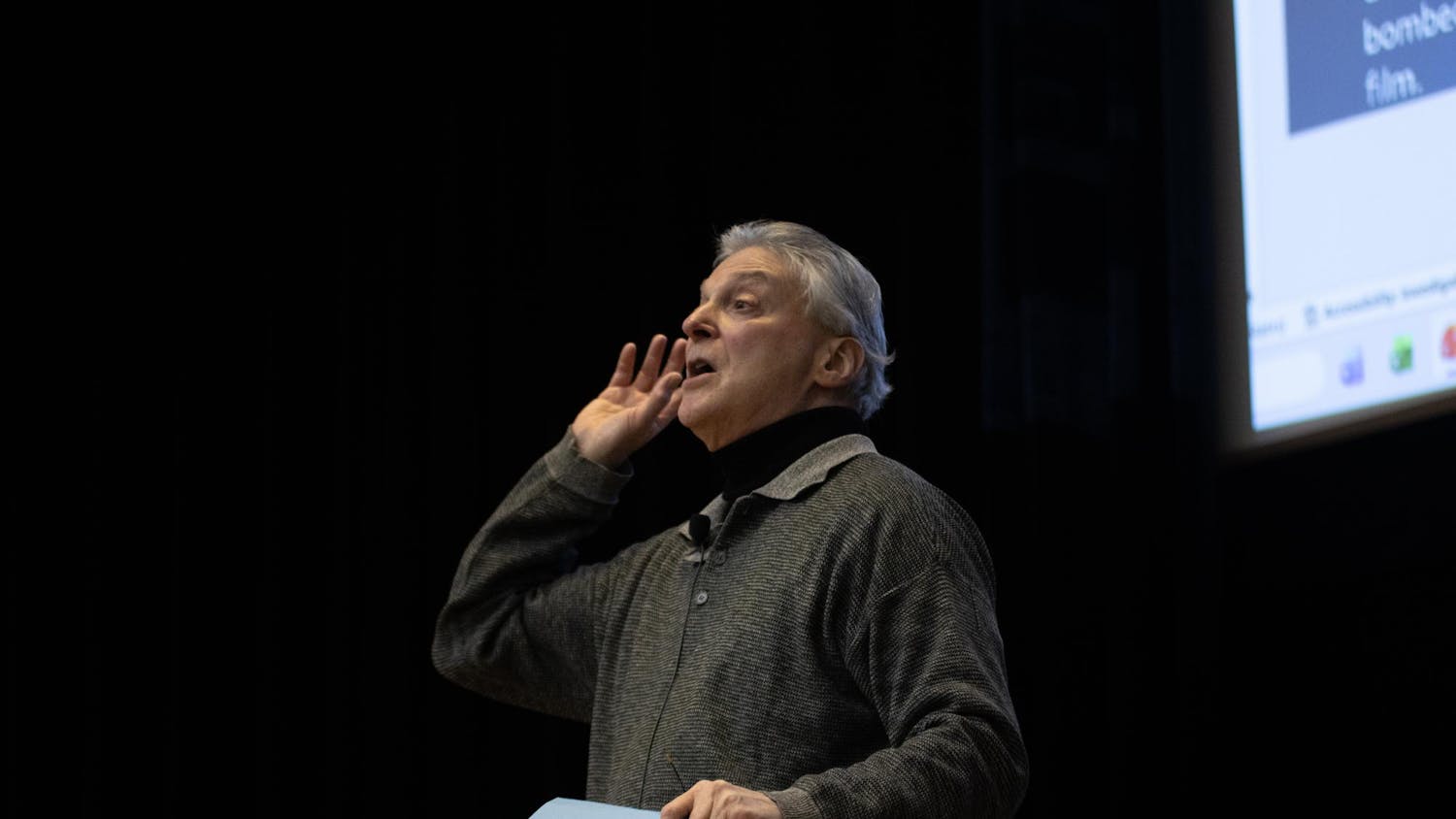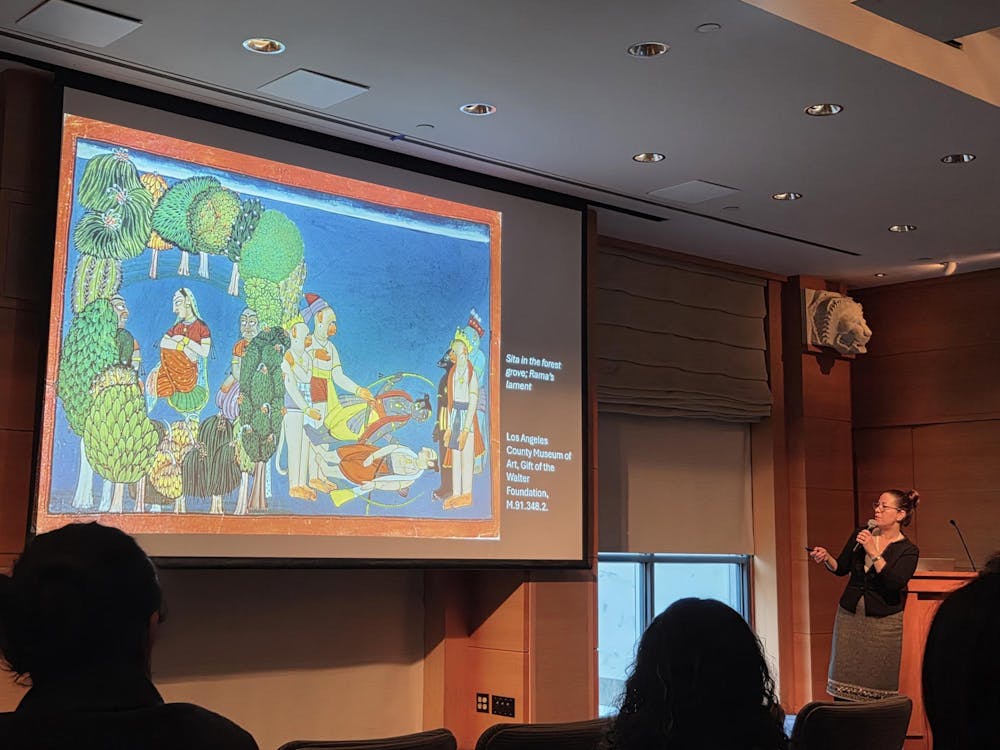
Tucked in the warmth of Ackerman Hall on the third floor of the Michael C. Carlos Museum, Sonya Rhie Mace, the George P. Bickford curator of Indian and Southeast Asian art at the Cleveland Museum of Art, prepared to give a lecture at Emory University on Oct. 27. Attendees of the Department of Middle Eastern and South Asian Studies South Asian Seminar avoided the crisp bite of the wind, finding safety — and community — in her storytelling.
Mace’s speech focused on “Narrative Strategies and Unexpected Climaxes in Pictorial Ramayana from the Northwest Himalayas.” The Shangri Ramayana, referenced in the lecture title, is a folio series illustrating the Ramayana. The Ramayana is a Sanskrit epic about a Hindu deity who embarks on a voyage to rescue his wife from a demon. The project’s namesake comes from the discovery of 270 folio pieces in an alpine mountain valley kingdom called Shangri.
A folio is a collection of individual art pieces that often serve to visualize different parts of a story.
The folio of the Shangri Ramayana is a collection of 270 paintings created on sheets of paper with ground mineral pigments, silver and gold metallic pigments, and bordered with mercury or arsenic to protect from insects. They aim to capture and portray the story of the Shangri Ramayana through the traditional art form of Pahari painting.
Although many Shangri Ramayana folio pieces are scattered across different collections, Mace presented this pictorial series in sequential order — a difficult task. The original 270 folios that were found have been the primary focus of this project in academia, but Mace has discovered 650 episodes as part of her research and believes the series most likely comprises around 1,000 pages in total. Mace went on to present the folios, explaining each photograph.
In her presentation, Mace compared the significance of folios to a temple, making one crucial distinction: the folios could be “distributed” and exist as a form of currency during the 1700s.
“The folios could have been viewed performatively, but maybe they weren't really viewed much at all,” Mace said. “Maybe they weren’t really used as a performative series. Maybe they were made as an act of devotion.”
While many historians examine the specific historical context and circumstances surrounding the folios, Mace encouraged the audience to examine the artistic techniques of the project and how they conveyed the narrative of the Ramanaya. She questioned why many scholars tend to discuss the paintings as individual works when the original artists designed this project as a series.
“See how the experience of looking at those paintings in the context of the series for which they were made, how that changes our understanding of the work itself,” Mace said.
Visweswara Rao and Sita Koppaka Associate Professor in Telugu Culture, Literature and History Harshita Kamath (04C, 12G) highlighted the Shangri Ramayana’s “plurality” and valuable role in scholarship.
“There were personal collections in Germany and in India and in the United States and in the United Kingdom,” Kamath said. “Just to think about the dissemination of this epic that continues to be really important for many South Asians and also for our study of art.”
In April, Mace’s exhibition on the Shangri Ramayana will open at the Cleveland Museum of Art in Ohio, for the first time reuniting 40 physical folios from 12 institutions and over 100 digital folios.
“Now that we have digital images, even though these series are all over the world, we can start to do the work of bringing them back together and seeing how their original creators first imagined them to be,” Mace said.
Ruby Lal, professor in the Department of Middle Eastern and South Asian Studies at Emory, describes the Ramayana as a “bardic text from India,” which, much like the Homeric epic poems, is a complex text that reflects various historical narratives.
“We have to understand that these texts bring out many ways of living, many ways of being, many different kinds of stories and many different kinds of people and geographies,” Lal said. “That's quite beautiful.”
Correction (11/12/2025 at 10:38 a.m.): A previous version of the article stated that the Interdisciplinary Workshop in Colonial and Postcolonial Studies was the primary sponsor of the event. This is incorrect; they were the co-sponsor. The Department of Middle Eastern and South Asian Studies South Asian Seminar provided the primary funding and organization for the talk. The article has been updated to reflect this.