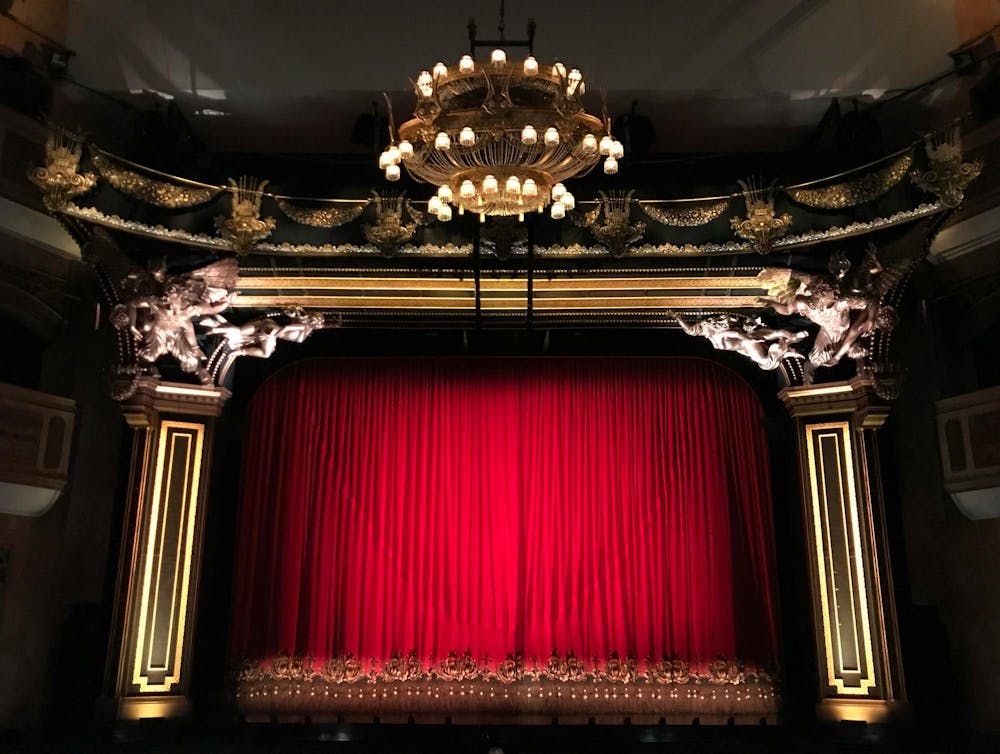
Before I entered the August Wilson Theater in New York, an usher handed me a black sticker reading, “Keep it in the Kit Kat Club,” meant to cover my phone’s camera — a nod to the strict photography policies of clubs in Berlin. I took my seat near the circular stage, surrounded by eerie and dark decor. This was not a typical Broadway theater — it was an invitation to a different world.
In late September, I attended the last performance of Rebecca Frecknall’s recent “Cabaret” revival. The show first opened on Broadway in 1966, yet it continues to surprise audiences around the world. Set in the fictional Kit Kat Club in 1930s Berlin, “Cabaret” offers a place of escape shadowed by the ominous rise of Nazism. At the show’s center is the Emcee, the Master of Ceremonies, embodying charm and menace while guiding us through a mysterious journey.
The musical opens with several over-the-top egregious numbers, but the tone soon darkens. The lights dim. The ensemble has shed its outlandish and revealing costumes, now wearing stark, uniform attire. Violins scrape their strings like nails on a chalkboard, and then the number begins. For the next few minutes, the audience watches in shock. “Tomorrow Belongs to Me,” “Cabaret’s” pastoral anthem, serves as a reminder of life as Weimar Germany descended into fascism, and stands as a cold and dark contrast to the overall fanatic theme of “Cabaret.”
“Tomorrow Belongs to Me” is more than a historical warning about the rise of Nazism — it mirrors our present reality. The song reminds audiences of the seductive and terrifying nature of fascism itself and how people can weaponize nostalgia — a disturbingly familiar melody that reverberates in American politics today.
When the song’s simple melody begins, it is accompanied by descriptive imagery such as “The branch of the linden is leafy and green” and “The Rhine gives its gold to the sea.” It feels warm and inviting, but looking closer reveals that the Emcee is invoking an idyllic, pure image of life in Germany with darker meanings. The Nazis used the linden tree and the Rhine as symbols of German nationalism, hinting at a deeper racial message that the purity of the land mirrors the purity of the people. This is precisely what makes “Tomorrow Belongs to Me” so chilling: It transforms beauty into ideology, revealing how political figures weave nostalgic rhetoric into movements.
Nostalgia is a powerful human emotion, and in modern American politics, no one has wielded it as effectively as U.S. President Donald Trump. A 2022 study on the prevalence of nostalgia in U.S. presidential elections since 1952 found that Trump used nostalgic rhetoric in nearly 10% of his 2016 campaign speech paragraphs — the most of any candidate. Even his slogan, “Make America Great Again,” is a longing for an illusory and mythologized past. The weaponization of nostalgia thus reframes regression as restoration, selling the past as a promise for the future.
“Tomorrow Belongs to Me” swells when the Cabaret Boys join the Emcee. Lullaby imagery is developed by the harmonies of “the baby in his cradle is closing his eyes,” followed by the whisper “Arise, arise!” The reference to a baby in a cradle indicates how the ideology is not just being sung to the people — fascist leaders indoctrinate the next generation, turning the cradle into a classroom and obedience into instinct. This pattern is not unique: Suppressing dissent early through education is a very successful tool for authoritarian regimes, as exemplified by the Trump administration’s crackdown on First Amendment rights and its attempt to control educational narratives. In fact, recently, as many as 40 college professors, including one at Emory University, were dismissed for comments they made about conservative activist Charlie Kirk after his assassination. Predictably, the Trump administration is shifting focus to education to ensure that our future generations learn what is sanctioned as “truth” while censoring those who disagree, a tactic disturbingly reminiscent of fascist regimes in the past.
Lastly, the repeated refrain “Tomorrow belongs to me” is both triumphant and terrifying. In the context of the song, these words imply that only those deemed worthy can belong. The essence of fascism is a collective pride, the illusions of hope and a system rooted in discrimination and domination. In Weimar Germany, it was the Nazi myth of the Aryan race’s superiority. In America today, it reflects the greater “Make America Great Again” values of putting America first, but more specifically, white America. The federal government should represent the nation’s diversity, yet of Trump’s 98 Senate-confirmed appointees to his administration, only two are Black members. The message is clear: this government does not represent the entire American people. Therefore, “Cabaret’s” “Tomorrow Belongs To Me” is no longer just a warning from history — it is a reflection of the exclusionary language and the creation of a racial superiority that is shaping the America of today.
I believe in America and the dream it promises, but these days, the dream feels foggy. We now live in a country where Immigration and Customs Enforcement arrests are surging under the guise of supposedly “protecting” American communities, and the criteria for conducting these arrests include targeting people for their race, ethnicity or even their accent. Our president has decreed a presidential action to rewrite history to preserve a false mythic past of American greatness. The consequences of these actions are catastrophic: They erode trust in established institutions, normalize discrimination and let the executive branch’s power go unchecked.
But, even amid these threats to our democracy, there is hope. On Oct. 18, Americans across the country protested against our president in the “No Kings” rallies. The protesters stood firm against an ideology rooted in a collective pride around American greatness and a nostalgic, illusory past. These peaceful activists stood for civil liberties and the freedom of expression for all. They envision a future where tomorrow belongs to all of us.
“Willkommen, bienvenue, welcome.” Like these opening lines of “Cabaret,” the invitation still stands — but instead of greeting you in 1930s Berlin, “Tomorrow Belongs to Me” is an invitation to you, the audience, to wake up and pay attention to today. When you step outside the Kit Kat Club, look around. Notice the signs, slogans and chants. To decide whom tomorrow really belongs to, we must recognize and call out the Trump administration’s fascist rhetoric before it is too late. Fascism is not a relic of history. It is a political ideology that is quietly and quickly eroding our democratic values. And, ask yourself, just maybe, whether tomorrow already belongs to them.
Contact Joshua Glazer at joshua.glazer@emory.edu