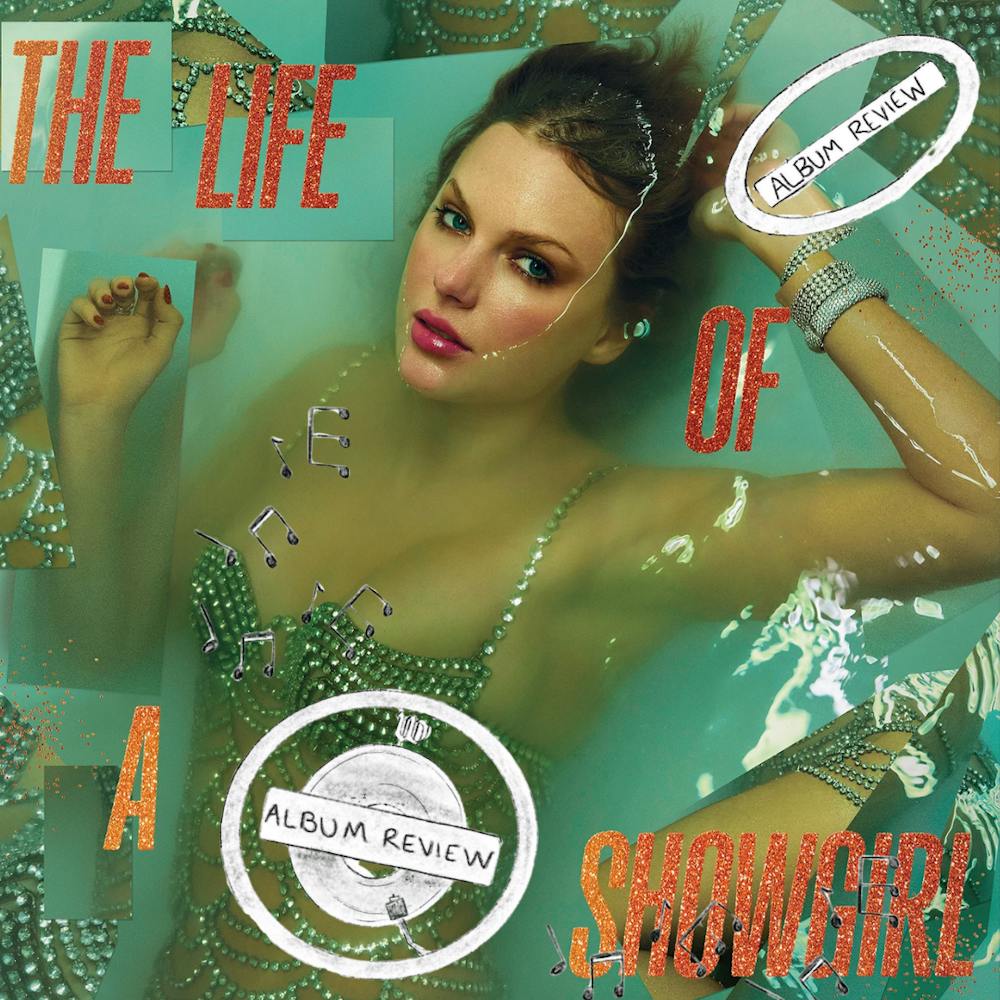
In an era full of musicians seeking virality and fame, one artist remains dedicated to evolution and risk: Taylor Swift. From 2023 to 2024, Swift embarked on her record-breaking Eras tour, during which she reached new heights — no pun intended. Her new album, “The Life of a Showgirl,” offers a behind-the-scenes look into her mind and life during this special period. On Oct. 3, Swift released her 12th studio album, reverting to old sonic and lyrical themes and marking an end — or at least a pause — to the somber trend of her discography.
The first track, "The Fate of Ophelia," encounters a classic theme in Swift’s writing: retelling old stories. From “cardigan” (2020) in which she evokes “Peter Pan” (1904) characters to “Love Story” (2008) in which she pleads for her own Romeo to take her away, Swift’s reimagining of the ending of William Shakespeare’s “Hamlet” (1623) fits perfectly within her world. Rather than letting her Ophelia go mad, Swift gives the character a happily ever after much like her own. “You dug me out of my grave and / Saved my heart from the fate of / Ophelia (Ophеlia),” Swift sings.Swift begins with somber words, “I sat alone in my tower,” but soon turns to hope, “No longer drowning and deceived / All because you came for me.”
Both the lyrics and the production, which features a mix of piano and percussion, amplify the positive and happy aesthetic and reflect a bright and charming change in Swift. The lead single sets the stage for the rest of the album — representing a revival in Swift’s confidence due to her newfound happiness.
“The Life of a Showgirl” offers a distinct tone of renewal and rebirth, especially in the tracks “Opalite” and “Eldest Daughter.” In “Opalite,” Swift rethinks her old attitude about life, singing, “Life is a song, it ends when it ends / I was wrong.” On this track, Swift acknowledges that she is still worthy of love, despite her missteps and hardships, with her distinct backing vocals reflecting her growing confidence. This realization reinforces the song’s central theme: Everything will be okay. Contrary to the angst and anger that Swift’s last album, “THE TORTURED POETS DEPARTMENT” (2024), depicts, she recognizes how her past pain brought her to her current happiness.
With a personal touch, “Eldest Daughter” highlights how finding the right person can change you. Swift sings, “But I'm never gonna let you down / I'm never gonna leave you out,” promising to herself and others around her that she will be a better partner and more self-assured. Showcasing her resilience, Swift demonstrates the importance of moving forward. In this track, Swift shifts to a more somber tone, explaining her past misfortune in love, “When I said I don't believe in marriage / That was a lie.” But, like other songs on the album, the track eventually changes to burst with love: “Shimmers that innocent light back / Like when we were young.”
Though this track reveals a beautiful message, it stumbles in its execution. For example, following the bridge, the instrumentation abruptly shifts, creating an unpleasant listening experience. In addition, the chorus breaks listeners’ engagement when Swift sings, “But I’m not a bad bitch / And this isn’t savage” which taints the entire song, making it feel shallow and surface-level. Despite the song’s romantic message, its inconsistent production and Swift’s superficial lyrics make it a conflicting listen.
“Father Figure” uses an extended metaphor about family to explain Swift’s protection of her musical legacy. Singing, “Leave it with me, I protect the family,” Swift equates her music to her reputation — one that Swift, and her faithful fans, have protected ceaselessly during her battle for her master recordings, which she bought in June. The song also discusses an up-and-coming “protégé,” who Swift becomes a “father figure” to. Unlike other tracks, “Father Figure” has a darker vibe, demonstrating the precarity of upholding a livelihood when people attempt to bring you down.
In “Father Figure,” Swift’s characterization as a “father” emphasizes how making tough decisions is often associated with masculinity. By taking on this gendered role, Swift is able to express her rage about her former misgivings as a musician. Men are traditionally able to express their anger without being shamed for it, and are rather praised for such emotions. Swift is showcasing her autonomy and leadership as an artist through sharing her feelings like a man would. Channelling these stereotypical notions about what masculine leadership, Swift questions, “Whose portrait’s on the mantel? Who covered up your scandals?” underscoring her role as a powerful authority figure.
Although “The Life of a Showgirl” brings a new sound to Swift’s discography, the album lacks the powerful lyricism of her past projects. Swift’s older discography, especially “folklore” (2020) and “evermore” (2020), offers more profound songwriting with a softer emphasis on production. This record has the opposite effect, where lyrics such as “Did you girlboss too close to the sun?” from “CANCELLED!” or “Everyone's unbothered ‘til they're not” from “Eldest Daughter” suggest a decline in her songwriting.
“CANCELLED!” in particular reflects an issue with Swift’s rising stardom and her declining lyricism. While it demonstrates the precarious relationship between friendship and fame, instead of enlightening comments on life and love in the spotlight, Swift offers superficial sass. “Welcome to my underworld / Where it gets quite dark / At least you know exactly who your friends are / They’re the ones with matching scars,” she sings. Her breathy tone, with a sharp edge, does not help the delivery of these choppy lines.
However, the album's production makes up for what the songwriting lacks. The surface-level lyrics make the record more relatable to casual listeners and the bubbly, fun sounds such as the drum machine or electronic synth in “Elizabeth Taylor” bring the record together. In “The Life of a Showgirl,” Swift gains more confidence than ever before, solidifying herself as a household name while simultaneously striving for more.