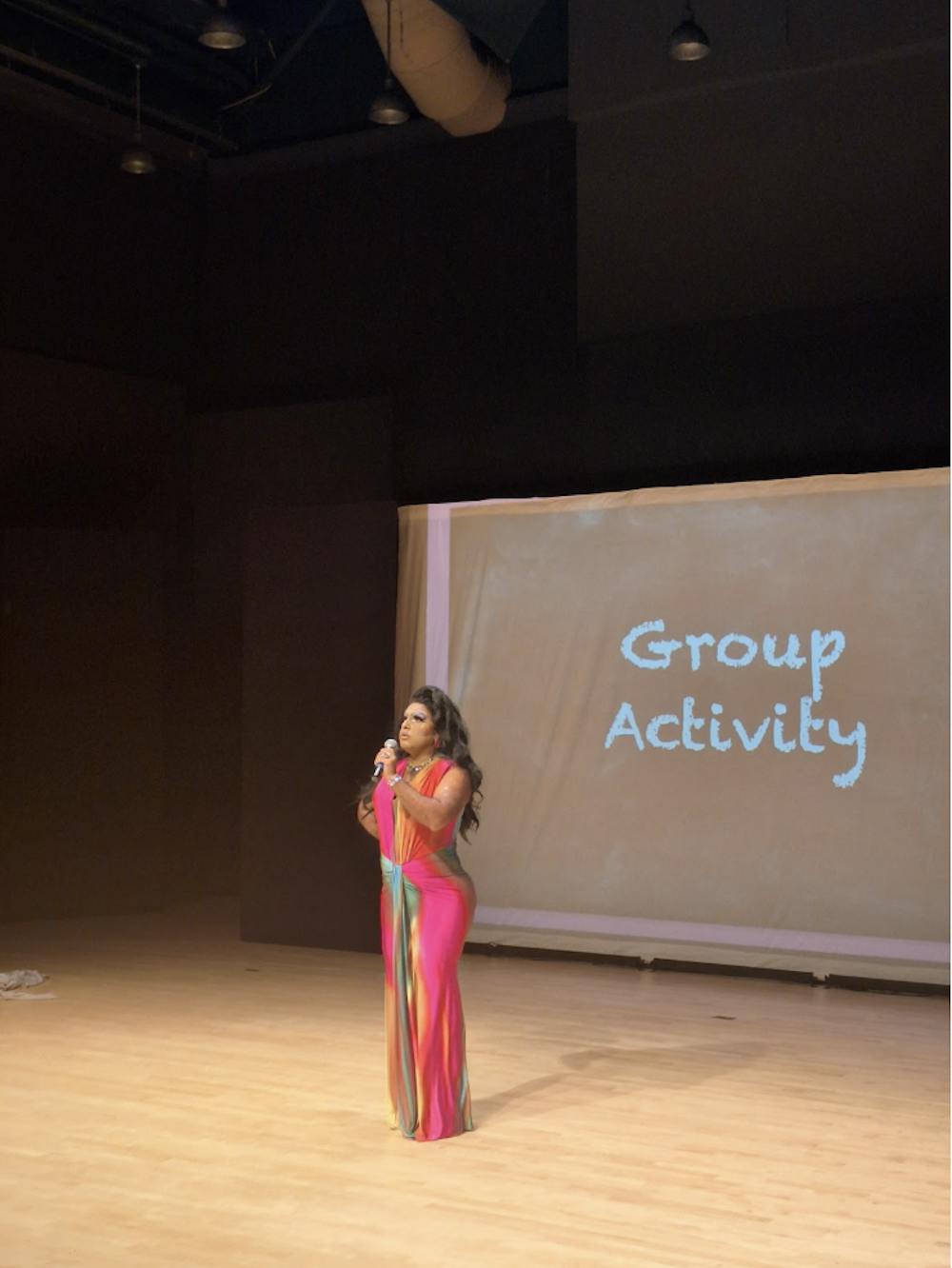
Videos of South Asian performers flashed across Emory University’s Performing Arts Studio stage, accompanied by chalk text scrawled onto the screen: “Lessons in Drag w/ LaWhore Vagistan.” The audience cheered as the screen shifted to images of bursting fireworks — drag queen LaWhore Vagistan was about to begin her show.
Vagistan came to Emory on Oct. 9 for the “Lessons in Drag” performance, which was the last event in her three-part drag education and workshop series on campus. The previous two events, held on Oct. 8 in Cox Hall and the Schwartz Center for Performing Arts, explored how drag encompasses people from all walks of life and offered an interactive drag workshop, respectively. Vagistan has presented her drag workshop on college campuses nationwide, including Brown University (R.I.) and Wesleyan University (Conn.).
The drag queen combined her performance with a lecture, discussing the intersection between South Asian culture and drag. Vagistan chooses to perform using a persona of a South Asian aunty, — a respectful term referring to any older woman, regardless if they are a relative — because she has an age and waistline “over 35.”
“I’m too old and too thick to occupy the skinny glamour that is so highly prized with the drag community,” Vagistan said. “Instead, I fall into a different imagination of femininity altogether: Aunty.”
According to Vagistan, being an aunty honors the long history of queer South Asians and gives their often hidden stories more visibility. In embodying this figure, Vagistan celebrates decades of intergenerational activism and LGBTQ+ joy.
“I first realized the value of being an aunty in 2013 at DesiQ, a conference for LGBT South Asians,” Vagistan said. “The younger queer and trans people there kept saying, ‘Oh, my God, I can't believe there's so many uncles and aunties here.’”
Vagistan holds a doctorate in Performance Studies from Northwestern University (Ill.) and currently performs drag and teaches Women, Gender, and Sexuality studies as a visiting professor at Harvard University (Mass.). Being of Pakistani descent, Vagistan based her first name on the capital of the Pakistani province of Punjab, Lahore. With her last name, Vagistan hopes to pay homage to South and Central Asian countries such as Pakistan, Afghanistan, Uzbekistan and Kazakhstan.
“I, like a good post-colonial drag queen, like to bring it back together as one big, beautiful vagistan,” Vagistan said. “It's a much more capacious view of our subcontinent.”
Her aunty drag persona likewise honors the women who raised Vagistan, including relatives and family friends, and taught her lessons that extend beyond her childhood.
“They taught me that sequins are day wear, and they taught me that leopard print is a neutral,” Vagistan said.
Although younger generations often give aunties a “bad rap” for assuming dominant positions in families even while not being in the nuclear family, to Vagistan, these women allow for social progress and important conversations. Aunties are not merely “loud and domineering, judgemental and gossipy” but inspirations for introspection, according to Vagistan.
“Aunties are a cipher for younger generations to critique older people's outdated politics and style,” Vagistan said. “Given these stereotypes, nobody wants to be an auntie these days, but I do.”.
For Lauren Stephenson (26C), the informational yet entertaining format of the performance helped her learn while still having fun. For example, before Vagistan’s choreographed dance to “Telephone” (2009) by Lady Gaga, Vagistan reenacted a call center workplace, demonstrating how such workers often curtail their accents, to be acceptable and “legible” to others, just like how people hide their queerness.
“I didn't realize that in call centers, people were trained to hide their accents,” Stephenson said. “This was a really cool way of spreading that knowledge.”
As “Lessons in Drag” flowed, Vagistan delivered an educational message through a vivacious performance. During the performance, the drag queen utilized Fergie and Ludacris’ “Glamorous” (2006), which spells out the title of the song in its lyrics. Vagistan mimicked the format of a spelling bee and commented on the harmful stereotypes of the “model minority” myth for South Asian Americans.
The enthralling format left audience members with lasting knowledge. Sophia Hawley (23Ox, 25C) said the “Lessons in Drag” event celebrated queerness, which provided Hawley with a sense of community.
“As someone who is queer and intellectualizes a lot of my own identity, it's wonderful to hear, ‘Oh, everyone does that,’” Hawley said. “That's something that felt really personal to me and also really important to know everyone thinks that much about what they do and who they are.”
Phanésia Pharel, the 2025-27 playwriting fellow at Emory, complimented Vagistan on her performance and the intentionality behind each aspect of it.
“She was using drag as a way to keep our attention, but to say deeper, profound things,” Pharel said.
Applause erupted and the energy in the auditorium jolted as audience members swarmed to the lobby to take pictures at the end of the event and have Vagistan sign their “Lessons in Drag” books. It seems as though Emory community members have now found their own favorite aunty: LaWhore Vagistan.