Content warning: This article includes references to sexual assault
Director Luca Guadagnino has never been afraid to embrace human nature at its messiest. The man behind “Challengers” (2024), “Bones and All” (2022) and “Call Me By Your Name” (2017), Guadagnino has achieved recognition for his sensual directing style, which contemplates interpersonal tension and emotional complexity.
In “After the Hunt,” released Oct. 17, Guadagnino addresses social policing, the enforcement of and pressure to conform to a widespread moral code, which may seem like a departure from his renowned interest in intimacy. However, Guadagnino’s film examines social policing through an individualistic lens, avoiding explicit commentary on the merits of cancel culture to explore its impact on understanding ourselves and others.
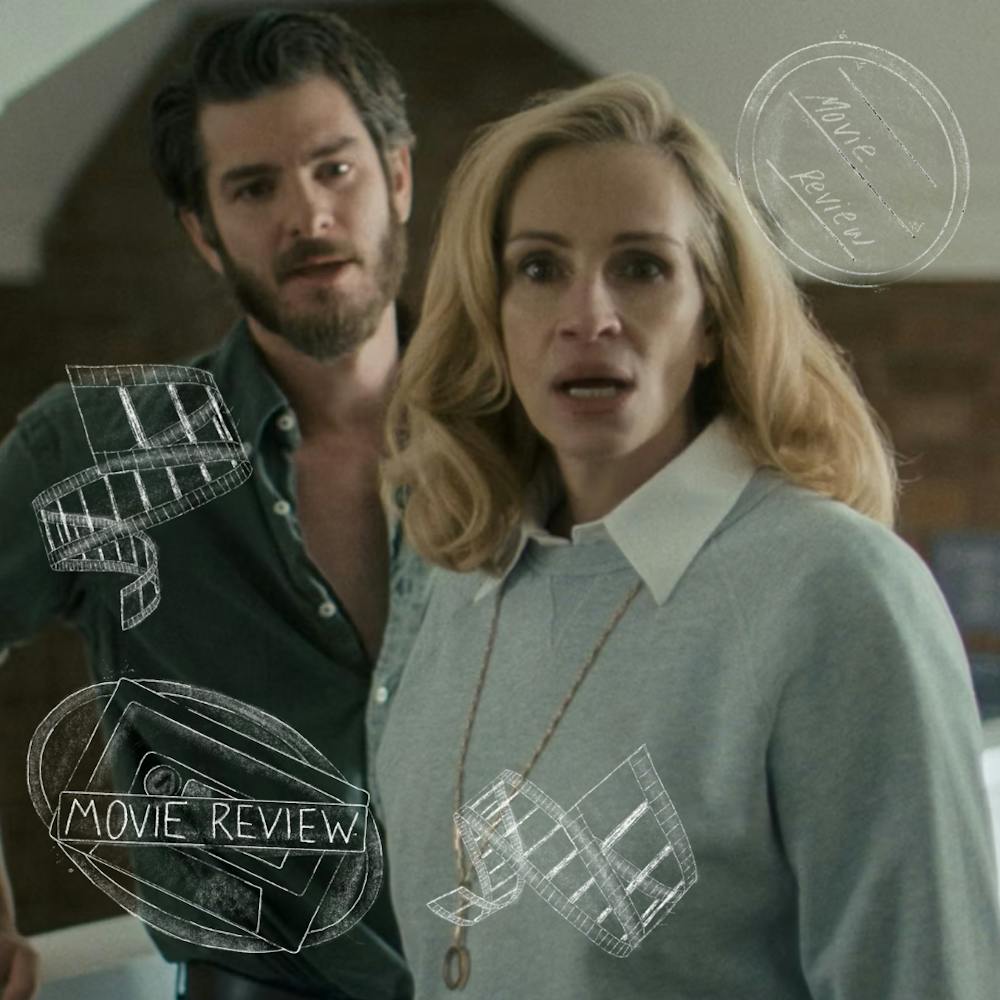
The film opens with Alma (Julia Roberts), a tenure-seeking philosophy professor at Yale University (Conn.), hosting a soirée. Among those in attendance are Hank (Andrew Garfield), another tenure-seeking professor, and Maggie (Ayo Edebiri), a philosophy Ph.D. student. The film explores supportive and critical perspectives on diversity, during which Alma defends her accomplishments against a male student who insinuates she has disproportionately benefited from a culture seeking to uplift women, and Hank criticizes Maggie and younger generations for their fear of offending others. With these scenes, Guadagnino thrusts the viewer into an all-too-familiar debate on woke ideology.
This repeated back-and-forth commentary is central to the film, yet Alma’s shifting, often contradictory perspective prevents the viewer from easily taking a side. Guadagnino avoids aligning with any particular viewpoint and provides a refreshing metacognitive perspective on modern political language, inviting viewers to consider not what they think, but how they address current issues.
After the party, Hank offers to walk Maggie back to her apartment, and Alma sees them off. Days later, Alma finds Maggie waiting outside her office, clearly upset, and Alma learns what happened after the party. In one of the most unsettling scenes of the film, Maggie confesses that Hank sexually assaulted her in her apartment. She fumbles over her words, diminishing her accusations by mentioning how everyone loves Hank. With no scene showing the assault, Guadagnino forces the viewer to empathize with Alma’s impartiality as she struggles to dissect the situation.
Throughout the film, Guadagnino immerses the viewer in each character's carefully constructed relationships and roles, which shift under the forceful demands of social policing. The situation forces Alma to choose between serving as Hank’s moral defense or Maggie’s ideal witness — both look to her as an arbiter of their respective fates. Ultimately, Alma refuses to defend Hank’s alleged inappropriate behavior. Alma’s decision redefines how Hank perceives her: No longer a confidant, Alma becomes a villain complicit with a system bent on his destruction. Hank’s hypocrisy emerges as he claims Maggie’s accusations will ruin all his supposed work advocating for women in philosophy. Guadagnino uses Hank’s hypocrisy, being an advocate for women in public, while abusing them behind closed doors, to underscore how cancel culture’s rigid definition of right and wrong can obscure the truth.
By weaponizing his so-called activism, Hank undermines the cause he claims to defend and diminishes genuine efforts at academic inclusivity, which is invaluable to innovation in higher education. His hypocrisy illuminates cancel culture’s potential for cognitive dissonance — Hank presents himself as morally correct but fails to uphold its principles in practice.
While Maggie advocates for herself, she discovers that Alma had a relationship with an older man when she was a teen. In a confession to her husband at the end of the film, Alma claims that she loved this man, but, feeling that he wronged her, accused him of sexual assault. She believes these accusations led to his suicide, which has burdened her ever since. Alma’s guilt is disturbing yet reminiscent of persistent social attitudes toward pedophilia. Decades later, she still feels she was a consenting party, despite being a child. Through Alma’s introspection, the film explores the victim-blaming culture embedded in society.
Alma and Hank eventually reconnect, voicing shared feelings of indignation and rejection. Their interaction becomes sexual — Hank’s forcefulness and disregard for her boundaries alarm Alma. In a sudden rupture, the camera focus snaps to Alma as a piano thunders. Guadagnino presents this scene in a climactic, horror-esque manner, deviating from his characteristic steady and sensual camerawork to underscore the moment’s significance. This experience aligns with Maggie’s accusations, forcing Alma to reconcile that she has invalidated her own feelings and blinded herself to the complexity of others.
First siding with Maggie’s perspective, then Hank’s, Alma finally acknowledges her contradictory desire to both condemn and empathize with each character. Yet, instead of addressing Maggie or Hank’s behavior, she turns inward, seeing herself.
By viewing an inherently social issue through Alma’s emotional lens, Guadagnino avoids an outright valuation of the woke ideology often associated with cancel culture. Instead, he highlights the reductive nature of social policing more generally, depicting cancel culture as a societal phenomenon that obscures the complexities of truth. Guadagnino’s “After the Hunt” celebrates nuance. In a society obsessed with optics, we ultimately retain the ability to deny reductionism its power and, like Alma, see ourselves.
Sexual Assault Online Resources
If you or someone you know experienced sexual assault, you can access Emory’s Title IX resources at 404-727-0541 or https://equityandcompliance.emory.edu/title-ix/index.html and the Office of Respect at https://respect.emory.edu/ or their hotline 24/7 at (404) 727-1514. You