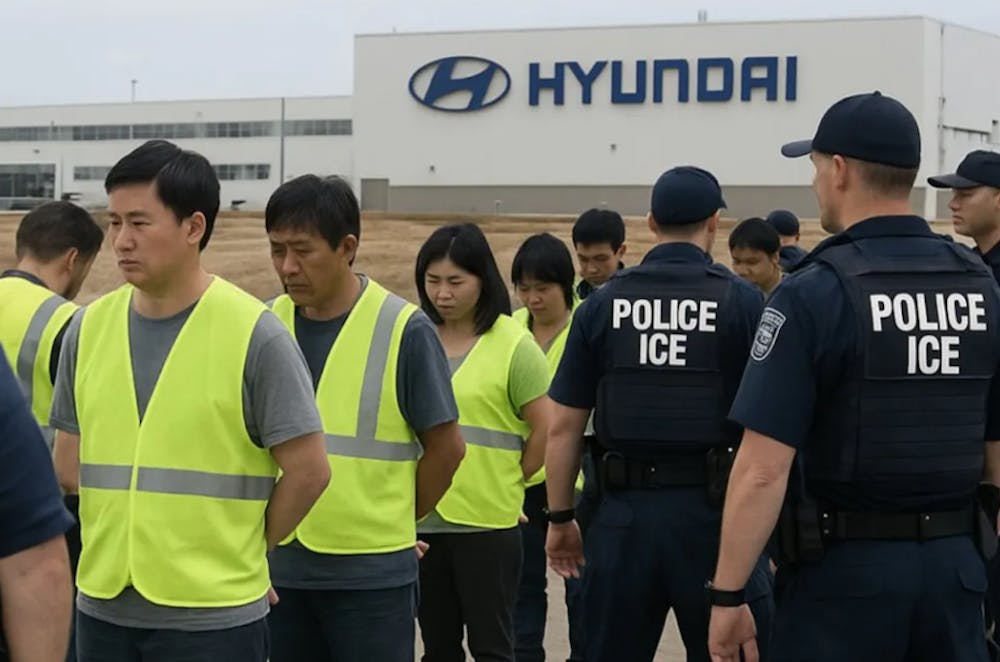
On Sept. 18, Hyundai announced that it would funnel $2.7 billion into the Hyundai Motor Group and LG Energy Solution manufacturing plant in Ellabel, Ga. Just two weeks earlier U.S. Immigration and Customs Enforcement (ICE) raided that same factory. The raid comes in the aftermath of the United States and South Korea summit where both parties negotiated a nearly $150 billion industry trade deal.
During the raid at the Hyundai factory, United States immigration authorities detained 475 people at the plant due to allegations of "unlawful employment practices and other serious federal crimes." Back in February, The Emory Wheel Editorial Board wrote about the threat of ICE to our nation’s diversity, as part of the Trump administration’s overarching agenda to turn the United States into a monolith of national identity. Since then, the situation has only worsened — violations of rights are so commonplace that people have become desensitized to their severity.
In the days following, ICE deported over 300 South Korean nationals whom the agency detained in the raid. U.S. President Donald Trump justified the deportations, citing that the Koreans were “illegal aliens and ICE was just doing its job.” Despite some of the group holding legal status, this did not stop ICE from holding several Korean nationals at gunpoint, detaining them in overcrowded rooms with little-to-no sunlight, and forcing them to drink water from the floor, according to the workers themselves. South Korean news outlets have been quick to point out the sadistic treatment of the South Korean workers, with one saying the U.S. treated the workers as “prisoners of war.” As of Sept. 12, the South Korean workers arrived home to reunions with loved ones and protests for justice in their names.
Through the Trump administration’s brash commitment to the fear-based corralling of immigrants, the United States not only faces forced isolationism but also becomes increasingly inhumane. In mainstream media, initial coverage of the Hyundai plant raid was predominantly focused on the potential economic fallout of this event. In framing the Hyundai ICE raid as a blow to economic diplomacy and foreign policy, opponents of ICE detentions disregard the humanity of those suffering these vile, horrific acts.
In the wake of the raid, reports highlighted how rising tensions between South Korea and the United States have hindered economic and diplomatic relations. Despite South Korea and Hyundai’s investment plans to the Ellabel plant and other U.S. industries, South Korean President Lee Jae Myung said that the ICE raid could have a “considerable impact” on future investments from his country. Georgia lawmakers have stepped into action, but these efforts have been focused on preventing further disruptions to local industries, not on reducing brutal detainments.
While these monetary concerns are valid, centering discourse on the investment impacts of the raid obscures the dystopian reality for immigrants. We are focusing too much on economic implications and sidestepping moral ones. Advocates of immigration reform often highlight how immigrant workers fill labor gaps — especially in manufacturing and construction — and call them the “backbone” of manual labor in this country. However, behind every data point is a life. Detainees face prolonged isolation in remote facilities with limited access to legal counsel and often lack due process. Reports show ICE agents throughout the country using excessive force and denying medical care to detainees, painting a disturbing picture of cruelty and inhumanity.
Focusing on investments, tariffs or labor shortages suggests that detainees only deserve respect if they bolster a bottom line. Our state’s commitment to justice should not hinge on how many cars or naval vessels a worker helps build. This was the largest single-site immigration raid in U.S. history, and it happened 200 miles from Emory. Based on the other massive ICE sweeps in Los Angeles, Boston and Chicago among other cities, this event is not an anomaly — these operations are becoming the norm, with no sign of slowing.
Worse, in a recent shadow docket decision, the Supreme Court quietly lifted two lower courts’ ban on ICE’s “roving patrols.” With no written explanation, the decision essentially allows ICE agents to question and detain people based on markers of “reasonable suspicion,” including their appearance, language, neighborhood or workplace. Race, identity, origin and visa status have become the measure of someone's worth, and anyone who does not appear white is susceptible to being confronted and asked to present their papers.
The Hyundai raid makes it abundantly clear that these events do not merely concern news happening in other states. As residents of metro Atlanta, we are interlaced with the people, culture and industry of rural Georgia — together, we all contribute to the lifeblood of the state. The Hyundai plant atrocity should infuriate the Emory community, not just as fellow residents of Georgia, but as fellow humans.
As citizens, we must not look the other way when such gross misconduct happens under our nose, especially when many members of our community come from immigrant families, including several of us on the Editorial Board. We implore you to look deeper than the headline. Reports of the Hyundai ICE raid have centered around the U.S. regaining its foothold in diplomatic relations with South Korea. However, when our coverage shifts to rectifying national friendships for the purpose of economic gain, we set aside our common humanity. News broadcasts of this detainment have been ultimately facile and have compartmentalized the real issue — human suffering is not an implication.
Organizations like Migrant Equity Southeast work to center the narratives and experiences of communities that the unencumbered cruelty of ICE raids has ripped apart. Standing in support of immigrants during protests, such as the Buford Highway protest highlighted in our previous article, demonstrates to the administration that we will not tolerate violations of our Constitutional rights. We must educate ourselves and our communities on our Fourth Amendment rights and how to respond during ICE encounters to ensure the safety of immigrants — especially as they grow more and more at risk.
The above editorial represents the majority opinion of The Emory Wheel’s Editorial Board. The Editorial Board is composed of Editorial Board Editor Carly Aikens, Mira Krichavsky, Eliana Liporace, Niki Rajani, Josh Rosenblut, and Crystal Zhang.