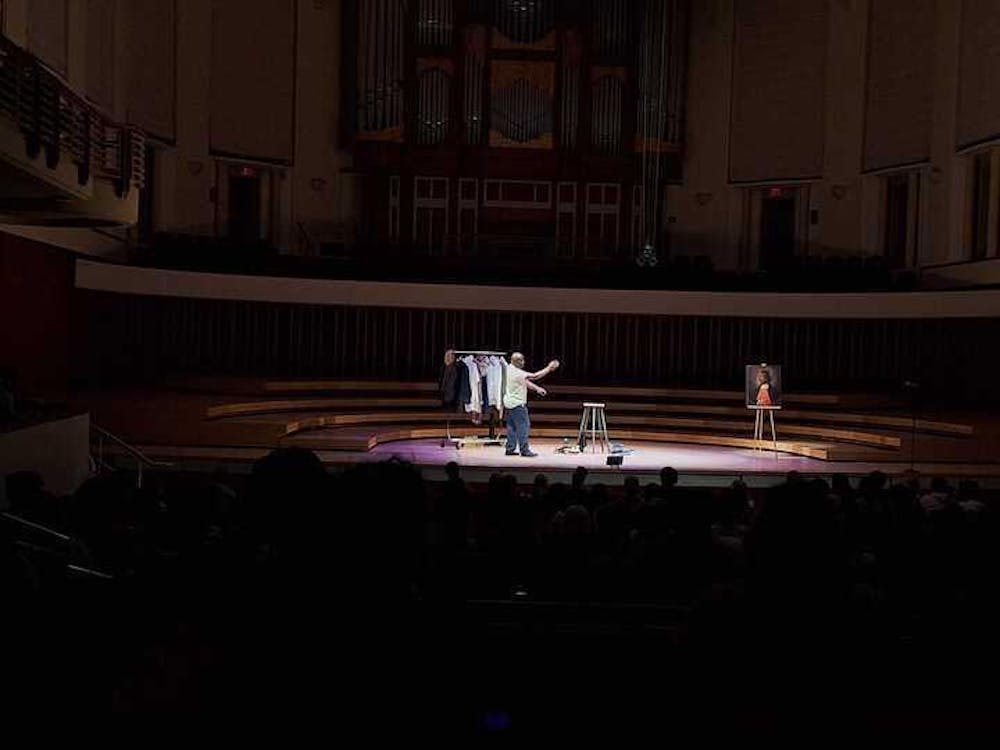
On the left stood a rack of various shirts and jackets, at the center, a stool with books scattered around and on the right a lone, empty easel. Intrigue increased as members of the Emory University community and beyond gathered on Sept. 18, at the Cherry Logan Emerson Concert Hall for an evening with actor Paterson Joseph as he unveiled the secret history of Charles Ignatius Sancho.
Sancho, an enslaved man turned writer, composer and playwright made history as one of the first Black British men to vote, yet his name and legacy are not well known. After learning about Sancho, Joseph worked to publicize the writer’s story through the written and performing arts.
Joseph, known for his roles in “Peep Show” (2003-2015) and “Wonka” (2023), came to campus on Sept. 18 to discuss his debut novel, “The Secret Diaries of Charles Ignatius Sancho: A Novel” (2022), which originated as a self-written and directed one-man show about the historical figure. Joseph performed excerpts of the play and dramatized readings of the diary, infusing his own origin story as an up-and-coming actor in England during the ’80s and ’90s, which paralleled Sancho's inspiring journey in the 18th century. The keynote event highlighted the significance of acknowledging unsung trailblazers like Sancho and how, even today, his story can inspire many.
Growing up, Joseph never felt truly at home. Even after he found his footing in theater at Britain’s Royal Shakespeare Company (RSC), playing Brutus in Julius Caesar and Oswald in King Lear, he still felt like a stranger.
“As far as I'm concerned, I'm a British kid who doesn't belong in Britain,” Joseph said. “I know I don't belong in Britain because everybody tells me that.”
As a 24-year-old Joseph said he stuck out as one of three Black people in the “homogenous” 84 person Stratford-upon-Avon company. The actor said he found himself in a constant state of rejection, grappling with the lack of roles available to him.
It was not until 1999 that Joseph stumbled upon “Black London” (1995) by Gretchen Gerzina, a historical account of the lives of Black people in London during the late 18th to early 19th century. After encountering this work, he started to find his place.
“This is my first intimation that there were any Black people doing anything at all significant in Britain,” Joseph said.
“Black London” also led Joseph to a portrait of Charles Ignatius Sancho, the butler of the Duke of Montague, by Thomas Gainsborough, one of the most important British artists of the 18th century. In the painting, Sancho was not wearing a uniform but fine clothing from Gainsborough’s costume box, with his hand inside his waistcoat, posing like a gentleman of leisure. The portrait enraptured Joseph — it was rare for artists to paint Black men at the time, let alone a famous one.
Joseph noticed that, while Sancho inspired him, no one else was adapting or publicizing his story.
“What a movie, what a play, what a novel that doesn't exist,” Joseph said.
Joseph seized the opportunity to share an unknown tale. From creating “Sancho & Me” (2010), his 70-minute-long one-man show, to publishing “The Secret Diaries of Charles Ignatius Sancho,” Joseph has been committed to sharing Sancho’s life and legacy with the public.
As Joseph walked the audience through Sancho’s story, he acted out chapters from his book, which contains Sancho’s diary entries. Throughout his journey, Sancho recorded his life in his diary, passing down his narrative to future generations. He was born on a slave ship in the Middle Passage and his mother died in childbirth. Sancho was sent to Britain as a servant and escaped at the age of 20, becoming a beloved butler to the Duchess of Montagu, where he remained head of command for many years. The Montagu family saw his spark and willingness to learn, encouraging him to read, compose music and publish his writing. After leaving his position, Sancho became a grocery store owner and, consequently, a property owner.
At the end of the talk, during a Q&A session with Emory students, Joseph discussed how marginalized voices can be shared — a statement that encapsulates his mission to make unknown stories known.
“If we knew their story, we wouldn't dismiss them,” Joseph said.
Joseph’s talk impacted those in the Emory community and beyond. Jara Jacobson (29C) said that Joseph made her reflect on how she can preserve her familial past.
“We often don't think about history,” Jacobson said. “When those people in the audience were talking about their relatives coming over, I thought to myself, ‘I don't know when my relatives came over, I don't know the year.’”
Daniel Keane (25Ox), a big fan of Joseph’s work on “Peep Show,” said he saw an Instagram post about the event two months ago, so he got Joseph’s book and read it.
“He does really bury himself in a character,” Keane said. “I'm not an expert when it comes to acting at all, but he goes full in to any character he's playing.”
Joseph enraptured the crowd with his interwoven story, pleasing the audience with his promise to return and continue the story of Sancho.
Fox Center Director Carla Freeman revealed that the theme for the Fox Center’s annual series of speakers is “Life Story.” Freeman stressed the importance of the series and how the events could positively impact those at Emory.
“Our students come from so many diverse backgrounds and places in the world, and you're in the process of crafting your life story right now,” Freeman said. “What kind of work do you want to do? What kind of contribution do you want to make to the world?”
Freeman said that Joseph was a perfect fit as the first “Life Story” theme for the Fox Center’s series.
“We wanted our kickoff event that was going to happen in September to be something that captured the importance and robustness of a life story that sheds light on more than just a single person, but that opens our eyes to big themes of history, culture, politics, place,” Freeman said.