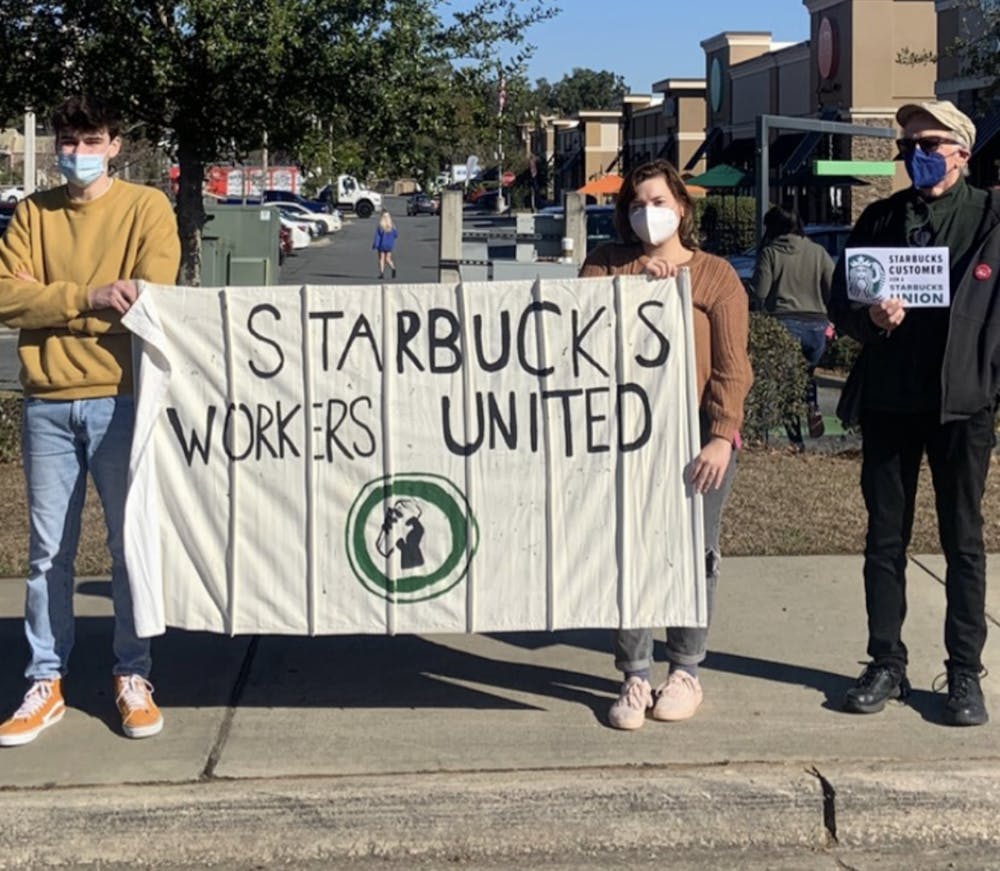
Every morning on campus, there is a line at Starbucks. Students in the store sit with laptops open, earbuds in, waiting for their caffeine fix before class or lab. Behind the counter, baristas move quickly, calling out names, steaming milk and juggling endless orders under pressure, all while smiling through exhaustion. For most customers, this daily exchange lasts less than a minute. But, for the workers making coffee, these activities are part of a much larger fight that has been brewing for years.
Since 2021, over 1,000 baristas from more than 640 Starbucks stores across the country have voted to unionize under Starbucks Workers United (SBWU). These workers are not asking for much, just the basics that should come with any job: living wages that actually cover rent and groceries, predictable scheduling so people can plan their lives, safe and equitable workplaces free from retaliation and harassment and a seat at the bargaining table.
Despite this massive nationwide mobilization and the modest demands the baristas bring forth, Starbucks has refused to come to an agreement with workers for more than four years. Instead, the company has fired union organizers, stalled negotiations and spent millions on union-busting, all while boasting record profits and maintaining one of the highest CEO-to-worker pay gaps in the United States. This standoff within Starbucks exposes a basic truth about the economic system itself: Bosses will preserve the terms of exploitation long before they will relinquish authority to the people who make their profits possible. SBWU’s fight is a frontline in a broader class struggle that workers at Emory University and across the country contend with every day. The Emory community can no longer ignore this struggle.
Starbucks workers escalated the fight for a fair contract even further on Nov. 5. In stores across the country, SBWU members voted overwhelmingly to authorize a strike on one of Starbucks’ most profitable annual events: Red Cup Day, which takes place on Nov. 13. Red Cup Day, a kickoff of the company’s holiday sales season, is built on record-breaking sales, frenetic labor and intense pressure on baristas. By walking out, workers made clear that the company cannot continue to profit off the holiday rush while refusing to negotiate fair contracts.
It has been four years since the first Starbucks store unionized in Buffalo, N.Y. During that time, Starbucks has improved wages and benefits — such as upping pay, adding credit card tipping and increasing parental leave for all retail workers — while under pressure from workers. But, these gestures fall short of what baristas have been organizing for: Only a binding contract, won through collective power, can secure real and lasting change.
For PhD workers at Emory, this struggle feels familiar. We see the same logic play out in our own jobs. Our labor is essential to keep the University’s teaching and research machine running, yet the institution treats our work as expendable when it comes to pay, security and respect. We, too, have faced rising costs of living that outpace our pay. We, too, learned that when workers demand basic improvements to pay and working conditions, those in power suddenly go deaf. And we, too, have joined our fellow workers in a national wave of unionization, pushing back against the same business models Starbucks uses: ones that depend on underpaid, disempowered workers as the institutions themselves thrive.
Starbucks’ resistance to improve pay or provide stability for its employees mirrors what is happening across the nation’s economy, from universities to hospitals and service counters, where workers are expected to shoulder ever-expanding workloads, endure a chronic power imbalance and remain silent about the conditions that make their jobs untenable. This is why EmoryUnite!, the PhD workers union at Emory, recently passed a resolution standing firmly with SBWU, with a decisive 97% supermajority voting “YES!” to boycott Starbucks and support SBWU’s campaign. Starbucks workers’ courage to organize in one of the most anti-union industries has inspired countless others to build their own unions, from Amazon warehouses to university campuses. SBWU’s “No Contract, No Coffee” campaign is a rallying cry for workers everywhere who are tired of being ignored.
In a public letter to the Starbucks Board of Directors, investors raised alarm about Starbucks’ labor relations and called on the company to “restart negotiations and promptly reach a first contract with Starbucks Workers United (SBWU).” Their letter notes that Starbucks’ labor relations have significantly deteriorated as the company has racked up hundreds of unfair labor practice complaints, and the investors warn that the labor crisis now threatens “long-term shareholder value.” Even those profiting from the company’s success recognize that ignoring employees threatens the company’s bottom line.
Just this week, that mounting pressure forced a significant shift. Starbucks agreed to pay about $35 million to more than 15,000 New York City workers after an investigation found that the company denied stable schedules and arbitrarily cut hours. A testament to the power of collective action, this settlement comes amid SBWU’s nationwide unfair labor practice strike, which has drawn politicians to the picket lines alongside baristas. These developments make clear that Starbucks’ labor crisis is no longer a dispute contained within individual stores, rather, it has become a national flashpoint. However, while this settlement is a major concession, it still falls short of workers’ core demands. The pressure must continue until Starbucks commits to a fair and enforceable contract so that such scheduling abuses and broader labor rights violations are not repeated.
When even investors begin echoing workers’ demands, and regulators, shareholders, consumers, and workers are all converging on a single message, it is clear that the situation has arrived at a breaking point. The message to Starbucks is now palpable: The era of unchecked corporate intransigence is ending. The question is no longer whether the company can reach a fair contract, but whether it will choose negotiation over escalation before this crisis engulfs the company itself.
The movement Starbucks workers have led, from their historic union drive in 2021 to their nationwide strike escalation, is about power: who has it, who does not and what happens when workers decide to take it back. It is about the right to a voice on the job and the simple, yet unshakeable, belief that the people who make a workplace function should also shape its future. Starbucks workers have shown us that organizing is possible in industries built on turnover and precarity, in which corporations expect exhaustion and demoralization to keep people quiet. Their success has inspired graduate workers, restaurant servers, nurses and countless other sectors of workers who see themselves reflected in the struggle for dignity. At its core, the movement asserts an idea that every worker should understand, that we create the value our employer survives on, so we should have a say in how the value is used.
EmoryUnite! has committed to supporting SBWU in concrete ways. Many of our members are participating in the “No Contract, No Coffee” campaign, boycotting all Starbucks products and stores until the company negotiates a fair contract for its workers. We are respecting and upholding picket lines at all Starbucks locations, refusing to cross them under any circumstances, and we will join and publicize those lines. We are also forming a working group within EmoryUnite! to coordinate ongoing solidarity work for Starbucks employees across the country. We call on the broader Emory community to take up these actions alongside us and boycott Starbucks until the Starbucks Board of Directors returns to the bargaining table and meets SBWU’s demands.
As students, workers and community members who recognize this struggle, we have a choice to treat solidarity as a slogan or live it out in practice. Starbucks workers have already proven that when workers stand together, they cannot be ignored. It is time we meet the call they have courageously put before us — Emory students and student workers must be bold, be brave and make history by joining the movement: No Contract, No Coffee!
Tasfia Jahangir serves as co-chair, and Federico Sánchez Vargas serves on the Labor Management Committee of EmoryUnite!, the PhD workers’ union at Emory University. EmoryUnite! is part of Service Employees International Union (SEIU)/ Workers United, Southern Region (Local 29). SEIU represents over 2 million members across the United States and Canada in industries ranging from healthcare and public services to higher education.