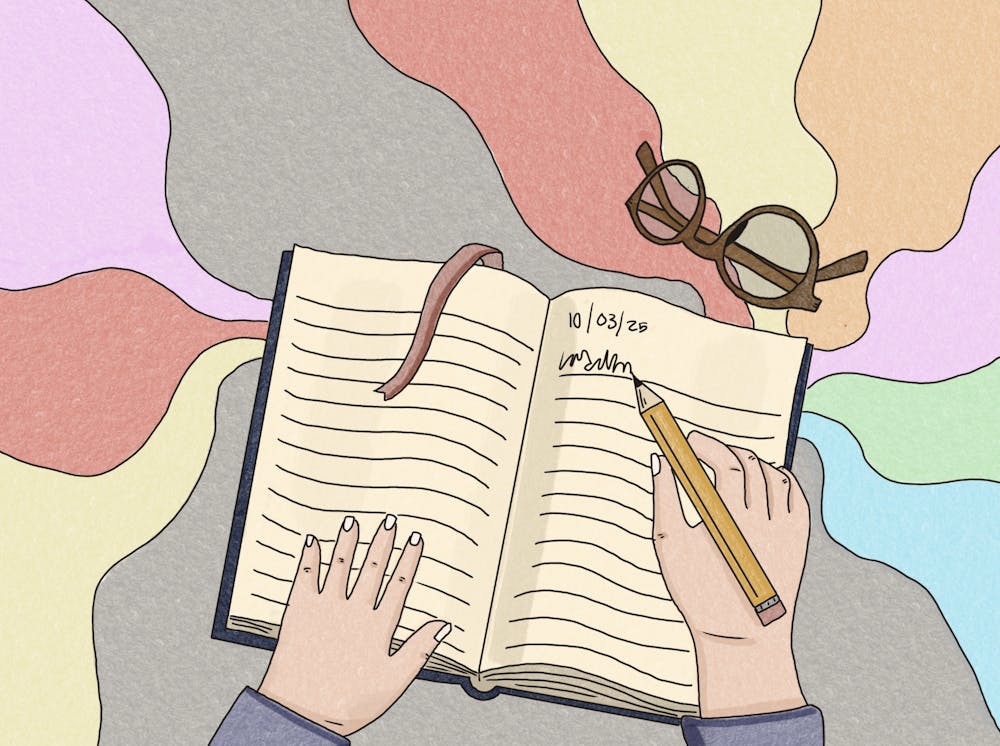
At least once a week on the fourth floor of Raoul Hall, you can hear me click-clacking away on my laptop well past midnight. I am not writing an essay for my religion class, nor am I typing up microeconomics notes. While shuffling songs from my beloved “J’s Journaling Playlist,” instead, I am spending 20 minutes typing up a journal entry — or as I call it, a late-night thought.
There is no better flow state I can reach than when I write a late-night thought. That is the beauty of freewriting without form or structure: It reduces writing anxiety. The product does not need to be grammatically correct nor logical. It simply flows from one thought to the next. And, in that process, freewriting becomes less about the act of writing and more about understanding yourself — it’s a way to think honestly, feel deeply and express with clarity and freedom.
I began journaling as a high school junior studying abroad in Zaragoza, Spain. During the plane ride over the Atlantic Ocean, I made a goal for myself in the hope of documenting my journey: Write one journal entry every night capturing my day-to-day life and thoughts. Shockingly, I kept my promise, resulting in a 51-page Google document complete with more than 100 entries from my time in Spain. While the length of what I wrote was impressive, more important was how freewriting helped me process my days, build empathy for myself and others and sharpen how I communicate.
When I returned home, I stopped journaling my daily life, but I continued to write when I needed to vent. Every once in a while, when thoughts swirled in my head and I could not fall asleep, I would open my “Free Writes” document and begin writing. I had no outline, no point to make and no sense of coherence. I just wrote until I felt satisfied.
Eventually, I decided to publish my private writing. I created a Snapchat story called “late-night thoughts” to post my writing every week or two. Each entry was only titled with the date and hour in military time, a tradition I started in Spain. I write about whatever is on my mind, including current events, my search for purpose or anything that was bugging me that night.
During first-year orientation at Emory University, for instance, I wrote about wanting to act less superficially.
“With the start of September I find myself pausing my social crusade and figuring out who I will wave to on the way to class and who I’ll actually spend time with,” I wrote. “But in doing so, I find more and more new people whom I want to know and become friends with. And that’s what is so great about college; the period of meeting new people doesn’t really ever end.”
Writing this full entry was hard. I was exposing an insecurity of mine to a handful of people I had only known for a week. Even though my writing was not polished or profound, it was real. When I posted it, the new friends I had just made instantly felt closer. One of my friends privately messaged me after he read my entry, asking who wrote it — he could not believe it was my own writing. Sharing personal thoughts did more than just let friends see my inner thoughts. Journaling also provided a welcoming audience to whom I could display my work.
I will admit that posting deep and sensitive writing on social media is not easy. I still get nervous that my friends will think I’m weird, crazy or both. Instead, they tell me they look forward to my posts. My friends say my writing captures emotions they have felt but have never put into words. My writing is raw, and it is undoubtedly mine. And, when I slip into that flow state and get a rush of that indescribable feeling of joy and euphoria, that’s what keeps me going.
Freewriting has changed my life. I have become more empathetic, understanding and forgiving of myself. Unexpectedly, what began as a solitary ritual has grown into a small community of people drawn to my honesty. In a few cases, some readers of my writing have started writing for themselves as well. I have even started posting some of my friends’ writing to my page.
If you find yourself overcome with stress and need a way to internalize and understand your thoughts and emotions, I urge you to try journaling for yourself. Here’s how you should approach the art: When you get a few minutes of free time — which admittedly is never, but try your best — find a quiet place and set a 15-minute timer. Use whatever medium works best and in that time, try just to write. Don’t think, just write. It can be hard at first, with no prompt or end goal in mind. You may not succeed initially or be happy with the results, but that is okay. Freewriting is hard. It took me years of practice to get to where I am now. After all, the more times you try it, the better you will get.
Freewriting does not have to be about what you ate for lunch or how much you procrastinated today. Freewriting can be raw, emotional and meaningful. It can be messy. That’s what makes it liberating. In a world that rarely slows down, a blank page at midnight is one of the simplest and most transformative gifts you can give yourself.
Contact Joshua Glazer at joshua.glazer@emory.edu