
The Foundation for Individual Rights and Expression (FIRE) has ranked Emory University No. 67 out of 257 U.S. colleges in the 2026 College Free Speech Rankings. Emory’s ranking soared up by 87 spots from 2025, with its score rising from 44.07 to 61.3 out of 100. FIRE also gave the University’s policies a “green light” rating, indicating that the school's policies do not seriously threaten free speech.
The FIRE rankings assess colleges’ commitment to upholding free speech by conducting student surveys, reviewing campus policies and analyzing speech-related controversies. FIRE's sixth annual report included survey responses from 68,510 students nationwide about their comfort expressing dissent, tolerance of controversial speakers and self-censorship around peers and faculty.
The survey results displayed mixed opinions about how comfortable students felt expressing their views. Of the 281 Emory students who responded to the survey, 41% reported self-censoring in conversations with other students on campus at least once a month and 19% reported self-censoring at least twice in a week.
The Emory student respondents were also largely opposed to controversial speech on campus. Of the Emory students surveyed, 32% said it is acceptable to shout down a speaker to prevent them from speaking, with another 39% of respondents who reported that it was acceptable in rare cases. Another question revealed that 14% of Emory students believe it is sometimes acceptable to use violence to prevent a person from speaking, and a further 16% think it is acceptable in rare cases.
Professor of Law and University Senate Committee for Open Expression Chair Sasha Volokh said that student self-censorship can be harmful if it inhibits general discussion at Emory.
“It’s not necessarily, as such, wrong for people to feel that they need to self-censor, but it is a problem if overall it means that you don’t have the robust discussion on campuses, which you should,” Volokh said. “If anything, universities are the top place where that ought to be happening.”
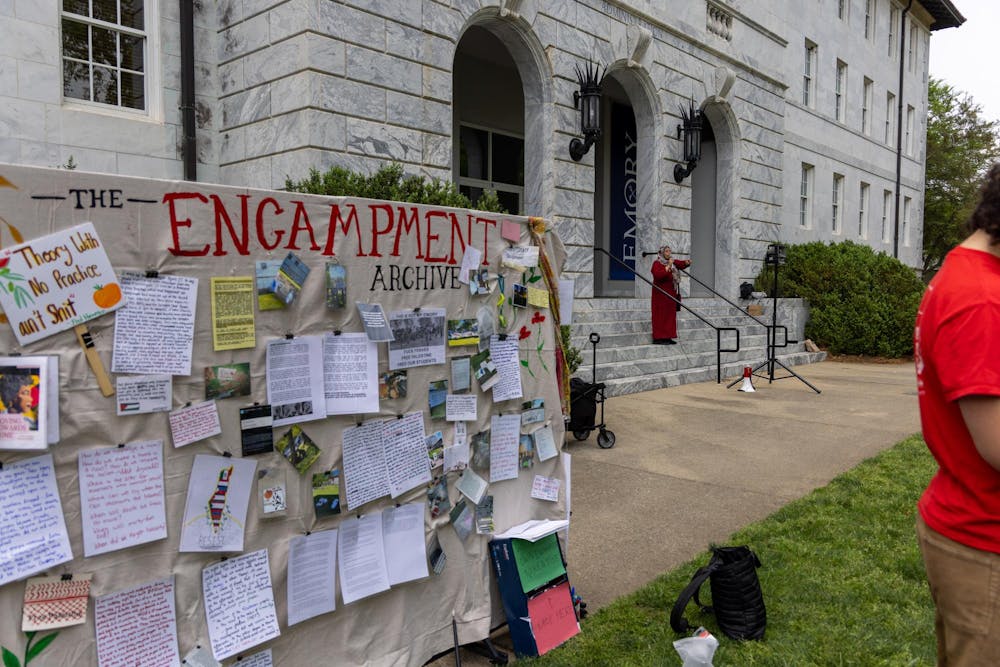
In recent years, the University has been the subject of various free speech debates. In April 2024, police arrested 28 people, including 20 Emory community members, during pro-Palestine protests on the Quadrangle. FIRE has also been involved in a free speech controversy when in April 2025, the organization sent a letter to former University President and current Chancellor Gregory Fenves on behalf of Kappa Sigma, demanding that the university lift its ban on the fraternity’s social functions and chapter meetings.
Emory announced an updated Open Expression Policy in March that outlined content-neutral boundaries related to the time and place in which demonstrations can occur. The new policy upholds that Emory community members and visitors have the same rights under the policy. These clarifications were designed to balance community members’ rights to expression with campus safety.
University Senate President and Chair of the Philosophy Department Noëlle McAfee emphasized the importance of fostering a University environment that does not punish free speech.
“We need to call out and call on our University leaders to be able to listen and tolerate and not succumb to political pressure,” McAfee said.
FIRE’s report also noted that Emory has not adopted the Chicago Statement for free speech or officially committed to institutional neutrality. Both are clauses that affirm a university’s support for the rights to all speech and have been adopted by peer institutions including Vanderbilt University, Johns Hopkins University and Northwestern University.
Raleigh Maxwell (28C), treasurer of Young Democrats of Emory, noted that students involved in campus organizations may suppress speech to avoid losing key resources.
“A registered student organization is reliant on the school for things like funding, for even being chartered,” Maxwell said. “The students who are members of those organizations can sometimes feel more reluctant to exercise fully their free speech.”
Maxwell reiterated that student perception of free speech may improve if the University further communicates with students about the Open Expression Policy.
“The best way the University can apply their rules and communicate their rules better is always involving the students,” Maxwell said. “It always needs to involve lots of communication with the students, not just emails.”
Looking forward, McAfee expressed hope that the University will do more to ensure students feel comfortable expressing their views.
“We have an excellent policy, and we should probably, as a community, learn how to live up to it,” McAfee said.


