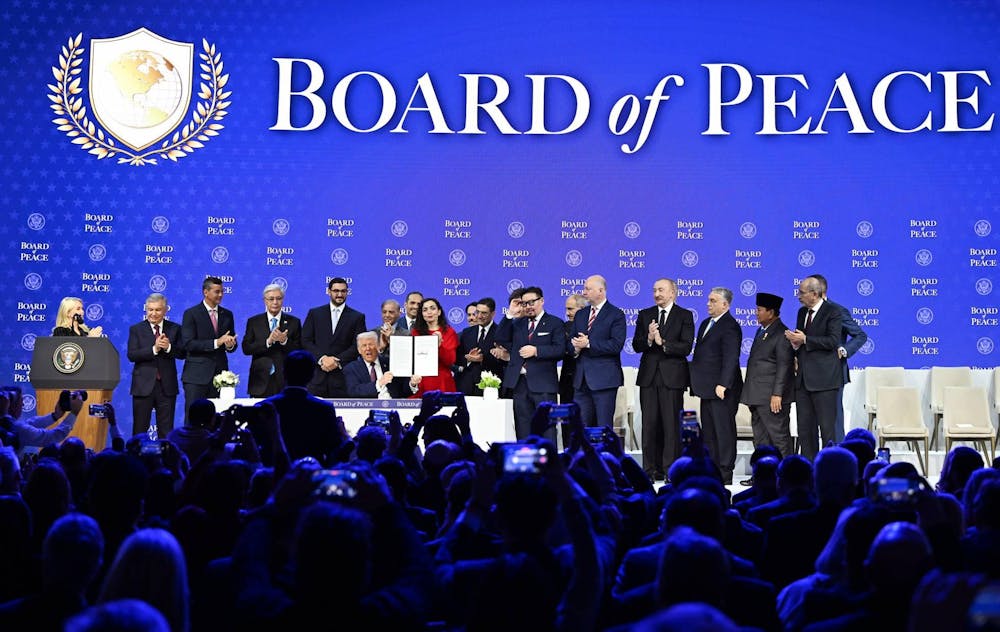
World leaders descended upon the alpine town of Davos, Switzerland on Jan. 19 for the annual meeting of the World Economic Forum, with U.S. President Donald Trump among them. In the weeks leading up to the conference, Trump levied a myriad of threats to the United States’ European allies over his desire to control the Danish territory of Greenland, ranging from tariffs to outright invasion. Prior to his Greenland obsession, the U.S. military captured Venezuelan President Nicolás Maduro in a highly controversial violation of international sovereignty.
Despite these recent examples of flouting international law, Trump has dubbed himself the “President of Peace” and unveiled a new intergovernmental organization, the Board of Peace. Originally developed to negotiate a peaceful solution to the war in Gaza, the Board’s scope has since expanded to a much more global mandate. Many of the United States’ closest allies see the board as a threat to the already limited power of the United Nations (U.N.). Even Trump himself floated the idea that the board could perhaps replace the U.N., which has served as the backbone of the post-war global order since the mid-20th century. But, the Board of Peace is not diplomacy — it is nothing but an exclusive country club for world leaders who are willing to cozy up to Trump and his authoritarian tendencies. Trump's desire to unilaterally command the world order with his word alone is inherently anti-peace. The Board of Peace is significantly undermining Americans’ representation abroad as well as the United States' place and reputation among its allies on the world stage, and, despite all the conflict and fear within our own borders, its creation should not go unnoticed.
Following decades of violent global conflict, world leaders founded the U.N. in 1945 with the goal of maintaining international peace and security by fostering international collaboration. Years later, the U.N. has largely followed through on that objective, facilitating peace settlements and ceasefires for numerous global conflicts. However, Trump has frequently criticized the organization’s limited efficacy and authority. In a speech before the U.N. General Assembly in September 2025, Trump, who has positioned himself at the helm of anti-U.N. rhetoric, delivered a scathing review of the organization’s peacebuilding efforts, claiming that “empty words don't solve war.” He then touted his own alleged accomplishments, asserting that he had ended seven wars in the first six months of his second term, a claim that foreign policy experts say lacks significant context. Whether or not the claims are valid, it is clear that Trump believes he alone can solve global conflicts, and the Board of Peace is an extension of this belief.
For all the U.N.’s faults and failures, it remains a primarily democratic institution. That is to say, there is not one person in charge. According to the Board of Peace charter, Trump will serve as chairman with significant power to govern its expansion and direction — a power Trump has already exercised. Trump revoked Canada’s invitation to the board on Jan. 23 following Canadian Prime Minister Mark Carney’s remarks in Davos that called out Trump’s destruction of the world order. Trump is certainly not afraid to put himself in charge and will clearly exercise the power chartered to him to the fullest. His power over the organization and his willingness to use it as a tool for revenge are entirely in opposition to the aims of a board meant to facilitate international peace and cooperation.
This inordinate power is troubling. Despite his alleged peacebuilding prowess, Trump’s foreign policy paints a different picture — one that the president’s recent enchantment with Greenland illustrates quite clearly. He claimed that Greenland must be American territory to protect it from Russian aggression, yet he simultaneously threatened to take it by force: a clear aggressive violation of international peace and sovereignty. Trump has also repeatedly resorted to violent use of American firepower to enact his so-called peaceful agenda. His second term has seen airstrikes in Nigeria, Somalia, Yemen, Iran, Iraq, Syria and Venezuela, as well as against boats in international waters in the Caribbean Sea and East Pacific Ocean. Trump may claim that he wants peace, but his reputation of invasion and conflict suggests a more geopolitical motivation: power. Trump’s need for power and influence — and his overuse of violence to get it — have already hurt the United States’ reputation among its allies, and failure to keep the president in check risks significant further harm.
What remains clear is that Trump should not be king of the world, and we must not overlook his imperialistic power grabs disguised as benevolent peace efforts. For the average American, negotiations over faraway conflicts can seem, in fact, far away. While beliefs surrounding the importance of foreign policy are on the rise, only 16% of young, college-educated Americans reported prioritizing foreign policy in their 2024 election vote, according to a Dec. 2024 poll. With so many immigration crackdowns, protests and violence unfolding around the nation, it is unsurprising that Americans’ attention is elsewhere. Trump’s second term has rained down a firestorm of domestic issues, but his actions on the world stage are just as important as his stateside drama and deserve the same attention from the American public.
Now more than ever, Americans must keep an eye on Trump’s international behavior. This ultimately comes down to research and discourse. Reading perspectives of American actions from foreign news sources is a great way to stay informed while eliminating the distraction of domestic events and interests, but local and national American media outlets also frequently cover the government's foreign presence. Emory students must read diverse stories, form their own opinions and have meaningful conversations and informed debates to fully understand the true motivations of the U.S. government’s actions abroad. Our representation and reputation in the world are at stake. Americans must see through the smokescreen and ask themselves what peace in the world really means — because an exclusive Board of Peace Trump utilizes as a unilateral tool for vengeance against international political rivals certainly falls short.
Contact Will Carraway at will.carraway@emory.edu