
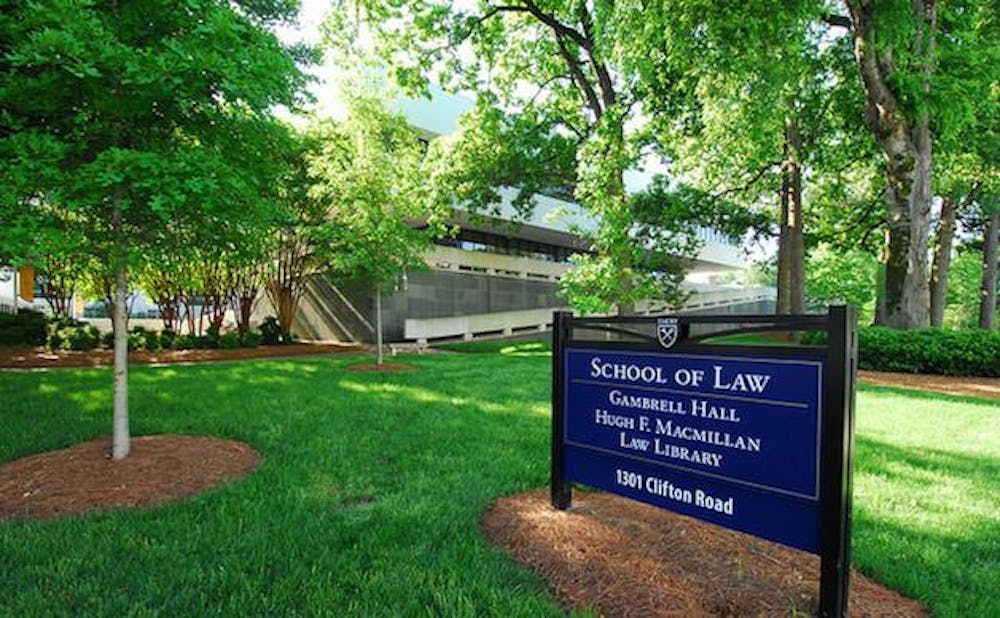
Emory University School of Law hosted its 10th annual Martin Luther King Jr. lecture event in Gambrell Hall titled “Beyond Service Hours: From Transactional to Transformative Engagement” on Jan. 15. CEO, Executive Director and Founder of Wish for WASH Jasmine Burton (22B) delivered the keynote address, and Careshia Moore, attorney and former president and CEO of Usher’s New Look, and James Roland (18L, 23T), senior director of Emory’s Center for Civic and Community Engagement joined Burton as panelists. The speakers discussed the significance of service in King’s work and ways in which the Emory community can carry his legacy forward.
A. Kenyatta Greer, Emory Law School’s Senior Director of Communication and Director of Belonging and Community Council, opened the event by comparing acts of service in the modern day to those during King’s time. She emphasized how service today is often leveraged for transactional purposes and that the purpose of service has been diluted to acts of self-service.
“Dr. King did not call for service as a hobby,” Greer said. “He called for a revolution of values. Our purpose today is to challenge the transactional model.”
Greer then introduced Burton, who focused on the relationship between service and community. According to Burton, engaging in service can help people develop empathy and responsibility, as well as enlighten people to realities and communities that are different from their own.
“What I’ve learned over time is that service is not something to move past or to accomplish, it’s something to grow into,” Burton said. “When service is allowed to deepen, it begins to raise new questions. Questions about why needs persist, how systems were designed, and what it would take to stay long enough to change the conditions, rather than just respond to them.”
Following Burton’s address, Greer opened the panel by asking the panelists about the importance of celebrating Emory King Week.
“When I think about King Week, I think about the need to honor history, but also to get to a better future, and so we have to be that bridge,” Roland said. “Each and every one of us has an opportunity to be a bridge to the past that connects to a better future.”
During the panel, Burton discussed civic engagement and highlighted how young people in Atlanta are engaging with democracy and community-building.
“What I know to be true about Atlanta, and just humanity in general, is we’re resilient, we are capable, and we can build together,” Burton said. “These things are possible to move through the challenges of the moment.”
After the panel, in an interview with The Emory Wheel, Moore said she envisioned a future where people move past transactional work. To get there, Moore said we need systemic reform and change that address root causes, not just the consequences of oppression in society.
“Helping to inspire folks to envision a better future, and what that will take in terms of us moving from transactional work, which exists in abundance, but now recognizing that there is system change that needs to take place,” Moore said.
Moore hopes King’s legacy will continue to inspire people to engage in tangible forms of service and become involved with their communities. She urged the Emory community to learn about King’s legacy and apply his teachings in their future endeavors.
“With this being the 10th annual event, first of all continuing it, continuing to bring in the voices of those who are doing the work in the community to inspire, but also to partner with students and faculty and the community to continue to extend the work that we're all doing,” Moore said.


