
This review contains spoilers.
For years, Disney has struggled to produce quality original films, opting instead to produce mediocre live-action remakes, resulting in declining theatrical performance. “Zootopia 2,” the sequel to Disney’s zany animated film “Zootopia” (2016), released on Nov. 26 with hopes that it might save Disney from a tide of middling performances. So far, “Zootopia 2” has reached a $156 million box office opening in the United States, with a Black Friday gross of $38.5 million, only being surpassed by Moana 2 .
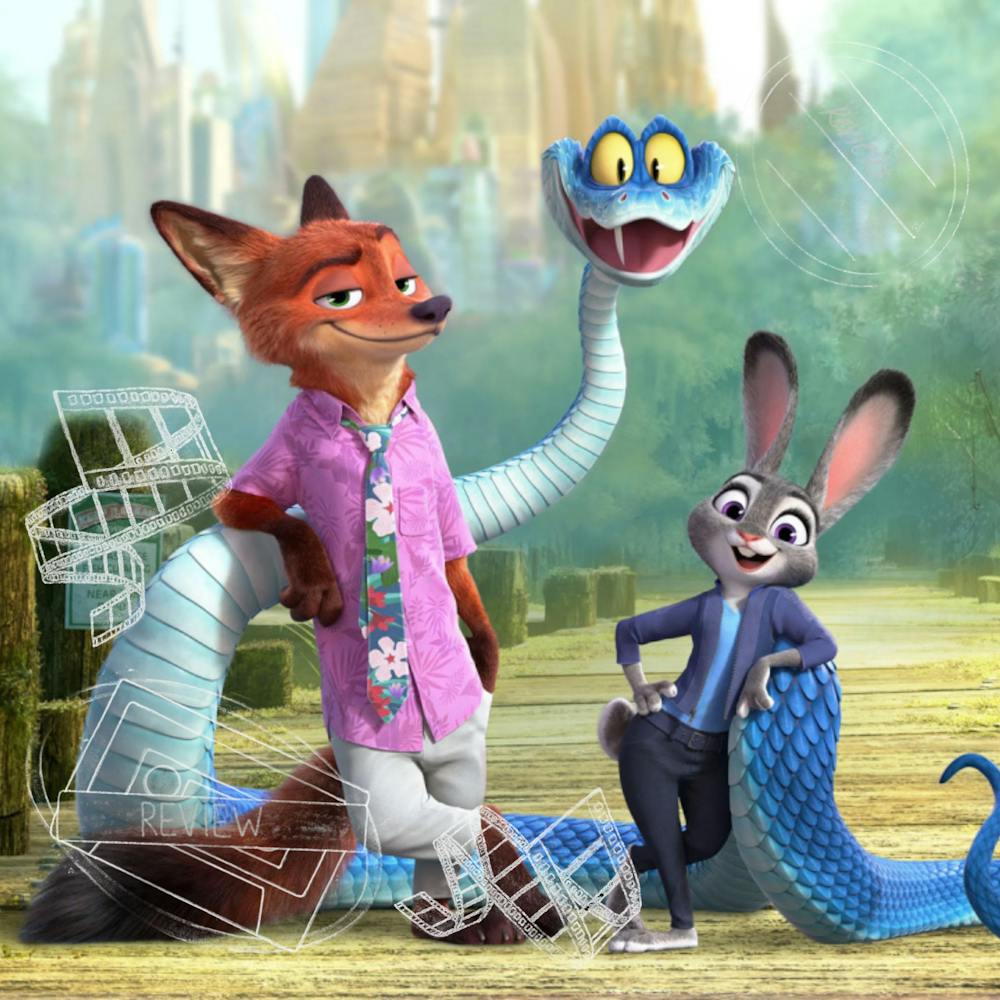
The “Zootopia” franchise follows the dynamic police duo, the Red Fox Nick Wilde (Jason Bateman) and Rabbit Judy Hopps (Ginnifer Goodwin), as they fight injustice in the fictional city of Zootopia, where a variety of anthropomorphic animals live together. From mice to polar bears, each species lives in specialized districts with sizes and weather adjusted to their primary needs, and both films center around bridging the tension between species.
Whereas the first “Zootopia” discussed racism and stereotyping through the analogy of the predator-prey dynamic, “Zootopia 2” discusses class issues and government corruption through a clan of wealthy mammals and a family of snakes, a microcosm for how industrialists utilize, appropriate and then discard the marginalized and less fortunate’s innovation. While narrower in focus than the original, “Zootopia 2” elaborates on prejudice and power relations as compellingly as it can without undoing its fundamental core identity as a kids’ movie.
In “Zootopia 2,” Judy and Nick try to find who stole the diary of Ebenezer Lynxley, a real estate developer and founder of the Zootopia district, Tundratown. The journal describes how, more than a century ago, he allegedly designed the weather infrastructure of Zootopia to allow animals from different biomes to live together. This added storytelling differentiates the sequel from the original film, focusing on world-building and history, a surprisingly refined addition that provokes intrigue.
Henceforth, a conspiracy theorist beaver, Nibbles Maplestick (Fortune Feimster), helps the police pair track down their foes and explains several parts of Zootopia’s history. While eccentric and annoying, she knows Zootopia’s true history, assisting Nick and Judy in finding their ancestor's diary. Her unique beaver traits, such as her ability to chew through wood, help Nick escape from jail. Nibbles provides balance, knowing when to bring in a silly story about koalas and when to be serious and helpful.
The film’s pacing is excellent, slowly building each twist, adventure or exposition toward the climax. Everything that the film introduces ultimately serves a narrative or thematic purpose. This structure reinforces the film's focus on gentrification, appropriation and classism, expanding on the first movie’s message of prejudice by illustrating the myriad of ways oppression can subtly exist between animals beyond blatant and violent racism. Whereas the first “Zootopia” uses a villainous sheep to demonstrate that not all prey are innocent and Nick’s character to prove that predators can be heroes, the second film explains the exact mechanism through which wealthy capitalists, like the Lynxleys, who are Canadian Lynxes, drive up prejudice against minorities, evicting them from their neighborhoods while also taking credit for their achievements. “Zootopia 2” is rich and complex; yet, it must ultimately simplify its contents for a younger audience through clear flashbacks and direct exposition.
While the flashback format fails in engaging mature viewers, the sophisticated yet subtle humor allows both young adults and children to enjoy the film. “Zootopia 2” includes many animal-related puns relating to more mature scenarios, such as the “Burning Mammal” festival, a bar raid of animals meant to represent Hispanic individuals, and even self-aware jokes directed at Disney, poking fun at their repetitive plot points. While the first “Zootopia” did contain references to films such as “The Godfather” (1972), the sheer increase in quantity and alignment with contemporary culture and trends made the sequel’s quips more engaging and refreshing.
While the humor shines, the relationship between Nick and Judy remains underdeveloped. Throughout the film, their partnership is strange both because of their circumstances and their undeniable chemistry. At the film’s climax, the pair reiterates their care for one another and apologizes for not listening enough, but they do not acknowledge their romantic potential. The duo focuses their emotional confession on admitting their failures as professional partners, a missed opportunity to resolve their simmering will-they-won’t-they dynamic. Nibbles’ entrance disrupts the moment, making the already strange moment even weirder as she shares a quirky witticism about oversharing, causing complete tonal whiplash.
However, the post-credit scenes add more fuel to the pair's chemistry. Judy keeps her recording pen and reveals Nick openly declaring that he loves her — as a partner. The segments where Nick and Judy discuss their dynamic feel out of place in the context of a well-crafted film with a consistent plot. While other organic elements of the movie, such Pawbert Lynxley’s (Andy Samberg) betrayal or Mayor Winddancer’s (Patrick Warburton) desire to be a real hero, get resolutions, Nick and Judy’s relationship remains just as open-ended at the end as it was at the start.
The jokes, themes and structure shine in “Zootopia 2.” With a runtime of approximately 108 minutes, the film neither overstays its welcome nor underdelivers. While Judy and Nick’s relationship needs more development, it is not, by any means, a fatal flaw. Perhaps, this film will quell the cries that the era of good original movies coming out from Disney is over, demonstrating that clever, well-crafted and excellent cartoons that break box office records are far from a remnant of the past.


