
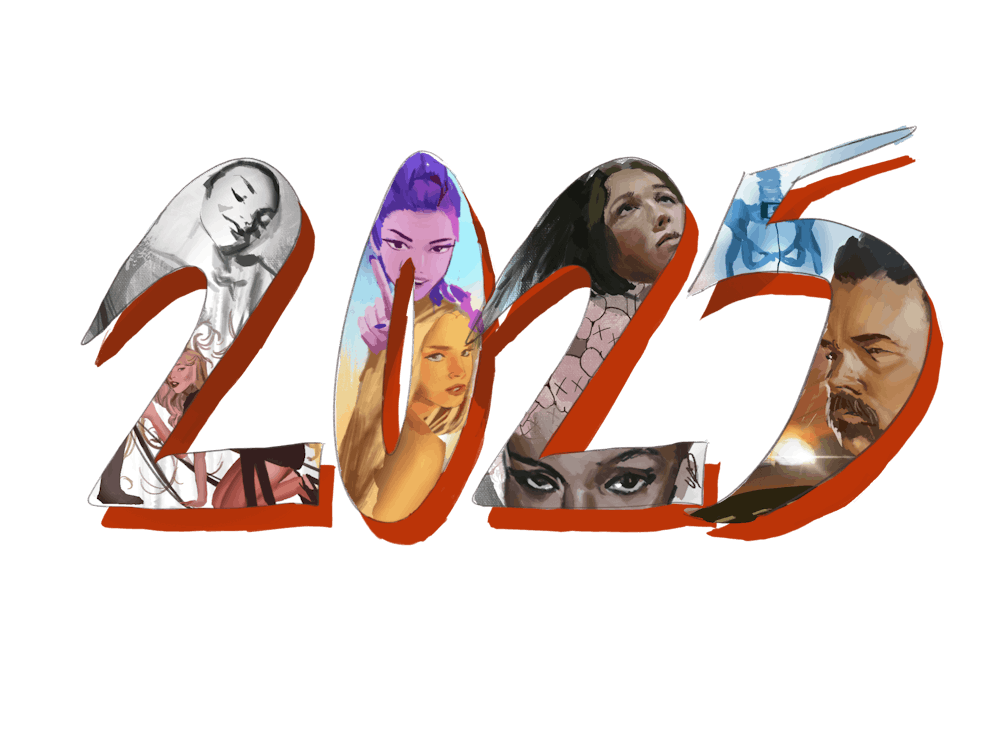
As 2026 beckons, the new year promises new adventures, memories and art. Before January sweeps 2025 under the rug, the Arts & Life staff reflects on our favorite albums and films of the past 12 months. From musical celebrations of femininity to cinematic high-speed car chases, these selections reflect the varied cultural contents of the past year and the art we will keep with us as the New Year’s Eve clock strikes midnight.
‘The Art of Loving’ by Olivia Dean
Although a coveted award, the Grammy’s “Best New Artist” can be a blessing or a curse. Since its inception in 1959, the category has seen stars rise and others promptly fall, from Billie Eilish to Esperanza Spalding. Of the 2026 nominees, Olivia Dean stands out as a clear winner — and the best-suited to avoid the award’s malicious mythology.
Dean’s sophomore album, “The Art of Loving,” arrived in September but remains a welcome earworm months later. Through keen language and a creative blend of pop, soul and R&B influences, the British singer-songwriter delivered a timeless album like Adele’s “21” (2011) or Amy Winehouse's “Back to Black” (2006). Across 12 tracks, Dean revels in her femininity, accepts affection in all forms and criticizes hypocritical lovers. Album highlights include the confident “Man I Need,” the flirtatious “So Easy (To Fall in Love)” and the fierce “Let Alone The One You Love.” The latter includes striking lyrics, which showcase the passion and power of Dean’s voice. “And, if you knew me at all / You wouldn’t try to keep me small / Who would do that to a friend, let alone the one you love?” Dean questions. From opening Sabrina Carpenter’s Short n’ Sweet Tour and making her “Saturday Night Live” (1975-) debut, Dean only needs one New Year’s resolution: keep it coming.
— Catherine Goodman, Managing Editor
‘If I Had Legs I’d Kick You’ by Mary Bronstein
After a 17-year hiatus, Mary Bronstein returned to the silver screen with “If I Had Legs I’d Kick You,” a tour de force of a film that left audiences holding their breath on the edge of their seats. The film is based on Bronstein’s time supporting her young daughter, Kate (Ella Beatty), and while not an autobiography, is “emotionally true,” according to Bronstein. As Linda, Rose Byrne delivers an amazing performance, complete with many close-ups and moments devoid of anything besides Byrne portraying a mother descending into madness. Throughout the nearly two-hour film, Byrne’s performances, combined with Bronstein’s direction, take viewers through a whirlwind of emotions, showing how Linda functions as a single mom, caring for her daughter on a feeding tube, while constantly on the verge of a breakdown.
At the beginning of the film, a hole bursts in Linda’s roof, which the film contrasts with the hole in Kate's stomach where a feeding tube is helping Kate maintain her weight. As the film moves on and Kate’s situation worsens, these two holes come to dominate Linda’s life. The movie climaxes when Linda finally breaks with reality, abandoning Kate at a motel to investigate the hole in her roof and is transported into a metaphysical realm. Returning to Kate, Linda pulls her feeding tube out, believing she is cured. Separated from reality, Linda’s husband Charles (Christian Slater), who has been off-screen the entire movie working on a ship, confronts her, causing Linda to run toward the ocean, away from all of her problems. In this moment, the audience and Linda share the same perspective, with tension busting, Bronstein ends the film with a climax that leaves viewers speechless, unable to know what parts of the film were in Linda’s head.
— Spencer Friedland, Editor-in-Chief
‘Addison’ by Addison Rae
Over the past few years, TikTok stars have shown the world that they can be more than amateur choreographers — some can sing catchy music too. Addison Rae, a TikTok dance sensation with her fair share of viral gaffs, belonged to this same brand of lip syncers-turned-popstars. However, with a small, mighty and growing fandom, Rae is now a Grammy-nominated artist sharing stories of gilded fame, unrequited love and childhood trauma through an idiosyncratic dance-pop lens.
On her self-titled debut album, “Addison,” Rae channels warm colors and whistle tones to portray the contrasting nature of fleeting youth and everlasting beauty. Throughout her album, listeners fall into the mythical, late-night rendezvous of “Diet Pepsi” or drive through the liberating, vulnerable sunset soundscape of “Summer Forever.”
Rae reveals a deep, intimate side to her artistry on this record. She sings about the loneliness of glamour and attention on “Fame is a Gun” and captures the nostalgia of youth on the euphoric “Times Like These.” And on “Headphones On,” one of the album’s standout tracks, Rae confronts her past self. In this climactic ballad, she explains how she found peace amid adversity: “Life's no fun through clear waters / You can't fix what has already been broken / You just have to surrender to the moment.” To anyone who tries to say Addison Rae is a talentless TikTok star, I will just put my headphones on.
— Jacob Muscolino, News Editor
‘Let God Sort Em Out’ by Clipse
I first listened to this album the day it came out while riding a train through New England. For those 40 minutes and 52 seconds, I was the closest I had ever felt to being a drug dealer. This record from the seasoned rap duo, consisting of siblings Pusha T and Malice, begins with the John Legend-backed “The Birds Don’t Sing,” a touching tribute and apology to the duo’s parents. From that point on, it is all gas and no brakes for Clipse. The following three songs make up the best run of the album, delivering nasty instrumentals to complementary, stellar features from Tyler, The Creator and Kendrick Lamar. This stretch culminates with the fourth track, “So Be It,” which I have dubbed the coke anthem of the summer. Sampling a track by Saudi artist Talal Maddah, the song delivers an untraditional hip-hop instrumental that the duo effortlessly flows on, recalling their early years of selling drugs and gaining the early cosign of their grandma.
After a flurry of premium tracks, especially the one-two punch of “E.B.I.T.D.A.” and “F.I.C.O.,” we get “So Far Ahead,” the climax of the Grammy-nominated album. Produced by and featuring Pharrell Williams, Clipse gifts the listener a luscious mix of a beautiful chorus and riveting synthesizers for two verses. “So Far Ahead” is not only a candidate for my personal favorite song of the year but also one of Clipse’s best songs in their storied discography. “Let God Sort Em Out” is a triumphant reunion for two hip hop pioneers and the best rap album of 2025.
— Sammy Brodsky, Sports Editor
‘Man’s Best Friend’ by Sabrina Carpenter
The first time I listened to Sabrina Carpenter’s album “Man’s Best Friend,” I was lying on News Editor Jacob Muscolino’s (28C) floor, kicking my feet in the air with excitement, ready to take notes on what I was sure would be my album of the year. But our mutual scavenging for commentary reflected an ugly truth: Upon first encounter, I did not like “Man’s Best Friend.”
But after a few hours and a few more listens, I realized the true beauty behind Carpenter’s latest project — she winks at her listeners, doling out witticisms while masking her pain with humor. From the provocative cover to the promiscuous music videos, Carpenter tells a story. Beginning with wishing to change her lover in tracks like “Sugar Talking,” Carpenter eventually switches to acceptance in “Goodbye.” Throughout the record, Carpenter’s uncensored honesty makes the project compelling. It is hard to take your eyes — or rather, ears — off of Carpenter as she showcases her lyrical wit on the ruthless singles “Manchild” and “Tears” or when she ironically promises “none of this is a metaphor” in the sensual “House Tour.” Apparently, finding someone with an ounce of competency is more difficult than Carpenter anticipated.
Carpenter is not promiscuous without reason — she walks the line of being too much but never crosses it. It is difficult to grapple with Carpenter’s whimsy, especially as her bouncy beats and playful instrumentals hide the true depth of the lyrics, but that is the point: Beneath the jokes, Carpenter is human, using comedy to cope with her unsatisfying love life. The album is layered and complicated, but that is what makes it so special. Carpenter may not be “Man’s Best Friend,” but her music, and this album especially, sure is mine.
— Amelia Bush, Arts & Life Editor
‘One Battle After Another’ by Paul Thomas Anderson
Paul Thomas Anderson’s movie “One Battle After Another” may be one of the best films of the decade — and I am not just saying that because I have seen it in theaters four times. The film is a sprawling, modern-day epic that feels expansive yet completely intimate. It feels bigger than his previous films while still retaining their sense of humanism throughout.
The movie follows Bob Ferguson (Leonardo DiCaprio), an ex-revolutionary who springs back into action when Colonel Steven J. Lockjaw (Sean Penn), an enemy from his past, returns to apprehend Ferguson and his daughter, Willa Ferguson (Chase Infiniti).
While the plot seems typical for an action-adventure flick, Anderson leaves his own distinct filmmaking mark at every twist and turn. From the comically named pseudo-white supremacist “Christmas Adventurer’s Club” to the self-described “Latino Harriet Tubman,” Sensei Sergio St. Carlos (Benicio Del Toro), Anderson crafts an engrossing world of zany yet true-to-life characters that are both hilarious and politically poignant.
For me, the most transcendent aspect of “One Battle After Another” was watching Anderson experiment in a genre he has never attempted before. Although the film has classic Anderson hallmarks, such as sharp dialogue, deeply written characters and a message that changes upon repeat viewing, the filmmaker tries his hand at an action movie, creating a film that is nothing short of awe-inspiring.
– Alex Gerson, Deputy Editor
‘Eusexua’ by FKA twigs
Strobe lights, heavy breathing and a crowd of ravers thrashing to a pulsing beat. In my mind, these are the images that FKA twigs’ “EUSEXUA” conjures: fleeting moments of complete freedom, a musical baptism and dance-induced perspiration. With the release of each new project, FKA twigs not only provides a collection of songs but also fully-realized eras to accompany them. From her blistering, religiously infused album “MAGDALENE” (2019) to her energetic, zodiac-inspired mixtape “CAPRISONGS” (2022), FKA twigs bolsters her songs with music videos that feature searing visuals and striking choreography.
With the January release of “EUSEXUA,” FKA twigs pushed her artistic vision to its limits, contorting her voice and body to craft a project that combined her musical strengths, including intricate, experimental soundscapes, soaring vocals and sleek yet alluring lyrics. From the alluring, sexy lyrics in “Striptease” and “Perfect Stranger” to the poetic vulnerability of “Wanderlust,” FKA twigs crafts an album that basks in its off-kilter storytelling, masterful production and reverence for the power of letting go of all inhibition.
On Nov. 14, FKA twigs released the follow-up to “EUSEXUA,” entitled “EUSEXUA Afterglow.” Offering 11 new tracks, “Afterglow” serves as a perfect complement to the original record. If “EUSEXUA” encapsulates the euphoria of a night in the club, “Afterglow” is the deep breath you take after leaving. From the sprawling, catchy “Sushi” to the intense, gut-wrenching “Stereo Boy,” “Afterglow” concludes the “EUSEXUA” era in a deeply emotional yet danceable fashion. As she sings on “Cheap Hotel,” life is best enjoyed in those fleeting yet seemingly eternal moments: “Lying on the floor at the cheap hotel / With some friends of mine, getting high / We’ll be going all night,” FKA twigs sings. Now the soundtrack to my late-night walks and twilight drives, “EUSEXUA” reminds me to appreciate the joyous ephemerality of my college years and the swell of emotions and self-discovery that accompany them.
– Hunter Buchheit, Arts & Life Editor
‘Virgin’ by Lorde
A month after graduating high school, I sat in my best friend’s minivan listening to Lorde’s newest album, “Virgin,” staring out of the rainy car window. It was an early Friday morning — sleeplessness from the previous night stained my eyes and excited anticipation for a road trip with my best friends engulfed my fatigue. Lorde released “Virgin” during a period of my life where peculiarity and change were inevitable as I graduated high school and prepared to move away from my home. Lorde’s ability to convey the complexities of growing pains, transformation and rebirth in “Virgin” resonated with multiple parts of myself — one that grieves my old life and another that works to embrace a new life.
Four years prior, Lorde released “Solar Power” (2021), where she reflects on maturity, reconnection and a desire to indulge in the natural world. In “Virgin,” Lorde rejects that all-encompassing maturity and admits that, despite growing up, her inner adolescence remains. Lorde’s signature up-tempo techno beat, reminiscent of “Supercut” (2017), emerges in her singles, “What Was That,” “Man of the Year” and “Hammer.” In each, Lorde embraces her individuality, no longer conforming to a singular identity. These themes continue in “Shapeshifter,” where Lorde accepts all versions of herself, recognizing that change is not linear, nor does it ever stop.
In the standout track, “David,”Lorde blends heavy production with powerful vocals, singing, “Said, ‘Why do we run to thе ones we do?’/ I don't belong to anyone, ooh.” This emotional conclusion to the album leaves the listener feeling uncertain yet unafraid. In comparison to the rest of the songs, this track slows the heartbeat of the album to a culminating stop, allowing the listener to reflect and revel in the final meaning. The emotional tides of “Virgin” are not accidental — it is a reminder that nothing is forever. However, these growing pains are impermanent. Although I fretted for the future a mere few months ago, I now think back to that quiet car ride I spent with Lorde and smile at all the good I was yet to experience.
— Mia Hamon, Music and Live Arts Desk
‘KPop Demon Hunters’
This past summer, I spent most of my time at a camp on the Washington coast. Working with the young campers, I quickly discovered the lengths children will go to for candy, the importance of banning “6-7” talk, and the craze behind “KPop Demon Hunters.” The incessant lyrics of “Soda Pop” haunted my every waking moment, which the cutest, most irritating, and testing little demons sing.
Out of curiosity, and somewhat against my will, I watched the movie and, like many others, the mesmerizing sounds of “Golden” possessed me. “KPop Demon Hunters,” an animated movie directed by Maggie Kang and Chris Appelhans, follows Huntrix, a famous girl group with demon-hunting secret lives who protect the world through song and battle. Conflict arises when a demon boy band threatens the fabric and harmony of humanity by unleashing an army of horrendous demons that suck the life out of innocent souls to feed their leader, Gwi-Ma (Lee Byung-hun). The movie roots itself in themes of identity and self-acceptance while drawing from different aspects of Korean culture, including casting Byung-hun, who plays the villain in “Squid Game” (2021-2025). With exceptional songwriting and vocal performances, the soundtrack bursts with earworms — each song captivates the audience. But the music is not the only thing enthralling: the fast-paced, colorful animation assists the captivating sonic landscape.
We all have our inner demons, but those of us who do not enjoy this movie have more than the rest. In that case, I recommend watching it again and doing some soul-searching, because while kids are wrong about a lot of things, they are not wrong about the addictive nature of “KPop Demon Hunters.”
— Sarah Yun, Contributing Writer


