
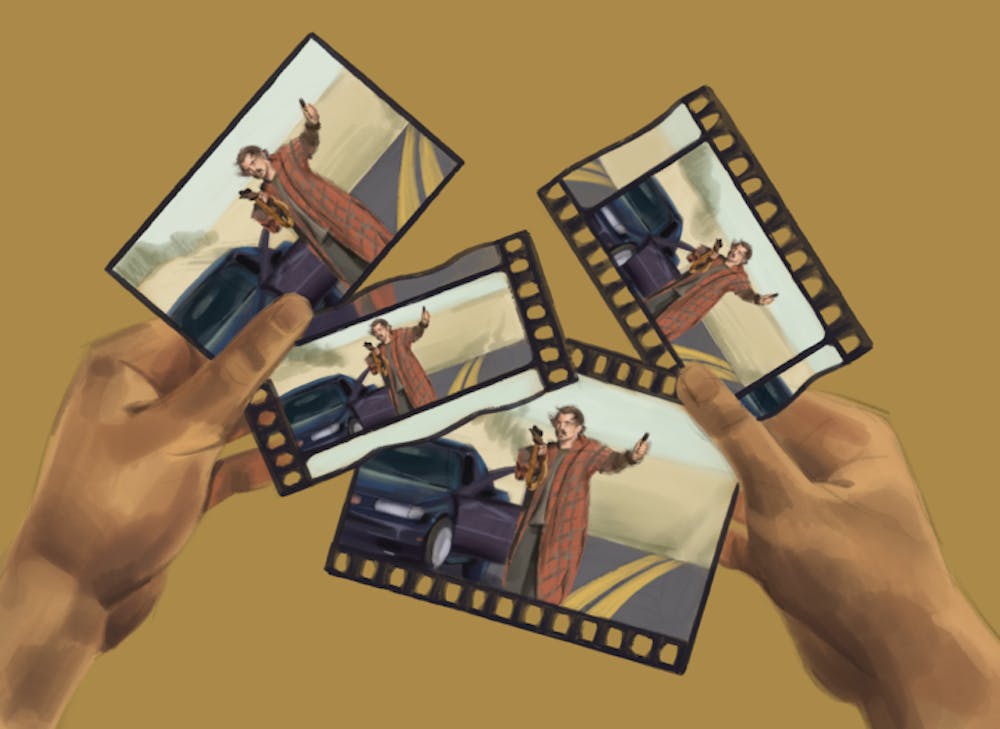
For many moviegoers, watching a film in theaters once is enough. Maybe, if they really like it, they will return to pick up on some details they missed the first time around. However, I am no ordinary man. While some may call me absurd for trekking to the theaters to watch the same movie more than twice, I embraced this film’s title to the fullest. Call me crazy if you must, because I have seen Paul Thomas Anderson’s newest film, “One Battle After Another,” on the big screen four times now. And if I am being honest, I could go for round five.
But, dear reader, let me tell you that these four experiences were all distinct. Every time I stepped into the theater to commune with Anderson, Leonardo DiCaprio and the cinema gods, I watched “One Battle After Another" in a different film format.
From the very moment I saw the film’s trailer, I knew I had to see it one time after another. I needed to immerse myself in the film. Just like how DiCaprio’s character Bob Ferguson will stop at nothing to rescue his daughter, I will stop at nothing to watch “One Battle After Another” as often as possible. I am essentially starring in my own version, entitled “One Format After Another.”
I watched the film for the first time on a classic digital projection screen in Los Angeles. While the cinematography was impressive and the movie’s story captivated me, the projection was a nondescript feature of the viewing experience. As the most common way to view a film, almost all theaters in the United States and across the globe offer movies exclusively through digital projection. While there is nothing wrong with seeing a movie digitally, there is also nothing extraordinary about this experience. This is why I ventured to watch “One Battle After Another” in three more unique formats.
For my second screening, I returned to Atlanta and saw “One Battle After Another” in 70mm projection at the local Plaza Theatre. Rather than relying on projecting a digital file, 70mm projection uses real celluloid film, giving the images a deeper, grainier and more well-defined picture. Seeing the screen flicker from frame to frame with scratches occasionally altering the images made the movie feel tangible. Studio executives did not just send the film on a computer chip to the theater; it was a tactile, living object that brought me deeper into the film’s world. I know I sound pretentious, and maybe I am. But seeing “One Battle After Another” on a 70mm print was glorious.
If you want to see a movie in a premium format but do not have a local theater that can project a film print, your best option is likely an IMAX screen. I chose this format for my third watch. Compared to regular digital projections, IMAX screens are bigger, with richer images and better sound. Watching the film’s closing car chase in IMAX was nothing short of a religious experience. The massive IMAX screen, combined with the booming sound, made it impossible not to get swept up in the film. For a second, I felt so immersed in the chase that I felt like I was Bob driving frantically to save my child. It was only when the credits started to roll that I remembered that I am Alex Gerson, a childless 21-year-old and not Bob, a middle-aged ex-revolutionary father.
You may think that after three screenings in three different formats, I would have nothing left to prove. But, alas, I am no quitter — I still had one mountain to climb. Anderson shot “One Battle After Another” on VistaVision cameras — a method that, until now, had been defunct for decades. On VistaVision cameras, the 35mm film moves through the camera horizontally rather than the typical vertical orientation. This choice delivers a wider image and the best possible picture quality. For 60 years, theaters have not projected VistaVision films in wide release, due to the format’s practical and economic disadvantages: VistaVision is bulkier and more expensive than traditional 35mm film or digital projection. Because of these hurdles, only four theaters around the world projected “One Battle After Another” in VistaVision.
So, when the opportunity arose, I hopped on a plane to London to get a chance to see the film in this format. While my friend Ben will try to tell you I went on the trip to visit him, Anderson is the only person I would cross an ocean for. Not only was seeing the VistaVision projection in person magnificent, but I now get to brag to everyone I know that I got to see it in this special format. While only about two of the 40 people I told this to found this feat impressive, I will continue flexing to anyone who will listen.
Ultimately, you cannot go wrong with whatever format you choose to watch “One Battle After Another” in. It is a film that takes on a different meaning every time you watch it — for me, some watches were more exhilarating, some more profound and some more tragic. While IMAX offers the most immersive experience and VistaVision the best image quality, what matters most is that you see “One Battle After Another” in theaters. The movie is a nearly three-hour-long thrill ride, guaranteed to keep you laughing and on the edge of your seat.
Having watched this film in two different continents, three time zones and four formats, I have dedicated over 11 hours of my life to “One Battle After Another.” To some, or perhaps just to myself, I am the coolest person ever, having seen the film in these various formats. To others, I am just a regular guy. But my quest never ends — I will keep preaching the gospel of Anderson, “One Battle After Another” and VistaVision until the day I die.


