
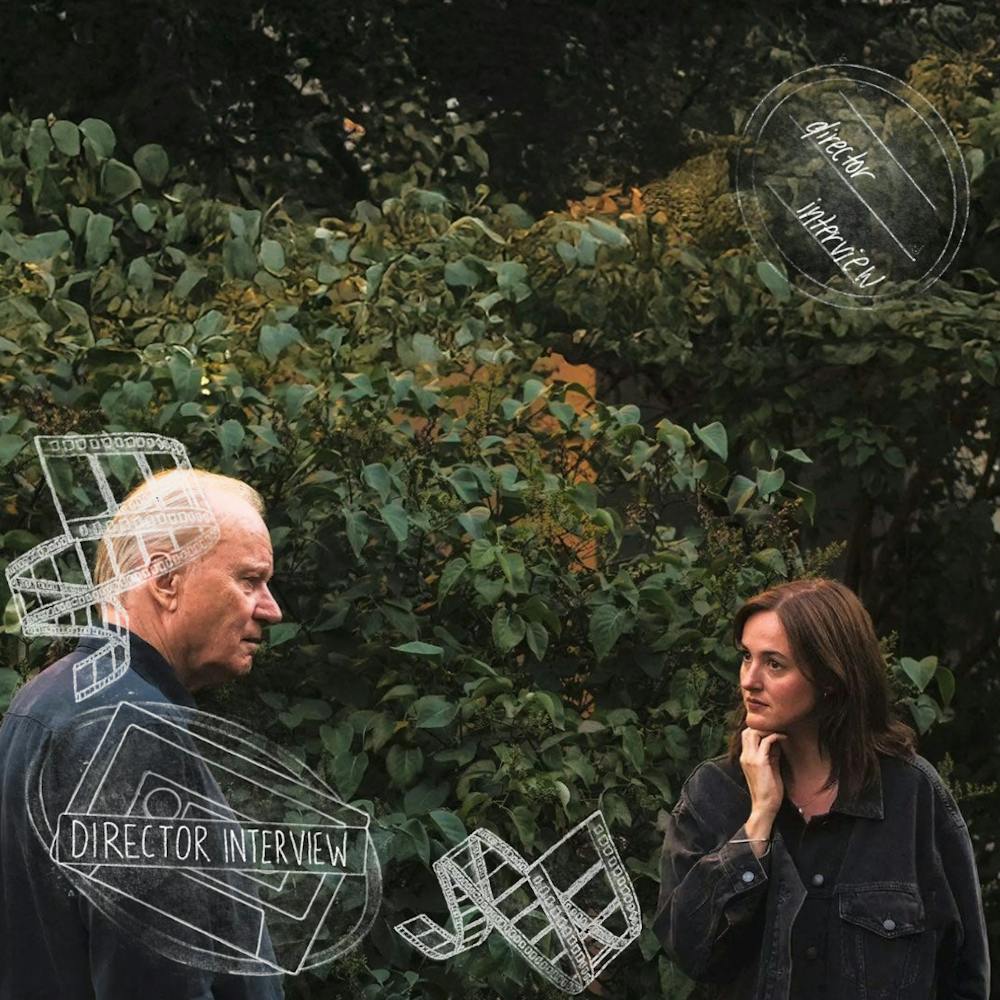
While childhood friendships ebb and flow throughout life, falling victim to time and distance, Norwegian directors and longtime friends Joachim Trier and Eskil Vogt’s lives remain intertwined through their filmmaking. For all of their films, the pair co-write the screenplay, with Trier directing. The two released their first feature-length film, “Reprise,” in 2006. Since then, the pair of Norwegian filmmakers have co-written five more movies together. Their 2021 film, “The Worst Person in the World,” thrust the pair into the spotlight, earning nominations at the Cannes Film Festival and Academy Awards. Their latest film, “Sentimental Value,” finds them reflecting on life, family and filmmaking.
“Sentimental Value” is both a continuation of the pair’s prior work and a new step for Trier and Vogt, reuniting with Norwegian actress and longtime collaborator Renate Reinsve while also working with A-list talent for the first time, with Stellan Skarsgård and Elle Fanning starring alongside Reinsve.
As “Sentimental Value” rolls out in theaters nationwide, Trier and Vogt sat down over Zoom with 11 college newspapers, including The Emory Wheel, to discuss their newest film.
The film follows Nora Borg (Reinsve), an actress whose entire life changes when her estranged father, Gustav Borg (Skasgård), returns to direct a movie about their family history. While Nora and Gustav care deeply for one another, they carry quite a bit of emotional baggage between them. Trier and Vogt felt that this theme is central to so many pieces of art, and they wanted to try their hand at tackling it in “Sentimental Value.”
“It’s a bit of a big swing for us, because we’re trying to talk about very, very fundamental human things,” Trier said. “Can reconciliation be something that we could achieve with parents that maybe didn’t give us all that we wished for?”
Trier noted that the pair figured out their writing process during their first film and then refined it over time. The duo said their films begin as simple conversations about life and art. The two meet in Vogt’s office, where they take turns lying on a couch, discussing their lives.
“We sit in that room where Escal is every morning with a cup of coffee and are very disciplined, try to put away our phones,” Trier said. “Except for lunch, we sit in that room and try to come up with ideas, and some days, we just nerd out and listen to music and talk about movies. Other days, we suddenly feel we’re doing well and we’re focusing on ideas that we develop together.”
These conversations between Trier and Vogt make up the first half of the pair’s writing process. Once the duo develops the story's shape and structure, Vogt takes over writing the script, hammering out the scenes and dialogue before sending it to Trier for notes.
However, while developing “Sentimental Value,” the pair felt that something was missing. While the pair knew they wanted to write a story about a family of artists, both thought the script lacked something that could open up the movie thematically.
One day, while trying to figure out the missing piece for “Sentimental Value,” Trier had to leave their writing session to take a call from his mother, who told him she was selling the house, which had been in their family for over a century. Trier and Vogt, inspired by real life, decided to center the movie on Nora and Gustav’s family home.
“That took away from our writing, and I was a little bit annoyed,” Vogt said. “Until one day, we were like, ‘Hmm, the thing we were looking for that could give this other perspective on this human story and remind us that our lives are so ridiculously short, that could be this house.’”
More than just a setting, Nora and Gustav’s house acts as a character in “Sentimental Value.” The movie opens with a narrator describing the building as though it has emotions — it feels sad when it is empty and happy when it is full of life.
The house holds emotional significance for Nora and Gustav; it is the place where Nazis arrested Gustav’s mother during their occupation of Norway, where Gustav grew up, where his mother took her own life and where he wants to film his upcoming movie. For Nora, the house is an emotional burden — a place where she grew up, often without her father because of his work. For others, it is a place of memories and nostalgia.
“It’s hard to carry all those things and you feel you have to keep it alive,” Vogt said. “If you have your grandfather’s house, you feel you have to keep his memory alive. It’s not really your house. And maybe you need your house, you need to start your life.”
Like their family home, Nora and Gustav both have emotionally complicated relationships with art making. Gustav, who was absent for much of Nora’s life, can only express his emotions through his films. Gustav’s work led him away from his family and Nora yet also brought him back, giving him the opportunity to reconnect with his daughter.
For Trier and Vogt, art acting as a source of communication, healing and understanding is central to “Sentimental Value.”
“We believe that art is important and has an ability to mirror and reflect on our lives in fundamental ways that we have no other place to do it,” Trier said. “It’s outside of the social language, you could go into a movie theater alone or with friends and be with strangers in the dark and experience something that could turn very personal. There’s a possibility of empathy with people that are very different than yourself.”
By the end of “Sentimental Value,” Nora and Gustav reach that same place of empathy. They might not fully reconcile, but they certainly understand each other and the world around them better. And as the audience, so do we.


