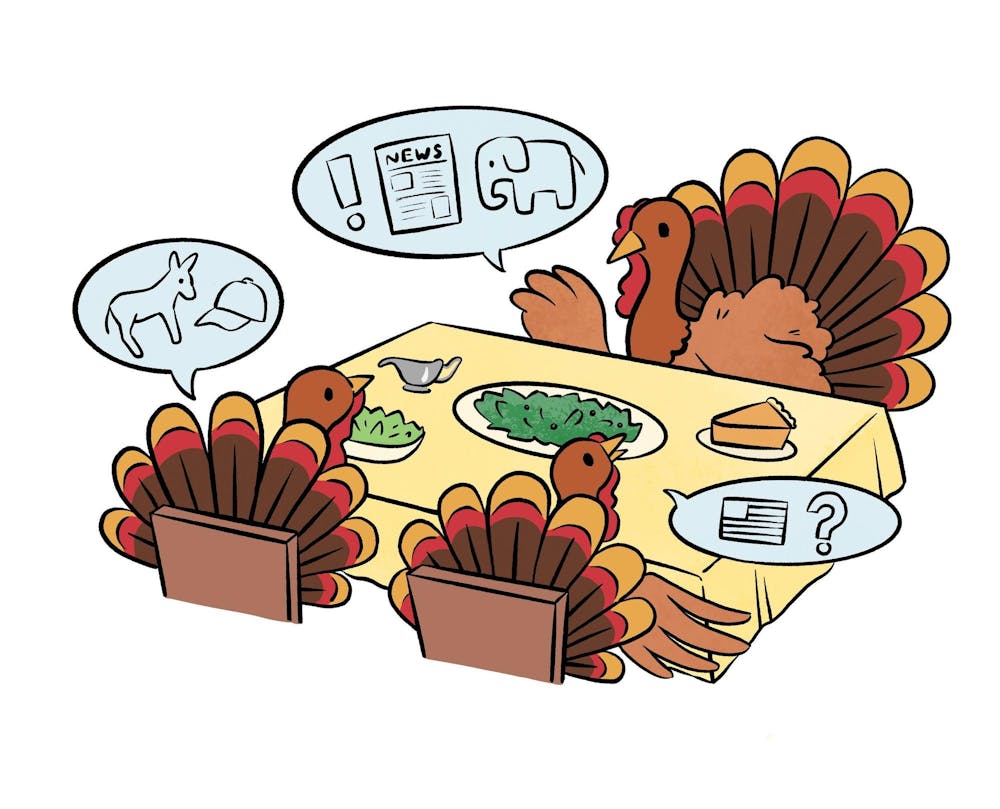
Each Thanksgiving, a familiar scene unfolds: Someone carves up the turkey, glasses overflow with sparkling cider, and relatives share stories across the table. Yet, beneath the clatter of plates, an unspoken tension simmers alongside the gravy. The mood shifts with an offhand comment about the news or a cynical political joke that lands flat. Everyone awkwardly laughs it off, trying to keep the peace. And then, someone mentions the recent presidential election and the tension snaps like a wishbone.
According to a November poll from Emerson College, 50.7% of voting Americans hope to avoid discussing politics with their families or friends on Thanksgiving. For college students heading home, the possibility of a holiday dispute can feel as inevitable as the post-meal food coma. In a time marked by deep partisan divides, many of us will return not only to our childhood bedrooms, but to uncomfortably politicized family conversations. However, as awkward as these discussions can be, collective unwillingness to have them only intensifies national political polarization. When we refuse to step out of our comfort zones and engage with disagreement, we reinforce our own ideological bubbles. The Thanksgiving dinner table is a space to practice respectful, meaningful political dialogue, and this year, we urge you to lean into the discomfort rather than shy away.
When we avoid political conversations, we often insulate ourselves from ideas that challenge our own, making it easier for us to caricature the opposing side as ignorant, hateful or misinformed. The internet exacerbates this issue, as the barrier of a screen creates anonymity and distance between users. On social media, algorithms reinforce echo chambers by continuously feeding users content they are most likely to interact with. In contrast, at home, when speaking face-to-face with people you have known your whole life, political discussions are more likely to be genuine or conducted in good faith. Unlike a random user on the internet with a generic name and profile picture, we tend to sympathize with, or at least, intimately understand, the reasons why our family members believe one thing or another. Perhaps meeting someone real and familiar, who happens to hold views that you feel are problematic or flawed, may push us toward more empathy and less dehumanization. When compared to the empty posturing of devil’s advocates on X, these conversations offer a real chance to hear another perspective or refine your own stance.
Arguing politics at Thanksgiving also exposes us to a spectrum of experiences and viewpoints. Thanksgiving gatherings usually include multiple generations of family, along with extended relatives who might come from different backgrounds. From politics to religion to life priorities, the gap between younger and older generations has grown increasingly polarized throughout the 21st century. From your veteran grandfather to your philosophy major cousin, each perspective presents a unique opportunity to get out of your echo chamber and to start bridging generational or ideological divides.
This holiday also offers a rare window to practice the much-needed skill of respectful argumentation. Throughout childhood and into adulthood, our families are formative in shaping our political identities. Thanksgiving conversations operate as a microcosm of this effect — when we are exposed to more diverse perspectives from across our extended family, we are further developing our own political identities.
Additionally, we often know and care for the person behind the political ideology. Disagreeing with family teaches us how to compromise and adapt our views so they resonate with people beyond those who already agree with us. The skills we cultivate through these exercises not only allow us to garner confidence but also make our arguments more persuasive and tested through criticism. Far from frequent portrayals of Thanksgiving discussion as pointless and inflammatory, 33% of a sample of Americans actually find such dialogue to be “respectful” and 27% find it “passionate,” according to a recent Scripps News poll. When we engage with our family members who disagree with us in a measured, intelligent manner, such tactics spill over to the public sphere.
However, this does not mean anyone should abandon their convictions or tolerate disrespect, insults or theatrics. There is no need to engage with bad-faith actors, ragebaiters or family members expressing bigotry. Part of improving conversation skills involves recognizing when to mediate and when to step back. But if a family member truly does disagree with you, recognize that political dialogue and productive disagreement require patience, humility and a willingness to listen.
To fully reap the benefits of a civil familial dialogue, students should come prepared with a thoughtful understanding of the facts, narratives and complexity of the issues they want to discuss. While away at college, we strengthen our views, giving us the chance to bring a unique political perspective back to the family table. However, we should not overlook the insights that people from different generations and educational experiences offer. We, as college students, must not fall into the trap of assuming our formal education automatically makes our opinions superior — don’t dismiss the experiences and practical wisdom of others only for this reason.
Life on Emory University’s campus exposes us to a wide range of perspectives from varying backgrounds, disciplines and communities, and the dinner table is the perfect place to express these newfound insights. This Thanksgiving, share what you have encountered on campus, whether it is a new political theory, a community project or simply a broader outlook. If we approach the political conversations at Thanksgiving with curiosity rather than combativeness, this holiday can become one of the few remaining places where dissent does not require conflict. Don’t shy away from disagreement — instead, allow the free exchange of ideas with loved ones, and hope it can carry over from our dinner tables to the rest of the world.