
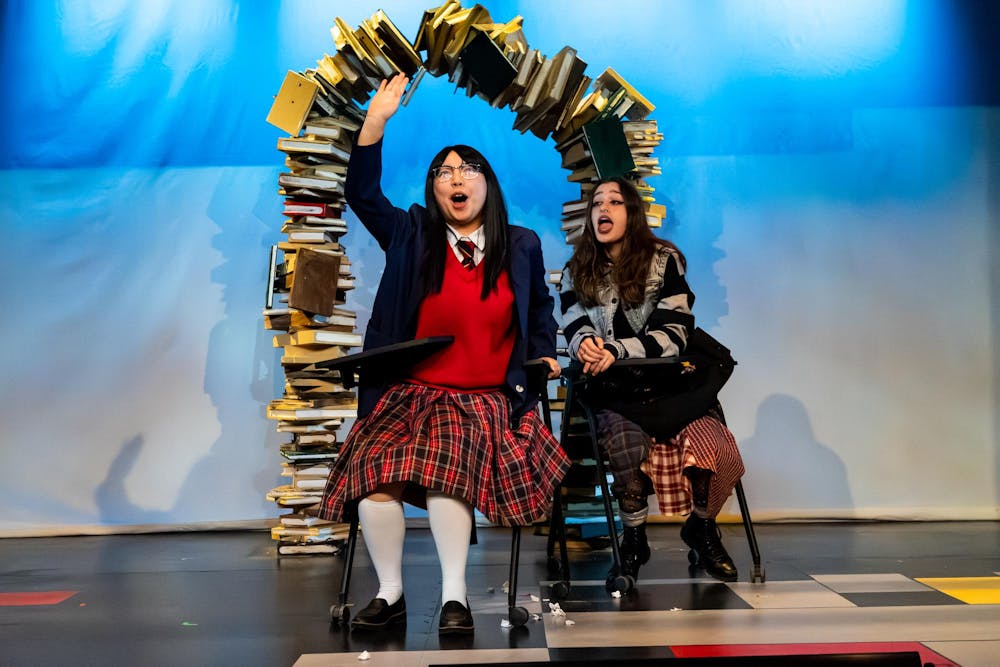
With the irresistible promise of academic success, brick buildings and colonial columns, one institution, “The College,” whispers the names of twin sisters M (Zexi Gui (26C)) and L (Sarah Lim (26C)) in Theater Emory’s latest production: “peerless.” In the dark satire play, which premiered on Nov. 13, playwright Jiehae Park explores what happens when the hypercompetitive college admissions process turns deadly, exposing the nastiness of the cutthroat system bent on alienating students from their peers. Refreshingly honest and surprisingly hilarious, “peerless” reflects an uncompromising view of higher education and exposes the institution's potential for absurdity.
M and L open the production with a lightning fast back-and-forth, expressing contempt, indignation and disgust after learning D (Colin Connery (28C)), a boy at their high school, took M’s spot at The College: an institution epitomizing prestige. Gui and Lim embody the sisters’ fierce intensity, hurling obscenities and crying out at the impossible injustice of their predicament. M and L recall the ridiculous steps they took to succeed in their quest to be admitted to The College. The twins' escapades included moving to the Midwest to become geographically distinct applicants and spending the summer in Africa for a college essay topic. Revealing a hyperbolic, ruthless view of the admissions process, the sisters waste no time establishing the production’s central themes of ambition, self-interest and bitter competition.
The following scene introduces Dirty Girl (Olivia Stanley (28C)), the production’s main antagonist and M’s foil. Dirty Girl accuses M and L of an obscure, sinister plot and foretells the discovery of a dead body. Stanley’s expressive performance lends a palpable sting to Dirty Girl’s taunting demeanor and her accusations infuse the production with a foreboding quality, foreshadowing a dark turn.
Further highlighting the twins’ unyielding intensity, M breaks up with Boyfriend (Christian Ford (28C)), after he accuses her of flirting with their statistics teacher. Despite this, M’s boyfriend remains a disconcerted witness to her actions throughout the production, with the two later reconciling.
After her conflict with her Boyfriend, M has no date to the school’s “Hoopcoming” dance, but through this misfortune, L sees an opportunity. L insists M attend the event with D, suggesting they poison D so M can reclaim her spot at The College. Although initially reluctant, M agrees to her sister’s plan. Their interaction establishes L as the proponent of the twins’ murderous plotting and M as her reluctant pawn. Although M retains her own aggressive desires, this dynamic adds nuance to the sisters’ conflict and underscores M’s self-doubt. M’s internal strife throughout the production reveals the consequences of unabashed ambition: self-alienation and profound moral disconnect.
The Hoopcoming dance itself presents a humorous gem. Dirty Girl opens the scene with a rat prop in each fist as she sings Jessie J, Ariana Grande and Nicki Minaj’s “Bang Bang” (2014), substituting “rat” for nearly every lyric and laying the groundwork for madness. At the dance, the socially inept and self-deprecating D stumbles through conversation with M and L as repetitive pop instrumentals drone under their dialogue.
Connery’s performance as D is wonderful. With quick bursts of speech peppered by self-conscious chuckles and repeated, unreciprocated attempts at dancing, he epitomizes the pathetic gawkiness of his character. Shifting back and forth between topics, including his weight-loss journey, an eye-opening experience with psychoanalytic therapy and his one-sixteenth Native American heritage, D thrusts the audience into conversational whiplash. His oblivious optimism contrasts with the absurdity and occasional gravity of his dialogue, eliciting a mixture of laughs and shock from the audience, a reaction M’s stunned silence reinforces.
Once M and L murder D the production takes a darker turn. The audience watches as the twins’ carefully-constructed plot for admission into The College crumbles and Dirty Girl’s prophetic warnings come true. Rapid scene changes, prolonged moments of silence and creative lighting decisions such as color shifts and silhouettes, characterize the bleak latter half of the play. While not inherently flawed, the second leg of the production stalled compared to the incredibly strong performances in the production’s first half.
Nonetheless, some moments in the second half of “peerless” shine due to the cast’s performance. In M’s final appearance, Gui presents vicious taunting and crazed exaltation, revealing the true, unfettered nastiness of their character. Throughout the play, the cast demonstrated their acting strength through versatile performances and consistently expressive delivery.
With laughs and gasps erupting from audience members in the packed Mary Gray Munroe Theater throughout the play, Theater Emory’s “peerless” delivers pointed, hilarious commentary on the extremes of ambition in a hypercompetitive college admissions process, crafting an experience that is both hyperbolic and terrifyingly relatable.


