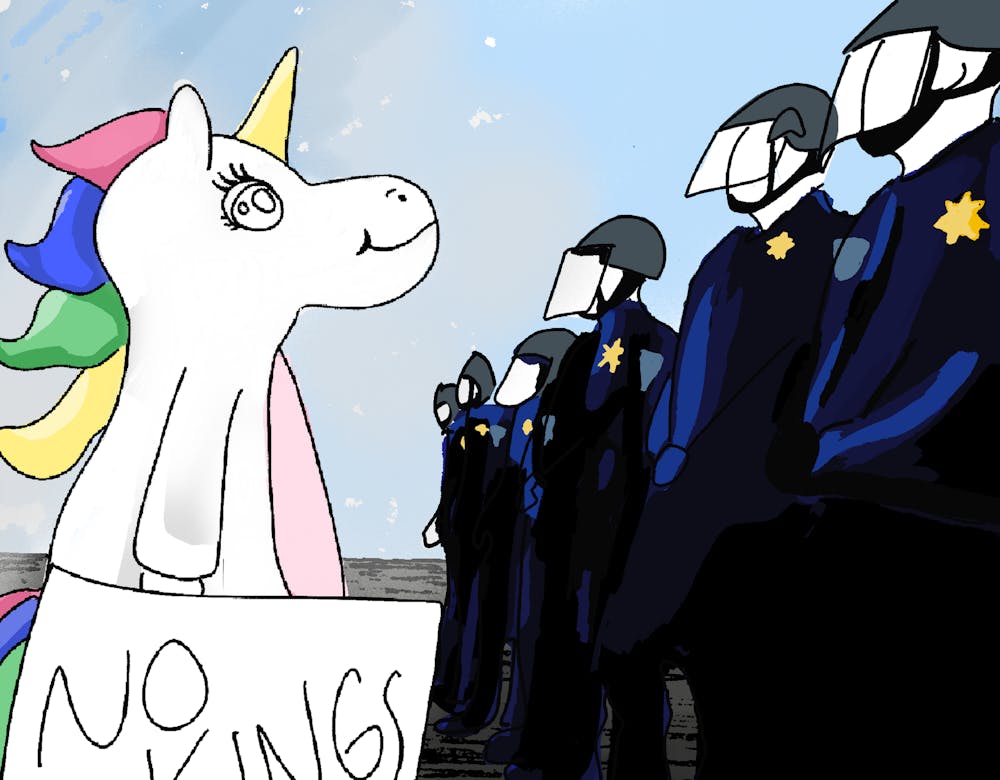
Protests are a serious matter, and one may expect this to be reflected by serious attire, perhaps masks and dark clothing that render demonstrators unrecognizable — the strategy taken by many in the past. However, imagine this: hundreds of protesters marching in full inflatable animal regalia — from frogs to dinosaurs and even unicorns. No, this is not a fever dream, rather, it’s a new trend erupting across protest movements in the United States against Immigration and Customs Enforcement (ICE) raids and rising authoritarianism.
At first glance, these demonstrations resemble the aftermath of a Party City clearance sale or the remnants of a parade. However, these whimsical displays are actually part of one of the most unusual acts of political resistance in recent memory: Operation Inflation. The grassroots effort distributes free inflatable costumes to protestors to keep them “safe and positive” while exercising their First Amendment Rights.
While their protest gear may seem nonsensical, the trend reflects a larger strategy — one adapted for an era in which protesters stage change online through social media as much as they do on the streets. In our current political climate, one defined by fear, surveillance and misinformation, these inflatable animal costumes remind us that protest can be communal and fun. Sometimes, the most effective way to combat injustice is by refusing to let it diffuse a sense of solidarity.
Operation Inflation began in Portland, Ore. During a demonstration protesting the deployment of ICE into the city, officers pepper-sprayed Seth Todd, who was wearing a blow-up frog costume. A video of the incident — particularly the moment when an officer spun Todd around to presumably target the blow-up suit’s air vent, quickly circulated across multiple social media sites.
Within hours, Todd became a meme, and within days, his assault became a symbol of the excessive use of police force. Soon, more protesters in frog suits were marching with signs reading “Frogs Together Strong.” What began as a single man in a costume has evolved into an expanding movement and an excellent example of how internet culture can cultivate new and effective forms of collective resistance.
The trend of wearing costumes to protest is not just isolated to Portland. Inflatable figures appeared at No Kings protests across the country on Oct. 18. This time, more than frogs showed up — instead, a full ecosystem of demonstrators turned out to demand change. Giraffes raised protest signs, dragons chanted against authoritarianism and birds handed out water bottles and snacks. The costumes looked ridiculous, and that was their point: a deliberate strategy to draw attention, challenge violent depictions of the protests and build solidarity. While this may not be the most direct form of action, this strategy has been successful in drawing attention to the cause at hand.
Weaponizing virality is a smart tactic in our digital age. Both humor and outrage travel fast on the internet, especially considering most social media algorithms recommend clips based on engagement. With Gen Z now the youngest voting bloc — one consistently showing low turnout and low interest in traditional politics — speaking the language of memes to encourage action is advantageous. In political movements, social media attention is currency now, and inflatable frogs certainly catch people’s attention — coverage of the incident by NowThisImpact on TikTok has gained 1.6 million likes.
This strategy also effectively combats the federal government’s misrepresentation of protest movements. President Donald Trump’s administration has repeatedly tried to cast the Portland protesters as “antifa thugs,” using that manipulative messaging to justify deploying militarized agents in the name of public safety. However, these claims have been thwarted by the visual irony of federal agents preparing to neutralize dangerous waddling frogs.
The Portland frogs are not the first to use absurdity to destabilize authoritarian posturing: Young people in China have also used satirical tactics in their opposition to President Xi Jinping, known for his crackdown on democracy, silencing of ethnic minorities and censorship of online spaces. Chinese students compared Xi to the popular cartoon character Winnie the Pooh on social media, a playful jab at his powerful image. While this satirical criticism is not the same as protesting, it still has the ability to foster dissent and help people realize that they are not the only ones who want to see change. And, because this resistance spreads through popular culture, it is incredibly hard to contain. Even with Xi’s attempts to scrub the meme off the internet through strict censorship policies, the Winnie the Pooh comparison keeps popping back up, showing the resilience of the silly protests.
Resistance is not solely about overthrowing a government structure or figure — it is also about fostering a community of people who work together to eventually achieve change. By giving the movement a friendlier face, Operation Inflation’s can make its anti-ICE protests more palatable and gain more followers who resonate with its message. Likewise, through these silly costumes, protesters can send messages to the public. For instance, in dressing up like a frog, Todd wanted his costume to combat Trump’s propaganda claiming the protests were aggressive. With unique, nonviolent attire, demonstrators extend a hand to their community to join them on the streets.
Not everyone feels comfortable standing on the front lines of a tense protest, but almost anyone can zip into a costume and stand with a crowd of others. With members of Operation Inflation even handing out free inflatable costumes to those who want to join, all hopeful participants have to do is be willing to look a little silly with strangers who care about the same things they do. For those who want to participate in a protest but are hesitant to due to inexperience, there is now an accessible entry point. In a time when activism is often framed as individual moral performance, Operation Inflation shows how protest is communal at its heart — and in this case, literally inflated with collective air.
Contact Josselyn St. Clair at jmstcla@emory.edu and Crystal Zhang at crzhan2@emory.edu
Josselyn St. Clair (26Ox, she/her) is a native of Eugene, Oregon, and is double majoring in International Relations and German on the pre-law track. Outside of the Wheel, she is an avid fiction writer and language learner. She hopes that she will be fluent in three or more languages by the time that she graduates from Emory.