
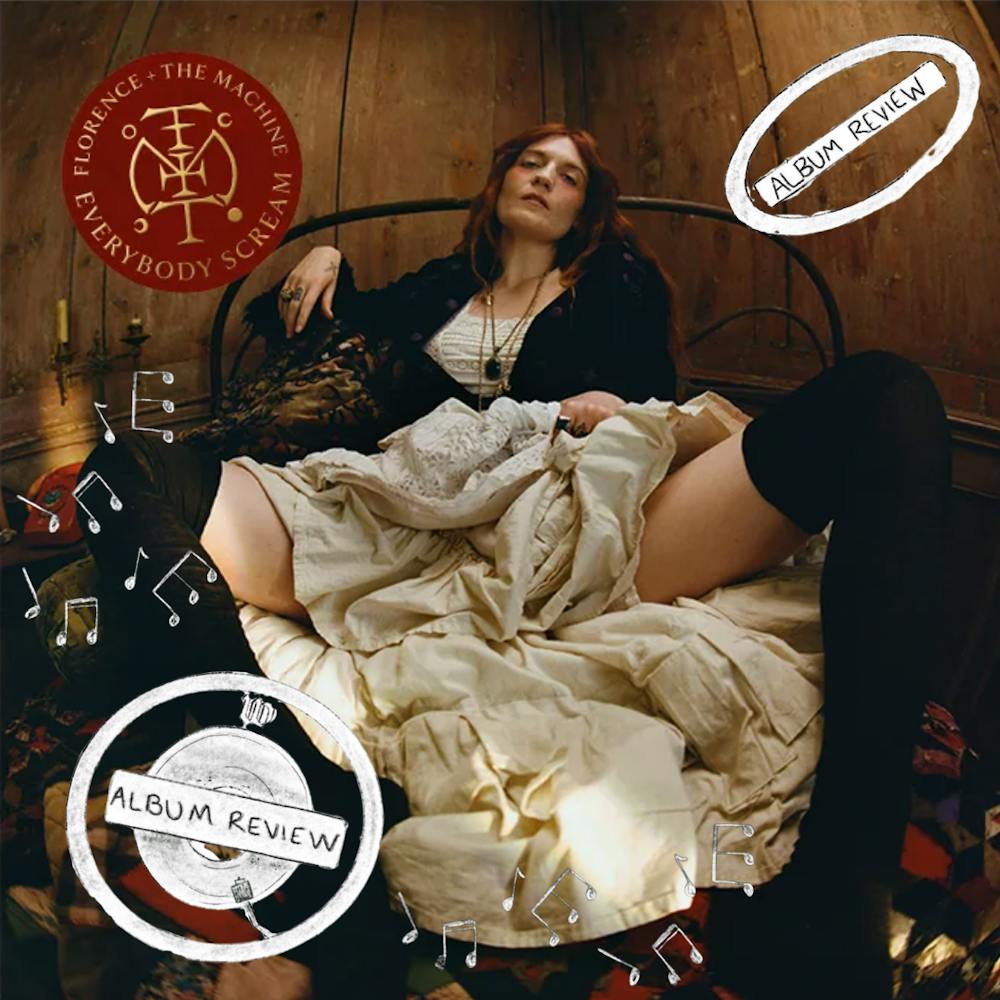
Known for unique instrumentation, powerful vocals and dramatic production, Florence + The Machine loves to break the mold. Their newest project, “Everybody Scream,” continues with the group’s style of subverting the rock genre, blending elements of pop, soul and folk into one whirlwind of an album. While embracing the fierce catharsis its title alludes to, “Everybody Scream” remains beautifully lyrical and reflective.
The record, released Oct. 31, channels lead singer Florence Welch’s vocal power to its fullest. Their sixth studio album evokes empathy, inviting listeners to share in experiences of love, triumph and pain.
The album begins with its titular track, “Everybody Scream.” A dreamy ambience unfolds as Welch simply vocalizes — angelic yet distant. However, a sudden scream jolts into the intro, interrupting Welch’s reverie and demanding the listener’s attention. A thumping bass and low, driving guitar riff follow, building the track’s intensity. “She gives me everything (Love), I feel no pain,” Welch groans, low and harsh. Her subdued vocals set the stage for the powerful chorus. “But how can I leave you when you're screaming my name?” Welch sings, a gorgeous yet desperate cry, paralleling her helplessness in being unable to leave a broken relationship. The following verse contains vivid imagery unpacking her unhealthy co-dependence. “I will come for you in the evening, ragged and reeling,” Welch sings.
“Witch Dance” touches on personal themes as Welch navigates her near-death experience following an ectopic pregnancy. Welch conveys this experience metaphorically, describing encounters that occur in the interval between life and death. In the first verse, Welch has sex with death: “Open my legs, lie down with death / We kiss, we sigh, we sweat,” she sings. Her rapid, rhythmic breathing merges with the track’s instrumental, establishing an intense, sensual listening experience. In the second verse, Welch is uncertain, consoling herself as she faces death. “Ran to the ancestral plane, but they all showed up drunk and insane,” Welch sings. Depicting the last of these near-death encounters in the bridge, the track’s ferocity collapses into a beautiful tempo shift; a lilting harp and powerful choir characterize the moment’s singularity. Welch sings, “I came to a clearing / Full of wailing and keening,” before describing an afterlife interaction with other women who died from fatal birth complications. “The women said, ‘We've been waiting / Waiting to meet you, it's only a matter of time,’” Welch sings. With these lines, Welch defies her fate. The group of women welcomes her, anticipating her arrival as “only a matter of time,” yet Welch resists, fighting for her life. The metaphors within “Witch Dance” evoke both intense physicality and spirituality, marking Welch’s scrape with death as a multifaceted experience that fundamentally reshaped her.
“Sympathy Magic,” the album’s fourth track, initially matches the momentous energy of “Everybody Scream” yet fails to sustain it. In the second verse leading into the chorus, Welch sings to a beating drum, “Aching, aching, aching / And alive,” underscoring the track’s free-spirited, triumphant energy. However, the outro fails to convey these compelling emotions, during which an amplified version of the instrumental’s repeating synthesizer replaces Welch’s vocals. Compared to other energetic moments on the album, the outro of “Sympathy Magic” comes across as a half-hearted attempt at intensity, falling just short of being painful to the ear.
While “Sympathy Magic” misses the mark, “Perfume and Milk” and “Buckle” are album highlights. In “Perfume and Milk,” Welch tells the story of personal growth and rediscovery following her miscarriage. “Well, healing is slow, it comes and it goes / A glimpse of the sun then a flurry of snow,” Welch sings, likening her healing process to nature’s cycles and embracing its beautiful unpredictability. She repeats "All shall be well,” and “The seasons change, the world turns,” viewing her suffering as a temporary reality within a greater, balanced scheme.
In “Buckle,” Welch describes an intense unrequited love. Singing, “A crowd of thousands came to see me, and you couldn't reply for three days,” Welch embodies her frustration with cold indifference. Welch’s impassioned vocals blend with the track’s calming acoustic instrumental, creating what could be a love song if not for its pained, resentful lyrics. The track’s contrast between its composition and lyrical content underscores her bittersweet longing. Bright, upbeat and atop a sweet strumming instrumental, Welch sings, “'Cause I'm stupid and I'm damaged, and you're a disaster.” She belts the bridge, “Oh, God, I thought I was too / Old for this / I should be over it,” showcasing a cathartic climax, desperate lyrics and layered vocals that depict her unparalleled passion.
“Drink Deep,” the album’s most somber and unsettling track, explores Welch’s bout with alcoholism. Chimes begin the song, crafting a dissonant ambiance that establishes an eerie atmosphere, which the drum’s deep, incessant pounding reinforces. Welch sings, “Through bramble and briar / Under ash and oak / I went to find the hidden folk,” depicting figures shrouded in mystery — illuminating the surreal escape alcohol provides. “And every cup they brought to me / Oh, you know I did / Drink deep,” Welch sings in a foreboding tone. Welch’s lyrical mysticism depicts her alcohol consumption as a surrender to occult forces, underscoring its veiled danger. Welch repeats “Still I drank deep” in the chorus. With a choir backing her and ceaseless drumming, the repetition highlights Welch’s dangerous decision to drink — she disregards the harm to favor temporary pleasure.
Cathartic yet sensitive, commanding yet vulnerable, “Everybody Scream” harnesses gorgeous lyricism and innovative instrumentation to embrace raw emotion. Staying true to the band’s unique, subversive style, Florence + The Machine delivers a deeply personal and evocative album, inviting listeners to share in and revel over its triumph and grief.


