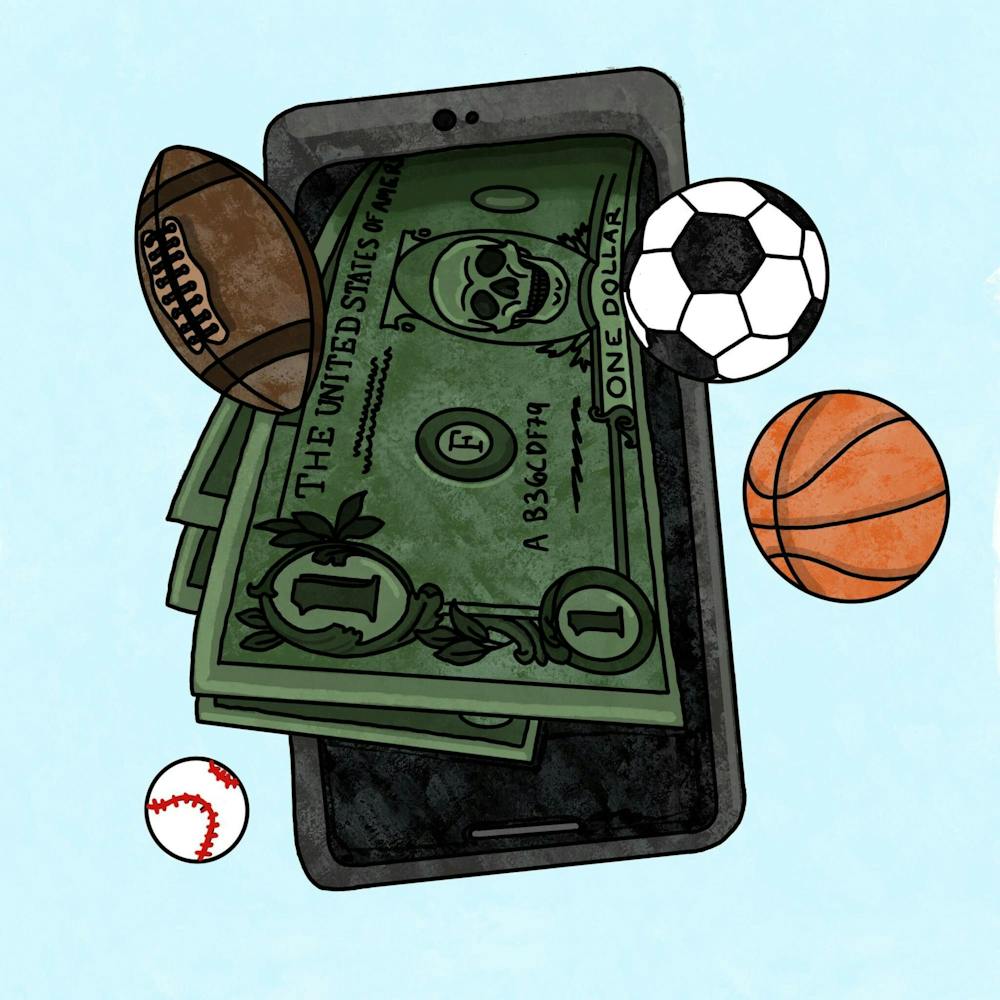
The NBA season was supposed to start with debuts and dunks — but, 36 hours into the season, it was not San Antonio Spurs center Victor Wembanyama's otherworldly stat lines or Dallas Mavericks rookie Cooper Flagg’s impressive debut that dominated front pages — instead, it was scandal. The FBI arrested 34 people in two federal gambling investigations on Oct. 23. The FBI indicted NBA Hall of Famer and Portland Trail Blazers head coach Chauncey Billups, Miami Heat guard Terry Rozier and former player and assistant coach Damon Jones for their roles in a complex scheme involving rigged poker games and illicit insider sports betting. The indictments read more like scripts for a Hollywood mob drama than a sports scandal, with the pages colored by anonymous monikers for mafiosos involved in the investigation, such as “Black Tony,” “Big Bruce,” “Pookie” and “The Wrestler.” Despite the public outcry, this is not the first time scandal has sent NBA players, coaches or officials into controversy surrounding organized crime. Over the years, the NBA has been a breeding ground for illegal activities, and this prevalence of racketeering will only get worse with the growing acceptance and legalization of sports betting.
The indictments cover two separate, but related, betting schemes. One used NBA players and coaches to draw wealthy victims into rigged card games secretly run by organized crime families. The second investigation surrounds gamblers receiving inside information on NBA games.
The FBI accused Rozier and Jones of leaking information about playing time and injury status and sharing betting profits with intermediaries. The probe grew out of an earlier case involving NBA forward Jontay Porter, whom the NBA banned for life in January. Later, a jury convicted Porter, and he is awaiting sentencing after he intentionally underperformed to benefit gamblers linked to the New York Mafia.
Recent investigations revealed that conspirators linked to crime families fronted Porter money and threatened his life if he did not comply with the betting scheme. These cases make it clear that the NBA needs to reform its security precautions and take a hard stance against criminal influence — the association’s current porous information economy and widespread public accessibility to minor bets on lesser-known players have invited crime into the league.
The NBA should have seen this coming. Since the 1950s, the league has overseen scandals surrounding rigged games and criminal influence. The NBA suspended Detroit Pistons player Jack Molinas in 1954 for betting on his own team and leading a giant point-shaving operation that resulted in the arrest of 37 players. Referee Tim Donaghy was sentenced to 15 months in prison in 2007 for leaking officiating reports to benefit the Gambino crime family. These moments led to scandal and highlighted the fallibility of the NBA’s information security. The league relies too much on internal honor systems for personnel in order to safeguard the NBA’s sensitive data, and lacks systemic betting safeguards against criminal infiltration.
This recent scandal should signal to the NBA brass that the stakes are now higher than before. Sports betting is now legal in 39 states, and betting markets are flush with new participants. Yet, despite currently dealing with sports betting scandals, the NBA has cozied up to large gambling sites such as DraftKings, ESPN Bet and FanDuel by offering them official partnerships, embedding sports betting within the league’s own infrastructure.
Instead of protecting consumers from financial risk and addiction or modernizing security infrastructure to prevent criminal exploitation, the league seems to be embracing betting as a modern method for generating revenue. These two scandals have already damaged the league’s image, making it harder for young fans to idolize players and coaches engulfed in criminal activity. To live up to its stewardship of basketball and its fans, the NBA must make preventing future sports betting scandals a top priority instead of becoming a willing broker.
Although it seems unlikely there will be a future in which the NBA deprioritizes its bottom line and rejects sports betting, there are still some solutions to stymie illegal schemes. To the league's credit, it has already partnered with third-party firms to track suspicious betting patterns. But, outsourcing to external vendors does not solve the root of the insider information problem. The NBA must enact new policies that treat injury reports, load management plans and rotation decisions as market-sensitive data subject to the same controls as corporate earnings reports. This data should face strict blackout periods before public release, when only a handful of trusted personnel can access the information. There should be automatic logs that are regularly audited and show which personnel accessed data and when. In other words, the NBA should build a security protocol around sensitive game plans that mimics corporate security on Wall Street to prevent gambling schemes like the one discovered by the FBI.
Additionally, the NBA should leverage its official partnerships with betting organizations to limit the number of prop bets that increase the risk of manipulation. Prop bets are wagers on individual player statistics unrelated to wins and losses. It did not make sense that gamblers could place bets on Jontay Porter, a benchwarmer whose integrity was far easier to buy than a well-paid all-star. Rozier, Porter and Jones’ cases are a grim reminder that salaried NBA players are still susceptible to financial and violent manipulation. To limit such cases, the league should ask betting partners to eliminate all props on player minutes and injury status and limit bets on individualized performance metrics to all-stars and well-known players. Otherwise, players with short, small or uncertain contracts will be easy prey for organized criminals who seek to manipulate prop bets.
The cards are now in the hands of the NBA. The league was once a victim of criminal gambling schemes, but now it risks becoming an accomplice as it effectively brokers deals and recruits consumers for the gambling industry. Unless the NBA combats security risks and acknowledges that the illegal ecosystem that encourages insider sports betting is not external but structural — born from its willingness to monetize the very betting vulnerabilities that criminals are exploiting — the league will continue to breed rackets and indictments, engulfing the sport in further scandal and failing its responsibility to fans.
Contact Ethan Jacobs at ethan.jacobs@emory.edu