
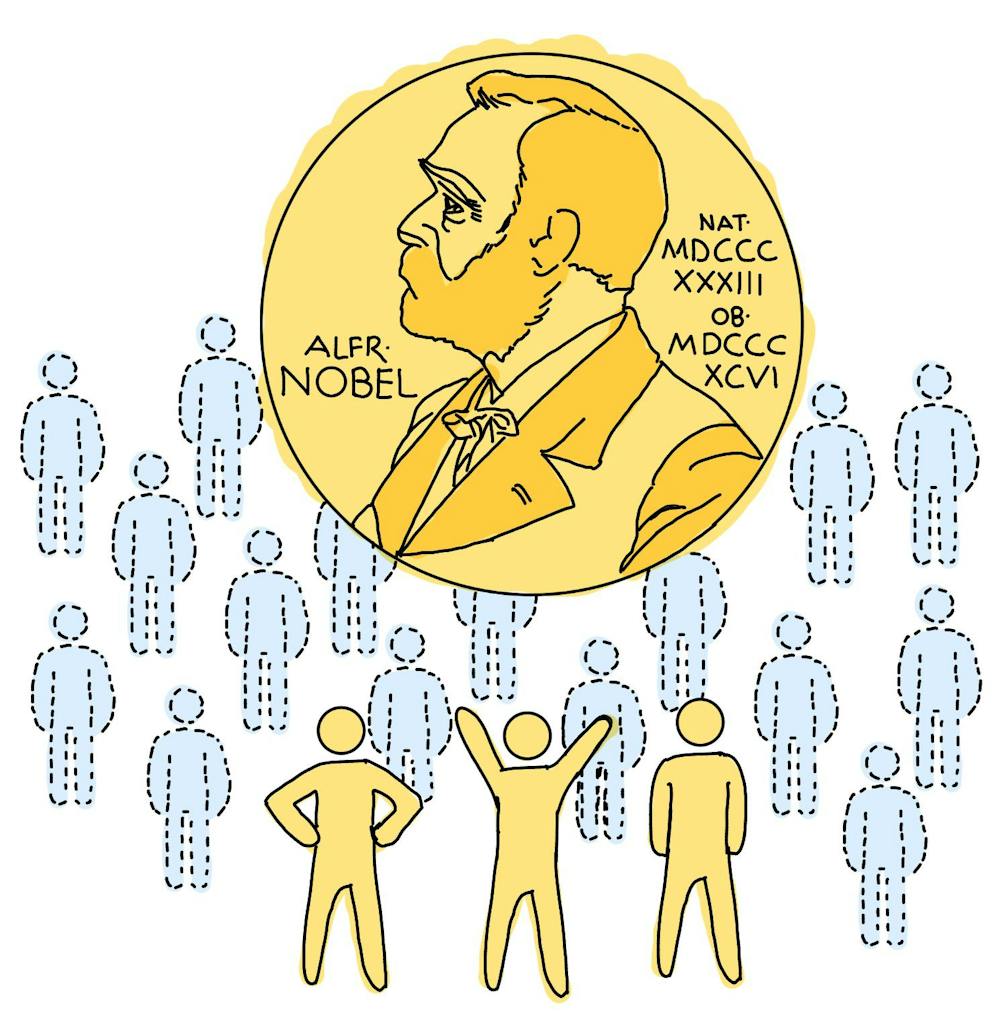
October is one of my favorite months. It is not only a time of prime apple picking and pumpkin spice drinking but also something much more exciting for scientists and journalists alike: Nobel Prize season.
These prestigious awards honor individuals who have made “discoveries that have conferred the greatest benefit to humankind” in categories of peace, literature, chemistry, physics, economics and physiology or medicine. Alfred Nobel, the wealthy chemist who invented dynamite and founded the prestigious prize, left in his will a three recipient limit for each prize. This rule was not an issue in the early years when the Nobel Committee only recognized one or two people in each category. But today, nearly every science prize is split among three people.
The increase in awarded prizes reflects a growing trend in science: The field is no longer a one-man team. Instead, science necessitates a vast global collaboration in which ideas are built on top of one another. Herein lies the issue with the Nobel Prize: although hundreds of scientists may have contributed to a discovery, only three can earn the honor of fame and riches, keeping the other scientists out of the public eye. By continuing to honor a select few, the prize reinforces an outdated myth of lone scientific genius rather than reflecting the real collective, slow progress that defines contemporary research.
Even though there are fundamental issues with its awarding, I am not calling for the abolition of the prize nor changing the terms so that more than three people can win. Recognizing 100 people is not only impractical but also against Nobel’s will. However, I wish that the Nobel Foundation would recognize the other scientists it chooses not to include in the awards for a particular discovery. By not, at the very least, spotlighting their contributions, the selected laureates are portrayed as the sole pioneers, overlooking the rest of the community whose work built up and innovated the discovery.
There is no better example of this exclusion than that of Rosalind Franklin, the photographer of Photo 51, an X-ray picture of the structure of DNA. Her photograph provided the critical evidence needed for James Watson and Francis Crick to elucidate DNA’s double helix structure. Yet Franklin’s contributions went uncredited when the discovery was published in Nature in 1953.
Franklin passed away before Watson, Crick and Maurice Wilkins won the Nobel Prize in 1962, meaning she could not have won the Nobel as it can not be given posthumously. However, the Foundation never formally recognized her work. Even today, her contributions are relegated to a single sentence in the biography of one of the three 1962 laureates, Watson and Crick, Maurice Wilkins. Thankfully, her story has some justice. Her name is revered by biology students and scholars alike, though this widespread recognition did not occur until nearly 50 years after her initial discovery. But, this story is symptomatic of the larger problem with scientific awards: By only spotlighting the laureates, it erases the importance of the contributors.
Franklin's story is not an isolated case. Behind every Nobel-winning discovery lies a network of scientists whose names the public will never hear. In 2023, the Nobel Foundation awarded the Prize in Physiology or Medicine to Katalin Karikó and Drew Weissman for their discovery of mRNA modification, which was crucial to COVID-19 vaccine development. However, this left Pieter Cullis, who led research on the lipid-based delivery system that later resulted in the Pfizer and BioNTech vaccines, out of the conversation.
Another example is Feng Zhang, a researcher who showed how CRISPR, a gene-editing tool, can be used in eukaryotic cells. His research paved the way for gene therapies that could treat illnesses such as sickle cell diseases. Yet, when the Nobel Foundation awarded chemists Jennifer Doudna and Emmanuelle Charpentier the 2020 Nobel Prize in Chemistry for their discovery of gene editing, Zhang never received any recognition from the Foundation. Given the Nobel’s tendency to award discoveries only after their real-world impact is proven, it is striking that they overlook the scientists who helped realize that impact when doling out the honors.
Even though many of these scientists lack well-deserved recognition, I am not suggesting that they were robbed of a Nobel nor that the laureates who received the honors are undeserving of their prize. However, I wish the Nobel Foundation would recognize the work of scientists whose research underpins these discoveries that have had such a fundamental impact on our lives. While their omissions do not dismiss the achievements of the laureates, they do shape how the public views scientific progress. Long gone are the days of Albert Einstein and Werner Heisenberg, whose theories may have been primarily a product of their own genius. By simplifying scientific discoveries to merely a few heroes, the Nobel narrative obscures the modern-day reality that most innovations depend on extensive collaboration, replication and refinement. In doing so, it not only overlooks deserving scientists but also pushes the idea that individuals should seek glory, not community, when striving toward scientific discovery.
The Nobel Prize is the most prestigious and widely recognized global honor for many of its categories. Since the prizes have such a large cultural impact, the Foundation should publish essays or digital archives that recognize key contributors to each awarded discovery, not just the three awardees, so that the public gains a greater appreciation for the collaborative nature of science. This gesture best exemplifies Alfred Nobel’s original vision for the prize and reflects the 21st-century modality of science. True prestige, therefore, lies not in exclusivity but in acknowledging everyone who moves innovation forward.
Contact Cayden Xia at cayden.xia@emory.edu

Cayden Xia (he/him) (26Ox) is from Wellesley, MA, and is majoring in chemistry with a minor in religion. Apart from the Wheel, he designs tests for Emory and Georgia Tech Science Olympiad. Outside of school, Xia likes to watch Tottenham Hotspur (COYS,) speed solving the Rubik's Cube, or binging a TV Show.


