
Content Warning: This article contains references to gun violence.
Across Emory University’s Atlanta and Oxford College campuses, Jewish and Israeli community members and organizations marked the second anniversary of Hamas’ Oct. 7, 2023, attack on Israel and the intensification of the ongoing conflict in the Middle East. The anniversary comes as U.S. President Donald Trump attempts to broker a ceasefire to end the Israel-Hamas war.
During the Oct. 7 attacks, Hamas killed nearly 1,200 people and took 251 hostages. Currently, the U.S.-designated terrorist organization is holding 48 hostages, with 26 publicly confirmed to be dead, in the Gaza Strip.
Pro-Israeli, Jewish organizations unite to host memorial
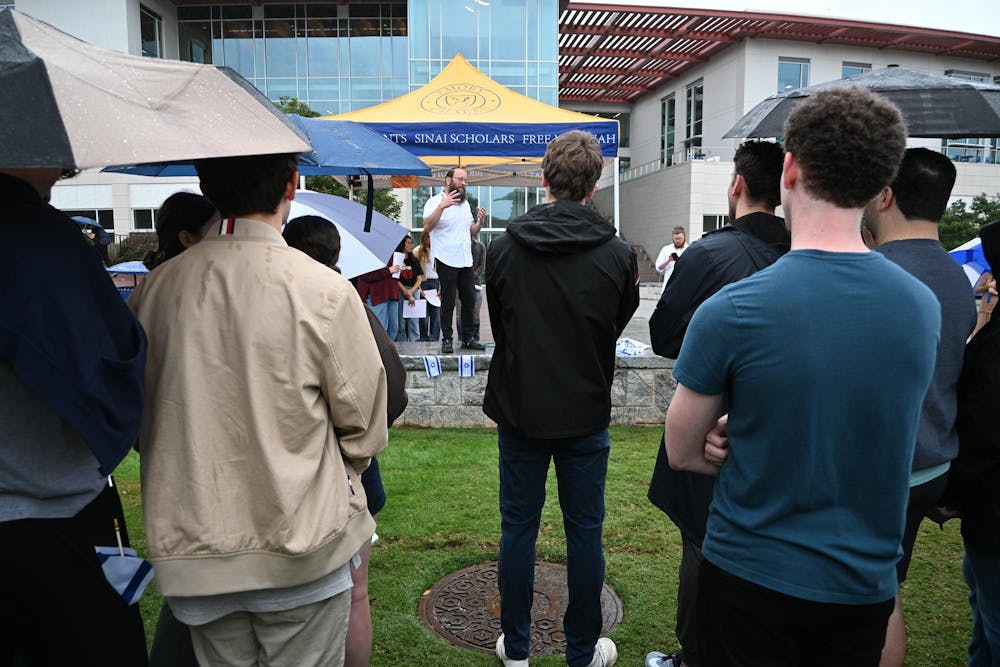
Nearly 100 Emory University community members gathered on McDonough Plaza on Oct. 5 to host a vigil honoring those killed and taken hostage by Hamas on Oct. 7. Chabad at Emory, Emory Hillel, Emory-Israel Public Affairs Committee, TAMID at Emory, MEOR at Emory and Emory Eagles for Israel organized the event.
The event began with organizers passing out Israeli flags and attendees singing the Hatikvah, Israel’s national anthem.
Chabad at Emory Rabbi Zalman Lipskier began the vigil by leading students in prayer.
Following Lipskier, Assistant Teaching Professor and Language Coordinator in Hebrew Pazit Kahlon-Shelnutt said the feeling of simultaneously watching the Oct. 7 attacks happen from the United States while trying to contact her family in Israel was an experience “beyond anything we could have imagined.”
“I remember sitting in front of the TV, frozen, and my mind refusing to understand,” Kahlon-Shelnutt said. “That day, something inside of all of us broke. And for me, it is still broken.”
With an increase in antisemitism across the United States since the war’s inception two years ago, Kahlon-Shelnutt said Israeli and Jewish students are facing a “painful reality” and urged attendees to stand up against hate.
“Being against antisemitism does not mean being against anyone else,” Kahlon-Shelnutt said. “It means being for humanity, for dignity, safety and empathy for all people.”
Jewish Chaplain Jordan Braunig recited the Mourner’s Kaddish, a prayer said to honor the deceased, and offered words of gratitude to the Jewish community for staying strong, despite trying times.
After Braunig, multiple students shared their stories and experiences of dealing with the grief and trauma of the Oct. 7 attacks.
Roxy Harary (28B), who was living in Israel on Oct. 7 shared her experiences in the weeks and months following the attack. A close friend of Harary attended the Nova Music Festival, where Hamas attacks killed 378 people.
“Resilience comes in all forms, but it always looks like life,” Harary said. “Resilience is not the absence of fear, it’s the decision to keep going in spite of that fear.”
Emory Hillel President Arielle Rezak (27C) said the attacks brought her hometown on Long Island, N.Y., together after Omer Neutra, a former classmate of hers, was presumed missing during the Oct. 7 weekend. Neutra became a commander in the Israel Defense Forces after high school and was believed to be held hostage in Gaza, but in December 2024, his death was confirmed to have occurred on Oct. 7.
On Oct. 6, the organizations set up tables on the Emory Student Center (ESC) promenade to further educate students about the Oct. 7 Hamas attacks. The memorial exhibit featured tables with information and visuals about the Nova Music Festival and Israeli flags and yellow roses, representing the movement known as Bring Them Home Now. The organizations also set up a dinner table with 48 empty place settings in honor of the hostages.
Emory Eagles for Israel Freshman Representative Maya Clare (29C) said events like this are important in not only bringing the Jewish communities together but also encouraging fellow students to join in showing support. Clare said that all students, Jewish or not, have the ability to fight antisemitism.
“When people are targeting someone, even if they’re across the world, it’s attacking everybody,” Clare said. “You should care about it, even if it’s not directed at you or it’s not impacting you directly.”
MEOR Board Member Nicole Kiblisky (28C) said that despite a rise in antisemitism around the country, being at Emory over the last year has been an encouraging space for her to advocate for Jewish groups on campus and promote education, both within and outside of the Jewish community.
Kiblisky had visited Israel four months before Oct. 7 and was devastated to learn that places she had visited were destroyed, and cemeteries she had walked through were completely filled up after the attacks.
“It hit very hard, seeing even just how places I had been to, communities I had slept in, had been completely decimated by terrorism on Oct. 7,” said Kiblisky.
Clare said she hopes community members see the vigil and tablings as symbolic of the strength of Jewish students and their ongoing perseverance.
“Jews are here,” Clare said. “We are not going away, no matter how much people tell us to, and that you can hate, but our love is stronger than your hate.”
Oxford students table to spread awareness for hostages
At the entrance of the Oxford Dining Hall, two Israeli students, Rom Zuckerman (26Ox) and Arad Ganir (26Ox), created a memorial for the lives lost on Oct. 7.
Zuckerman and Ganir decorated the memorial with artwork and informational posters. The students at the table gave out yellow flowers and ribbon pins, which symbolize remembrance and support for the return of hostages.
Last year, Zuckerman and Ganir felt unsupported by the lack of remembrance on Oxford’s campus, inspiring them to take things into their own hands. With the help of the Oxford College's Jewish Student Union and Emory Hillel, Zuckerman and Ganir set up a table to honor the deceased and raise awareness for the Israeli hostages.
Ganir, an Israeli student, emphasized he wanted the memorial to create a safe space for Jewish students.
“There isn’t a huge Israeli community over here,” Ganir said. “I knew that if I didn’t do it, if I didn’t make the initiative, no one else would.”
Ganir called the events of Oct. 7 “painful” and said it had been on his mind for the past two years.
“It’s infiltrated every space I’ve been in because of how pervasive it was,” Ganir said. “This is personal, it’s not just something you hear about on the news.”
Zuckerman mentioned the reception at the event had been good and that people at Oxford had been respectful. Ganir similarly commented on people’s reactions to the event.
“Jewish students have told me, ‘Thank you for doing this,’” Ganir said. “People have been like, ‘This is really sweet. This was a horrible thing, and we’re so happy that someone is memorializing it.’”
Zuckerman also emphasized that they appreciated the questions others asked them about the attacks.
“We are here because we want people to come ask, to come learn, as long as it’s from a place of curiosity, we are more than happy for any question to be asked,” Zuckerman said.
Max Bernstein (26Ox) said he attended the event to support his friends and connect with his community. He wanted people to be aware that there are still hostages from the Oct. 7 attacks.
“I know it’s a very important day for them, as well as for me, because Oct. 7th was a terrible tragedy,” Bernstein said. “We still need to bring awareness that it happened and to bring the hostages home.”
Ganir emphasized that he would like more people to know about the humanity of the Oct. 7 victims.
“These are real people,” Ganir said. “Each person has a real story. Each person did something. This is beyond just the numbers.”
Oct. 7 survivor recounts experiences for Emory community
Oriya Berlin, a survivor of the Hamas attack, gave a talk about her experience in an Emory Hillel-organized event on Oct. 7. Around 20 people attended the outdoor event on Tuesday night.
Berlin had finished her training at the Israel Defense Forces (IDF) and was serving as an observer on the Re’im base, a kibbutz in southern Israel, at the time of the attacks. Berlin served as an observer in the IDF and monitors intelligence feeds from different areas of Israel and the surrounding region.
Since Oct. 7, Berlin continued serving as an observer in the IDF before transferring to the IDF’s Spokesperson's Unit, where she finished her mandatory conscription. At the end of her service, she was decorated with the President's Award of Excellence, the highest honor of excellence for IDF soldiers and commanders.
Before Hamas attacked Israel in 2023, Berlin’s group was instructed to enter service immediately to monitor the Gaza Strip.
“They told us, the area is just very heated right now,” Berlin said. “We need you to go tomorrow to base to start your handover, to start doing what you were trained to do.”
When explosions from the attack first started on Oct. 7, Berlin was in her dormitory in the base. She said the system to warn of incoming missiles did not function as intended, so the IDF soldiers in the base learned of the attack from the explosions.
Berlin said she thought the explosions were thunder until someone told her to go to a safe room. She expected to exit the safe room around 10 minutes later. Instead, they began to hear gunfire drawing closer to their base. The IDF typically uses the M16 as its standard-issue rifle, which Berlin said she did not hear amongst the fire.
“I immediately recognized that it wasn’t an M16 and that it was a Kalashnikov, which sounds more like a footstep,” Berlin said. “The scariest part was that we didn’t hear any return fire. We didn’t hear our M16s, so we thought they’re just roaming the base, doing whatever they want. Nobody’s stopping them, and they’ll soon get to our residence area.”
Berlin said she tried to shut the safe room door, as it did not lock from the inside, but could not get the door to close fully. Her group then received a text in broken Hebrew, supposedly from her sergeant, telling them to scream “IDF” in Hebrew so IDF soldiers could rescue them. Berlin said the text was suspicious and thought it might have been Hamas trying to locate them, so the group did not follow the order.
The group Berlin was with remained in the safe room for a few hours until IDF soldiers arrived to rescue the people remaining in the base.
“I remember stepping out of that safe room,” Berlin said. “Everything did not look like the base I just got through just two days before. It was like everything on fire, a ton of smoke, I won’t get too graphic, but some bodies and blood … But the soldiers were so sweet, and they told us, ‘You got this. You’ll get through this.’”
If you or someone you know is struggling in the aftermath of gun violence, you can reach Emory’s Counseling and Psychological Services at (404) 727-7450 or the Substance Abuse and Mental Health Services Administration Disaster Distress hotline 24/7 at +1 (800) 985-5990.

Kimble Schiller (she/her) (26Ox,28C) is from Houston, Texas and is majoring in economics and philosophy, politics and law. Outside of the Wheel, she can be found studying, hiking, writing for fun, or spending time with friends.

Jack Rutherford (he/him) (27C) is a managing editor at The Emory Wheel. He is from Louisville, Ky., majoring in economics on the pre-law track. When not working for the Wheel, he can normally be found rowing with Emory Crew, where he serves as president, or at an Atlanta Opera performance. In his free time, Rutherford enjoys listening to music and walking in Lullwater.


