Content Warning: This article contains references to gun violence.
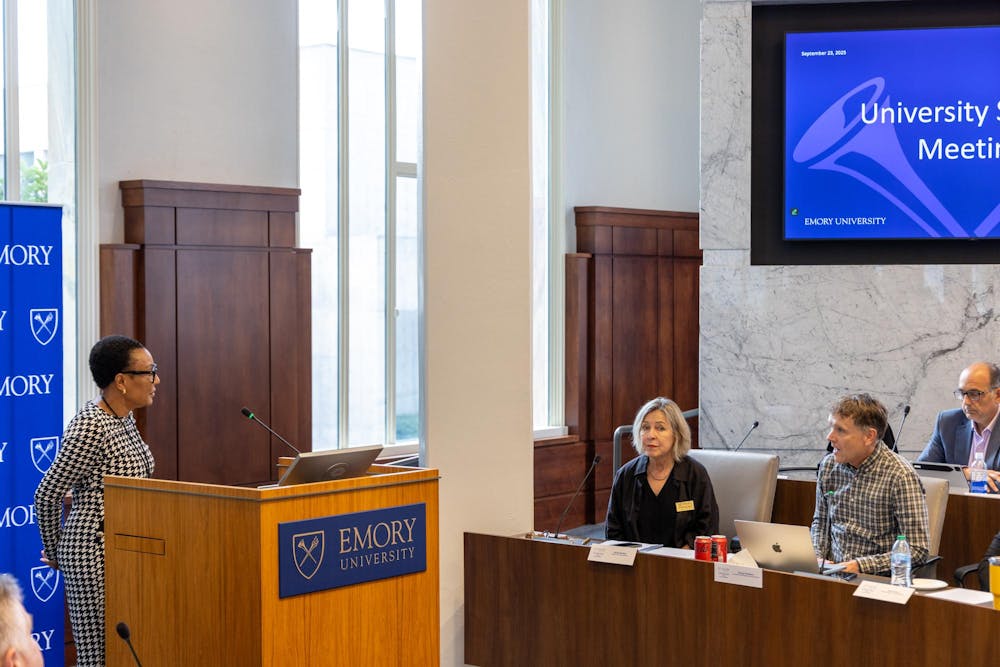
The University Senate returned for its first session of the Fall 2025 semester on Sept. 23. Emory Interim University President Leah Ward Sears (80L) addressed the University Senate and spoke about First Amendment violations in the Open Expression Policy and the end of need-blind admissions for the University. The meeting also included reflections from the Emory Police Department (EPD) about the Aug. 8 shooting at Emory Point. Contrary to the typical closed-door policy of University Senate meetings, this convening was public to all community members through Zoom.
The University Senate is a governing body composed of staff, faculty and student leaders on Emory’s campus.
Sears gives first University Senate address
Sears began the meeting with a statement setting her goals and emphasizing her commitments as interim president. She said she would revive Emory’s Administrative Council, which would bring together university officials to report directly to Sears.
The interim president added she will remain committed to shared governance between faculty and administration.
“Shared governance, to me, isn’t just about a structure, it’s about a process,” Sears said. “It’s a commitment to collaboration, mutual respect and to our shared responsibility for the future of this great university.”
Sears also addressed the university’s decision to terminate Diversity, Equity and Inclusion (DEI) programs at Emory, sharing that the debate over these closures had begun “months” before she took office.
“I know that that message raised many questions,” Sears said. “These conversations, debates and decisions began months before I took office, even months before I knew I would be here.”
Sears said she did not have a definition of what constituted a DEI program after being asked about the program cancellations by an audience member.
“I can’t say that yet,” Sears said. “It’s going to be a slow walk forward, so I can’t come here and put up a PowerPoint and tell you this is going to be in, and this is out. If we’re just going to, together, have to work through all of this, it’s just an unfolding thing.”
Sears also mentioned that the University can maintain affinity spaces as long as everyone is welcome.
Need-blind admissions come to an end
During the meeting, Sears announced the end of need-blind admissions at the Atlanta campus. The University’s need-blind admission policy meant that the admission committee would not consider an applicant’s financial status when making admission decisions. The Atlanta campus will now switch to a need-aware policy, which means they will consider an applicant’s financial status during admission. Already, Oxford College uses a need-aware policy during its admissions process.
Emory began its need-blind admissions policy in 1998 when it joined the 568 Presidents Group, a consortium of American universities and colleges that practice need-blind admissions. The 568 Presidents Group also created the Consensus Approach method to standardize a university’s ability to calculate an applicant’s family’s ability to pay tuition.
EPD updates in wake of CDC shooting
After Sears’ address, EPD updated the University Senate about their initial response to the CDC shooting on Aug. 8.
EPD Chief Burt Buchtinec said the University could not have predicted the shooting, and the police department is doing its best to address additional safety concerns.
Buchtinec also mentioned that EPD is working to increase multi-agency response communications during police emergencies.
“When the incident occurred on Augusta 8, I could immediately get on the phone with City of Atlanta Chief of Police and say, ‘We need X,’” Buchtinec said. “He did not hesitate. He said, ‘Absolutely, we’re on the way.’”
Buchtinec mentioned that EPD was considering increasing its presence on campus, especially in crisis intervention, first aid and tactical training.
Siya Kumar (she/her) (28C) is a news editor at The Emory Wheel. She is from New Orleans, La., majoring in Economics and Creative Writing on the pre-law track. Outside of the Wheel, Kumar is a market news analyst for the Emory Economics Investment Forum and a writer for the Emory Economics Review. She loves baking, reading, and drinking coffee.

Jack Rutherford (he/him) (27C) is a managing editor at The Emory Wheel. He is from Louisville, Ky., majoring in economics on the pre-law track. When not working for the Wheel, he can normally be found rowing with Emory Crew, where he serves as president, or at an Atlanta Opera performance. In his free time, Rutherford enjoys listening to music and walking in Lullwater.