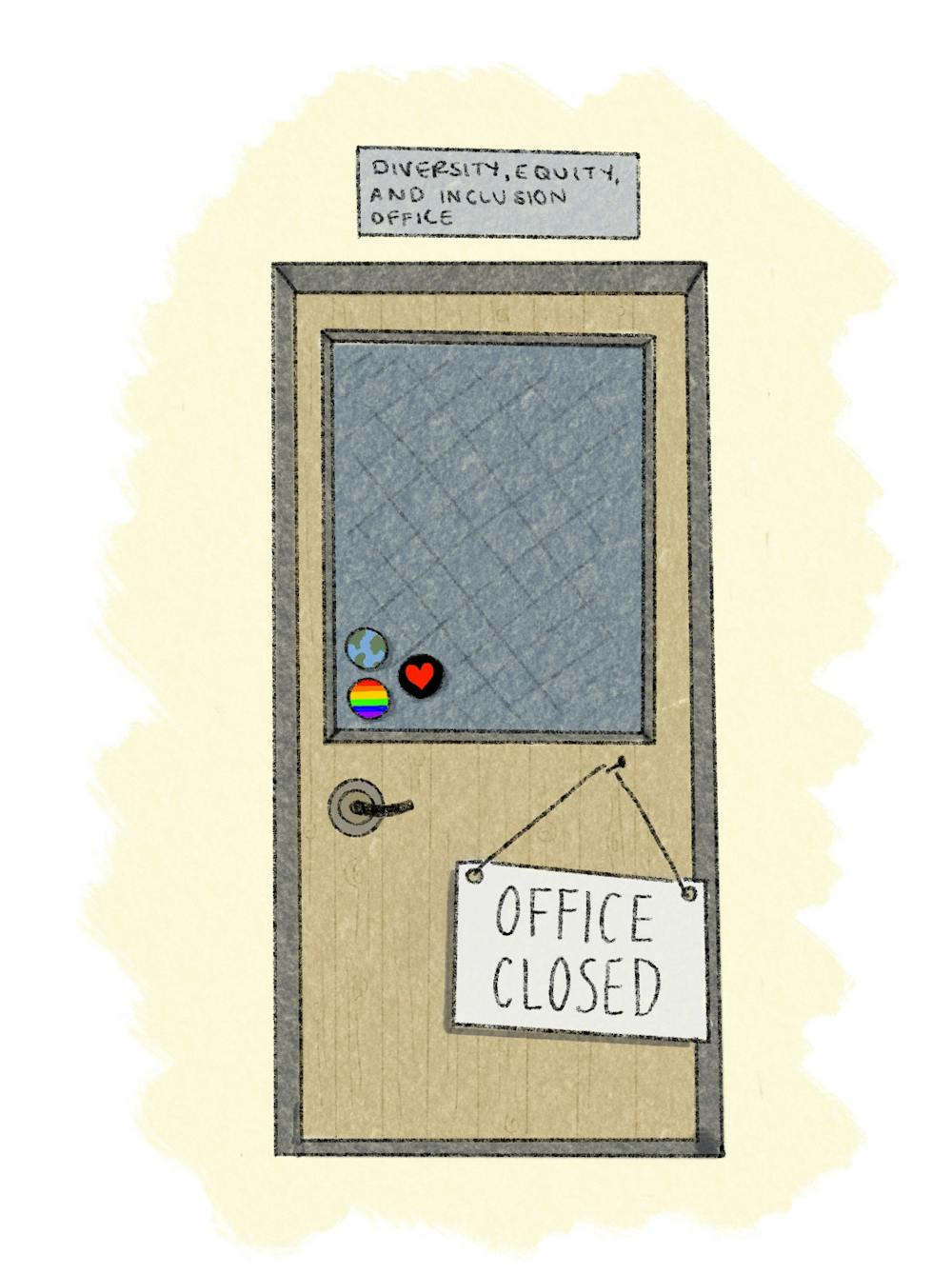
In the wake of Interim University President Leah Ward Sears’ (80L) announcement of Emory University’s discontinuation of Diversity, Equity and Inclusion (DEI) programs and offices, students, faculty and staff have been left asking: What’s next? While U.S. President Donald Trump and his cabinet have been promising to rip funding from universities that do not comply with his restrictions on DEI since January, it is unclear what will become of a higher education system stripped of these principles. Professors may have to teach rewritten histories, staff may experience forced transitions out of the University and years poured into fields of study could evaporate in an instant.
As the voice of The Emory Wheel, the Editorial Board, cannot hope to serve our university community while being apathetic to concerns that harm us all. The Emory Wheel’s Editorial Board unequivocally supports DEI efforts, and we believe that in no world should it be controversial or punishable to do so. Emory has not given its students a modicum of comfort in its actions all while going above and beyond to appease the Trump administration.
Emory scrubbing DEI from its most public image contradicts its presence as an Atlanta university, which comes with profound history. Atlanta is the cradle of the modern Civil Rights Movement, as well as being the South’s most vital LGBTQ+ hub. With this positionality in mind, past Emory students have not shied away from taking up the mantle of dissent. For example, in 1991, two Emory students, Michael Norris and Alfred Hildebrand, were harassed by other students after they were seen kissing in a common area. In response to the University’s handling of the situation, students marched through campus and organized a sit-in in the university president’s office. This action led to the formation of the Office of Gay, Lesbian and Bisexual Student Life. Emory’s office, now known as the Office of LGBT Life, was one of only nine U.S. universities and the only one in the Southeast to establish an office in a time of AIDS activism, campus organizing and ACT UP protests.
Additionally, Emory’s Political, Cultural and Social Movements Collection at the Stuart A. Rose Manuscript, Archives and Rare Book Library details the history of transformative protest and activism within Atlanta. With this collection, Emory fashions itself as a steward of marginalized histories and a beneficiary of Atlanta’s radical past, a position it now actively undermines by dismantling the very institutional commitments. Emory paid for its own Atlanta ZIP code, making a concerted effort to embed itself within the civic identity of this city. Emory’s decision is a repudiation of the social architecture that enriched student life and helped transform Georgia’s capital into a place where silenced voices grew impossible to ignore.
DEI erasure threatens major ramifications in Emory departments such as history, African American Studies and Women, Gender and Sexuality Studies. Beyond the more immediate concerns regarding staff layoffs and a lack of departmental funding, the silencing of minority narratives wields the potential to erode the integrity of the regional history upon which Emory sits. Stifling DEI is an affront to the academic ethos by which the University operates. As affirmed in Emory’s mission statement, “the intellectual and social energy that results from such diversity is critical to advancing knowledge.”
When asked if the University was explicitly told to comply with federal laws, Emory’s communications team only pointed the Board toward the previous unclear statement from Sears. By not issuing a further statement, Emory failed to confirm or deny if the Trump administration pressured Emory to make changes to its DEI programs. Emory’s capitulation also comes after a district judge found that the Trump administration acted illegally by freezing Harvard University’s (Mass.) research funding under the guise of anti-DEI actions. Further, on Aug. 14, another district judge ruled that the Education Department’s attempt to cut federal funding from institutions that continue with DEI initiatives violates the law. Emory’s choice to end DEI programs only further plays into perceptions that DEI is an unwieldy and dangerous aspect of education in the United States.
Right-wing pundits have shaped DEI into the new catch-all colloquialism for anything that dares to move the needle in a direction away from a homogenous America. The language surrounding DEI did not come about by accident and is reminiscent of the paranoia of McCarthyism. The Trump administration considers DEI in federally funded endeavors to be not only illegal but also “immoral,” “radical” and “wasteful.” As such, DEI has evolved into a boogeyman among the ranks of critical race theory and the “war on woke.” Anything connected to DEI is under attack because the far right has pigeon-holed it with noncompliance and a refusal to bend to dominant narratives.
Viewing DEI as a spreading, tangible enemy comes from deliberate moves to render all possible avenues of critical thought null. The condemnation of DEI coalesces around the demand of a pure America — one of inoffensiveness and simplification in its values. Yet, the legacy that Emory wishes to attach itself to is built on the bravery of dissent and action. Sears has asserted that an “unwavering commitment to fairness, belonging and opportunity” are “part of Emory’s DNA,” but the actions of the institution have not mitigated the harm, fear and uncertainty the Emory community faces.
With such immense cultural inheritance at stake, the University has a responsibility to be transparent about the tangible manifestations of compliance. This dearth of transparency has left students wondering if the end of DEI signals the uprooting of minority resources or a mere rebranding of affinity spaces. The lack of administrative communication is absolutely unacceptable, particularly when the fate of many students’ abilities to flourish, or retain scholarship funding at this institution, lies in the balance.
In light of this institutional silence, the Editorial Board will be hosting a public town hall to give voice to those Emory has failed to address and create space for. Emory’s community deserves a platform to share its grievances, fears and anger. Already, Students for Socialism at Emory has worked to provide opportunities to vocalize support for DEI, including through a walk-out on Sept. 9. If our administration will not engage with us, then we have to stop asking for permission to ask questions. The Editorial Board’s town hall will take place on Sunday, Sept. 21 at 1 p.m in room 106 of the Alumni Memorial University Center.
Emory’s community makes the University what it is and our breadth of diversity distinguishes it from a pure corporation. Without directly standing behind the diversity of our school, our values are empty, and our presence is antithetical to progress.
The above editorial represents the majority opinion of The Emory Wheel’s Editorial Board. The Editorial Board is composed of Editorial Board Editor Carly Aikens, Mira Krichavsky, Eliana Liporace, Niki Rajani, Josh Rosenblut, Ilka Tona and Crystal Zhang.