
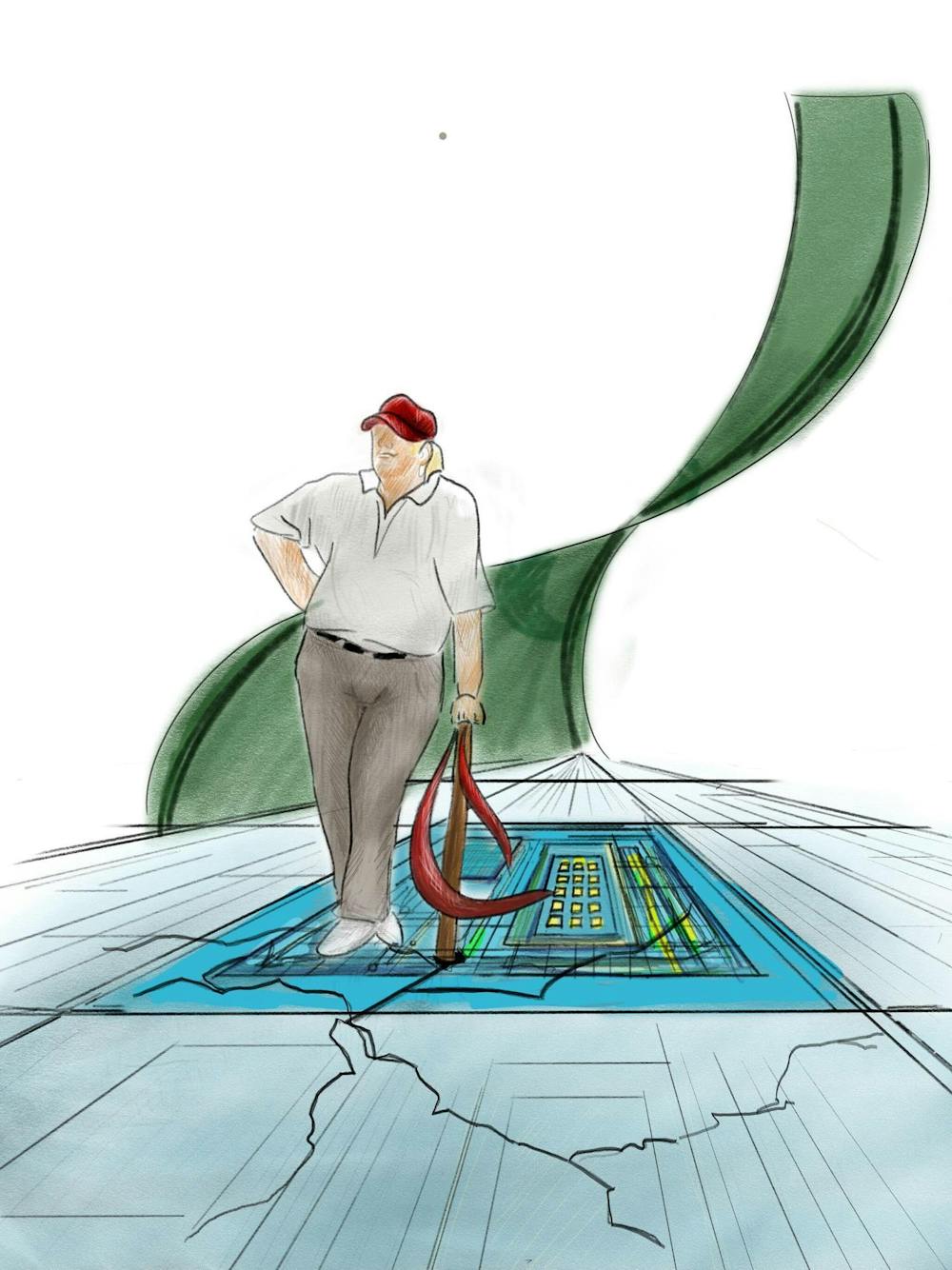
President Donald Trump has always been known for being a master in the “art of the deal.” In the past month, his reputation has become more evident than ever, following the federal government’s unprecedented steps into the business world. In August, the president made a deal with the chip giants NVIDIA and AMD, allowing them to sell their high-tech chips to China in exchange for a 15% cut of the companies’ chip profits. The following week, Intel announced that the existing government investment in the company would be used to purchase a 9.9% stake at a discount from the market price. These deals are some of the most recent in a growing list of government interventions into the private market.
These deals have sent shockwaves throughout the worlds of politics and business. While many Republicans have stayed silent on the topic, left-wing politicians like Sen. Bernie Sanders (I-Vt.) have praised Trump for returning profits from corporations back to citizens. Some right-wing politicians have even compared the move toward government ownership of private corporations to socialism. With Trump pledging “many more” deals with major corporations to come, it is clear that a major restructuring of American capitalism is underway. Now, and in the future, Trump’s business deals will fracture the relationship between the government, corporations and the public, and mechanisms already exist to address the problems he is trying to solve.
In April, Trump barred the sale of high-tech chips to China for national security concerns. However, the deal Trump brokered with NVIDIA and other industry leaders in August reaps profit from sales to China and bypasses this barrier, while speaking nothing to the validity of the national security concerns. The federal government has not made any substantive changes to the national security landscape between the United States and China regarding chips since April, so it does not make sense that these restrictions were lifted. Either the barring of chip sales to China was an overcautious error by the United States, or it stemmed from valid concerns that still exist but are now being ignored.
No matter which circumstance is the case, this new deal sets two dangerous precedents. Firstly, this deal allows the government to extort concessions from companies, like the 15% cut from NVIDIA chip sales, by placing and then lifting export restrictions on the products they sell, in exchange for a cut of their overseas profits. Additionally, it encourages companies facing export restrictions to make deals with the government to lift those regulations, no matter the underlying cause. These precedents are dangerous for American business and national security because they take the focus away from national security and onto government profit, a precarious shift for the American economy and American capitalism.
The conception of the Intel deal was quite different from that of NVIDIA and AMD, but it was decidedly even more dangerous. At the beginning of August, Trump held a meeting with the Intel CEO Lip-Bu Tan to address a conservative-fueled controversy related to his relations with China. However, the meeting gave grounds to Trump’s larger concerns about the return on the $11.1 billion investment the Biden administration made into the company. Trump thought that Americans and the American economy were not getting a high enough return on their investment, and brought these concerns to Lip-Bu Tan in their meeting.
Despite lambasting the personal allegations about business connections to China as false, Tan and his company still gave up 9.9% of the company’s shares to the federal government as a way to tamper political pressure and avoid government sanctions. This sets a dangerous precedent for the future, in which Trump or other administrations can directly interfere with business affairs by extorting companies that do not fall in line with their views. While the government has long invested in American companies, previous investments have come with benchmarks and strings attached, like requirements to build with American materials and labor, but not a direct stake in the companies A direct stake, on the other hand, opens a company up to the shifting whims of the current administration and creates conflicts of interest that could harm investors and workers. These deals set bad precedent but also ignore the existing precedent, which facilitates government and business interactions.
In the case of NVIDIA, national security concerns are a legitimate economic reason for which non-optimal market actions can be taken. Trump and future administrations should be willing to use this justification in valid cases and work with companies looking to sell products overseas, rather than simply demanding a quid pro quo and allowing this foreign trade with little oversight. Additionally, to address concerns related to the return on investment (ROI) of government funding for businesses — as in the case of Intel — Trump should remember that investment in American economies should come through job creation, infrastructure investment and the multiplier effect. Following the acquisition of direct stakes in companies like Intel, he has made these outcomes less likely through the removal of benchmarks tied to the original investment, like the requirement to build in America and meet job creation requirements. Even if benchmarks alone are not enough for the government to recoup a ROI from the original terms of the deal, Trump could have used other established mechanisms, like raising the corporate tax rate or increasing regulation, rather than making an unusual and harmful deal that threatens to destabilize American capitalism.
As deals like these become more prevalent, it is imperative that we return to the basics and analyze these deals and their effects. Many Emory University community members are voters in Georgia, a consequential state in elections, and we must do our research and understand how Trump’s actions impact our economy and its future. We must research how our elected officials feel about these actions, and use our vote and voices accordingly, electing lawmakers who will act in our best interest and in the interest of our economy’s future.
These two deals will almost certainly not be the last under the Trump administration. Alongside his tariff regime, changes in diversity, equity and inclusion and immigration policies, Trump is dramatically shifting the landscape of American workplaces and the country’s economy. Without dramatic pushback, these shifts will undoubtedly harm millions of Americans. We, as voters, citizens and participants in the American economy, must continue to stay vigilant and hope that these unprecedented moves do not tank our future economic prospects.
Contact Pierce McDade at pmcdade@emory.edu

Pierce McDade (he/him) (25Ox) is majoring in Economics and Political Science. He is from Bloomington, Illinois and enjoys thrifting, movies, books, pickleball, and spending time with friends.


