
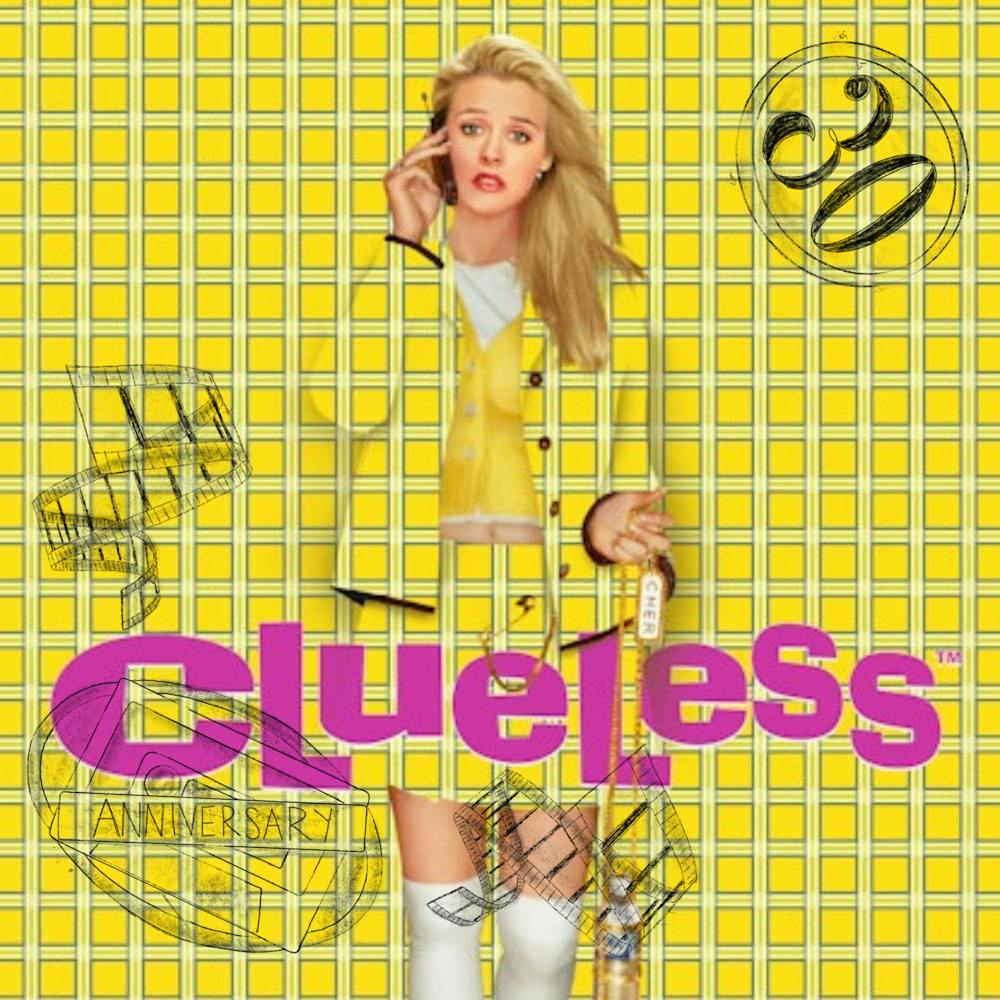
Before the charmingly awkward Romy White, the airheaded Karen Smith or the formidable Elle Woods, there was Cher Horowitz. With pearly white teeth, shiny blonde hair and Daddy’s credit card, the Beverly Hills high schooler — played by Alicia Silverstone — ushered in a new era of female protagonists: pretty, ditzy and much more than what meets the eye.
Just like its main girl, “Clueless” (1995) offers more than surface glitz and glam. Thirty years after its initial release, this seminal coming-of-age comedy remains a vital source for pop culture. From classic scenes and sayings to dazzling fashion, “Clueless” persists as one of the most influential teen films of all time.
A significant contributor to this continued cultural relevance is the disarmingly charming Cher. In the opening montage of “Clueless,” set to the anthemic “Kids in America” (1995) by The Muffs, Cher’s perfect life comes into focus. She takes her friends for a spin in her white Jeep, goes on a shopping spree and lounges by the pool in a pink che bikini. But the euphoric sequence is soon sliced by Cher’s narration: “But seriously, I actually have a way normal life for a teenage girl.”
Inspired by Jane Austen’s novel “Emma” (1815), writer and director Amy Heckerling was intentional in building Cher. Like Austen’s Emma, Cher meddles in matchmaking — and makeovers — as she seeks control over her social environment. But unlike the ruthless Regina George of “Mean Girls” (2004), Cher is misguided, not malicious.
Heckerling’s careful characterization of Cher surfaces in some of the film’s most iconic scenes. As she sports her classic yellow-plaid skirt set, she fends off the advances of ambitious high school boys, grimacing and griping, “Ugh, as if!” When she is robbed at gunpoint, she is more concerned about her feather-lined coat than her own skin. And when she wants to negotiate a higher grade in debate class, she plays matchmaker between two of her lovelorn teachers.
But Cher’s defining characteristic is not her fur coats or silly schemes with her best friend Dionne (Stacey Dash): it is her ditziness and how Heckerling writes this charismatic cluelessness.
The primary plot of “Clueless” does not revolve around Cher navigating complicated friendships, contributing to her dad’s multimillion-dollar lawsuit or even exploring her budding romance with Josh (Paul Rudd). Instead, the film introduces viewers to a new kind of woman: one who is comfortable, even confident, with what she does not know. While Heckerling paints a nostalgic portrait of pre-touch-screen adolescence — from class clowns to rowdy parties to bad dates — Cher remains the unequivocal focus.
Even as she embarks on the traditional journey from superficial beauty queen to self-aware young adult, Cher never attempts to conceal her unconventional intelligence. She is fluent in fashion, practiced in avoiding unwanted affection and a master of witty comebacks. So what if she is a “virgin who can’t drive” — we all have our faults.
“Clueless,” too, has shortcomings. While many aspects of the film remain culturally relevant, such as the confusing diction of adolescents, the distracting presence of phones at the dinner table and the alarming apathy of Department of Motor Vehicles workers, other elements prove more difficult to reconcile with modern culture. For example, the romanticization of diet culture and outdated language regarding the LGBTQ+ community ring hollow — even offensive — today.
Nevertheless, the lasting impacts of “Clueless” emerge across various media. The montage in which Cher shows a transfer student, Tai (Brittany Murphy), around the quad and points to the various cliques materializes in the iconic cafeteria scene from “Mean Girls.” Additionally, Heckerling subverts the makeover motif by drawing an inverted relationship between Tai’s inner and outer beauty: As she becomes more conventionally attractive, she becomes unkind and selfish. This dynamic appears in the straight-to-video film “Teen Spirit” (2011), during which an innocent scholar receives a complete remodeling from a socialite, only to become a nasty friend and betray her morals. Even popstar Olivia Rodrigo cites the film in her song “all-american b*tch” (2023) when she sings, “Coca-Cola bottles that I only use to curl my hair,” bringing to mind Tai in the bathroom with her red tendrils curled around tin cans.
These recurring allusions and the movie’s persistent popularity testify to the enduring authority of “Clueless” as the quintessential teen comedy of the ’90s. With Cher, Heckerling invited a fresh kind of female protagonist to the screen: the relatable, witty and awkward young girl with high aspirations and even higher stilettos. With this innovation, Heckerling also engineered a new kind of narrative — a character-driven exploration of the trials and tribulations of teenage life. Nearly 30 years after its release, it is hard to imagine the film losing its cultural relevance. I mean — “Ugh, as if!”
Catherine Goodman (26C) is the Managing Editor of Arts & Life and Editorial Board. She is a double major in English and Art History. She plans to pursue arts and culture journalism, with a special interest in criticism and feature writing. When she isn't listening to music or writing her column, you can find her baking specialty cakes or playing with her dog, Apollo.


