When I first watched “The Office” (2005-2013) in middle school, a lot of the jokes flew over my head. Nonetheless, the show still charmed me. Over the course of the sitcom’s nine seasons, we watch a paper company carve a comedic path for survival amid the rise of the big, scary internet. There’s so much to love about an ensemble of oddballs working in an office in Scranton, Penn., pulling pranks on each other, starting fires and contracting rabies to then search for a cure. And as a Stamford, Conn., native, I especially enjoyed Jim Halpert (John Krasinski)’s sidequest to the Stamford office, giving my ordinary city a small moment in the limelight.
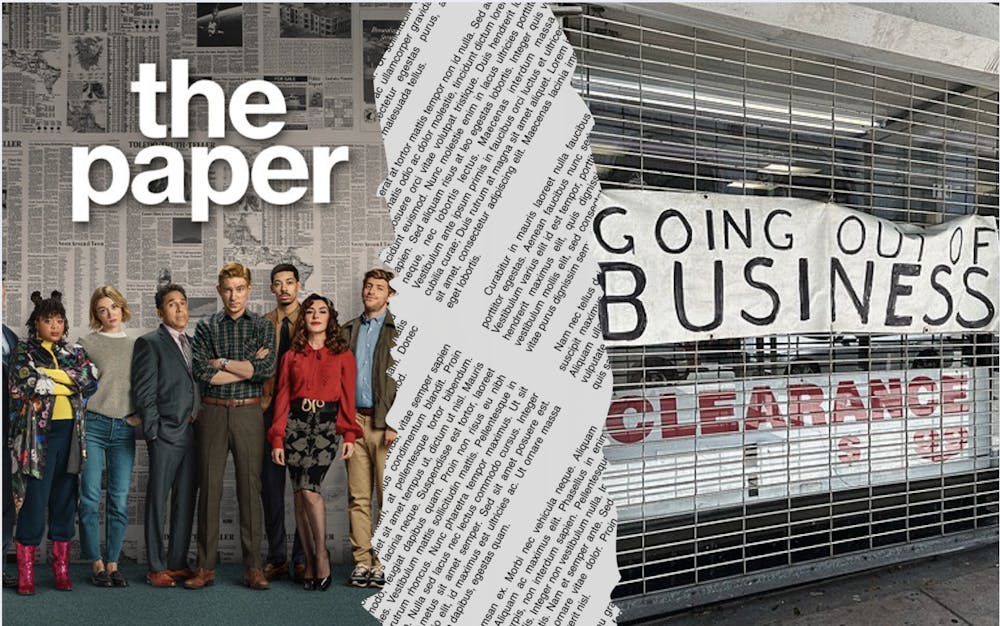
Over a decade later, some of “The Office” creators are returning with a new workplace sitcom, “The Paper” (2025). The show follows a struggling newspaper called The Truth Teller in Toledo, Ohio. With Greg Daniels, the screenwriter and producer who adapted Britain’s “The Office” (2001-2003) for American television, behind this new newspaper sitcom, it is destined to be funny. Despite my high hopes for the show, which premieres Sept. 4 on Peacock, I have discovered that I’m not ready for journalism to become the butt of the joke.
I can’t help but see the likely intentional parallels between “The Office,” a show about a paper company airing after the internet boom, and “The Paper,” a show about newspapers as print media sits on a knife edge. According to a 2024 Northwestern University (Ill.) study, 3,200 newspapers have shuttered their doors since 2005, the year of the original sitcom’s debut — a staggering rate of two newspapers per week as websites and short-form content pilfer market share.
This trend is not limited to national outlets either — it’s in our own backyard. Georgians are currently facing a heightening local news crisis, ranking 46th in the country for number of journalists per 100,000 residents. Out of Georgia’s 159 counties, 21 counties have no local newspaper and 116 counties only have one, contributing to a vast news desert across rural parts of the state. When local journalism disappears, accurate reporting on local emergencies, elections and culture goes with it, as well as a reliable record of local history. This absence can have a destabilizing effect on democracy at both the local and national levels. Statewide and nationally, fears of a tree falling in a rural forest and no one hearing it are becoming more and more real.
With an accelerating decline in local news, I worry “The Paper” will harp on this demise by poking fun at the underfunded and struggling state of current newsrooms without highlighting the evergreen value of local news. I can already predict that episodes will follow the show’s eccentric yet loveable oddball reporters face one curveball after another, like declining trust in the media or competition with viral influencers.
As a student journalist striving for a career in the media industry, it’s slightly unnerving that this crucial profession is about to be turned into over-the-top satire. While these characters will certainly win audiences over with their humor and heart, like the characters of “The Office” did, I worry that future generations may start to see local and traditional news as unimportant or silly, discouraging them from pursuing a job in the mocked profession.
Yet, some comparisons between the fictional paper company and a newsroom will likely be apt. During my last three years at The Emory Wheel, I have experienced much of the workplace camaraderie that the show celebrates. Spending hours on Tuesday print nights crammed in the Alumni Memorial University Center at Emory University’s fourth floor offices forges friendships, as does covering major breaking news on campus that ropes in each member of our small, yet dedicated, staff.
Not to engage too much in shameless self-promotion, but working on the newspaper has also been one of my most rewarding college experiences. I remember running on Wednesday mornings to the Emory Student Center to grab copies of my first stories in print. A few months later, my freshman year dorm wall was covered with cut-out clips of all my stories. Since my early days at the Wheel, my appreciation for the newspaper has only grown. Student reporters covering campus protests and administration changes have access to unique insights and information because of our proximity to the Emory community, enabling us to inform the wider student body. This has helped me see how real, tangible journalism matters on college campuses, as it does on the local level.
That is why a new sitcom poking fun at local journalism’s overall bleakness is terrifying. “The Paper” is a sadly accurate sign of the times, but I hope it will also serve as a call to action for communities to recognize and support how crucial their Sunday newspaper truly is. Nonprofit news organizations are forging a new path in media outside the constraints of typical ad sales business models, like ProPublica and Savannah, Ga.’s, The Current. As recently as 2024, the Georgia Trust for Local News bought 18 newspapers, hoping to save more communities on the brink of desertification. In “The Paper,” The Truth Teller will turn to volunteer reporters to combat its economic woes, something Canopy Atlanta leans on with its community-based journalism. Yet, as newsfeeds become oversaturated with short-form content and other noise on the internet, volunteer efforts can only go so far in filling gaps in local news coverage.
Considering “The Paper” has not even aired yet, it’s probably a little over the top to start making broad sweeping claims about what the fictional show means for journalism. Despite my reservations, I am excited to watch a journalism-themed sitcom from such storied TV executives. I only hope that decades from now, we won’t look back and reminisce on the days when local newsrooms were once enshrined on TV before going extinct, like the once-lauded, always reliable paper company.
Contact Madeline Shapiro at madeline.shapiro@emory.edu

Madeline Shapiro (she/her) (26C) is from Stamford, Conn., majoring in creative writing and classic civilizations. She manages the Wheel’s opinion section. Outside of the Wheel, Shapiro can be found playing low-stakes games of soccer, spending time outdoors and watching as many Premier League games as possible.