
The Georgia chapter of the Council on American-Islamic Relations (CAIR-Georgia), a national civil rights organization that focuses on legal advocacy for American Muslims, is suing Emory University for violating Title VI of the Civil Rights Act of 1964, according to an Aug. 4 press release. CAIR-Georgia is suing the University, along with the Emory Board of Trustees and the Emory School of Medicine Executive Associate Dean Dr. John Eley, on behalf of Umaymah Mohammad, a dual MD/Ph.D. student whom Emory suspended in November 2024 for allegedly violating the medical school’s conduct code.
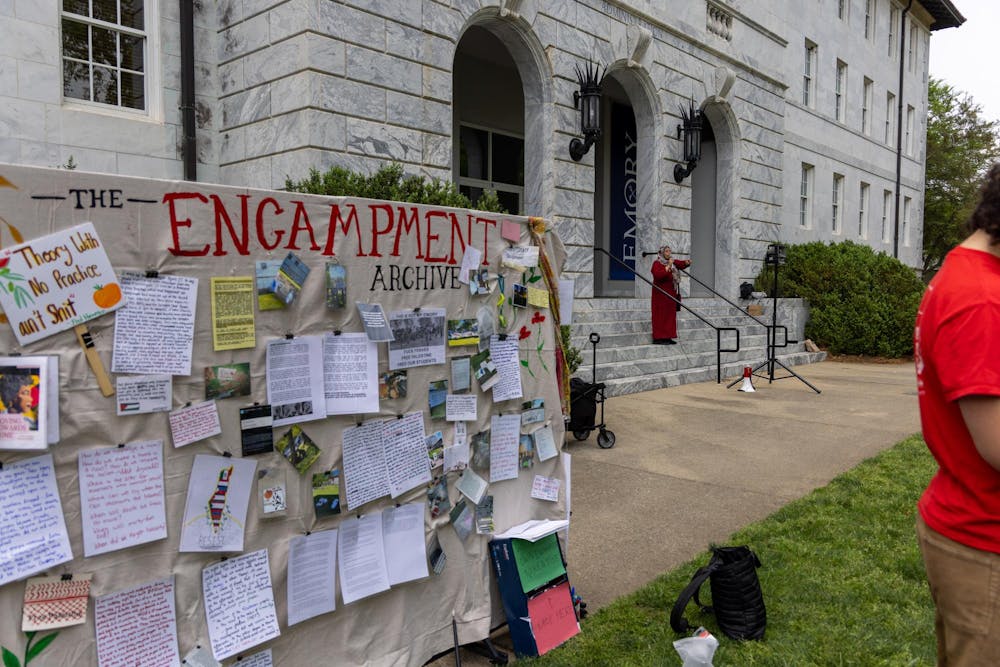
Mohammad, a Palestinian-American and Muslim, participated in various pro-Palestine demonstrations on Emory’s campus, including the April 2024 encampment. Last April, in an interview with DemocracyNow!, she criticized Emory Associate Professor of Surgical Oncology Dr. Joshua Winer for volunteering with the Israel Defense Forces. She did not name Winer directly in her interview.
According to CAIR-Georgia’s complaint filed on Aug. 4, Mohammad’s speech on campus and the interview led to her suspension for not adhering to “professionalism standards.” The medical school’s conduct code lists “explicit or implicit threats” directed at specific people as conduct that could result in disciplinary action, also noting that the conduct must also serve “no legitimate purpose.”
CAIR-Georgia alleges that Emory’s behavior violated federal and state law, including “intentional discrimination and retaliation in violation of Title VI, breach of contract, denial of procedural due process, and intentional infliction of emotional distress under Georgia law,” according to their press release.
Assistant Vice President of University Communications Laura Diamond wrote in an email to The Emory Wheel that the University declines to comment on pending litigation.
In April 2024, CAIR-Georgia filed another federal civil rights complaint which alleged violations of Title VI, specifically regarding Palestinian and Muslim students, and prompted an investigation into Emory’s allegedly hostile environment. In January, Emory settled with the Department of Education’s Office for Civil Rights, pledging to revise anti-discrimination policies, update on-campus protest policies and improve training for faculty and staff on these matters.
CAIR-Georgia Staff Attorney Keon Grant wrote in the press release that Emory’s alleged treatment of Mohammad is “not only the latest incident in their well-documented history of discriminatory treatment toward Palestinian students and their advocacy, but an intensification of this behavior.”
CAIR-Georgia’s complaint on behalf of Mohammad additionally alleges that the suspension and investigation into her conduct were unfair and discriminatory.
“This process was plagued by procedural irregularities, such as pressuring Plaintiff to admit guilt, altering charges, manipulating deadlines, disregarding institutional policies, and imposing disproportionate sanctions,” the complaint states.
Mohammad is seeking damages from the University, including redress for harm to her academic progress, reputational harm, emotional distress and “denial of educational benefits and equal access to educational opportunities,” according to the complaint.
The lawsuit is seeking relief through a private cause of action, a process where plaintiffs can directly seek compensation for damages such as lost tuition and forgone opportunities under Title VI rather than wait for the government to file a complaint. The complaint states that Mohammad is suing Emory for approximately $300,000 in lost income, her $38,400 annual stipend and additional costs relating to lost work, reputational and emotional harm.
While Mohammad is suspended from Emory until 2027, the disciplinary process is ongoing. She received another notification of a conduct code breach on July 18 for other actions related to her pro-Palestine speech, according to CAIR-Georgia’s complaint.
“Emory’s continued punishment of students who speak out against the genocide in Gaza is an act of complicity,” Mohammad wrote in the press release. “Disguising this repression as a matter of ‘professionalism’ or ‘conduct’ is a moral failure—one that stains not only Emory, but the entire U.S. healthcare and education system.”

Ellie Fivas (she/her) (26C) is from Cleveland, Tenn., and is majoring in political science and history on the pre-law track. When she is not working for the Wheel, she works in prison education, leads a human rights club and works at the Emory Writing Center. In her free time, you can find her reading trashy romances and The New York Times, basking on the Quadrangle and doing crossword puzzles.


