
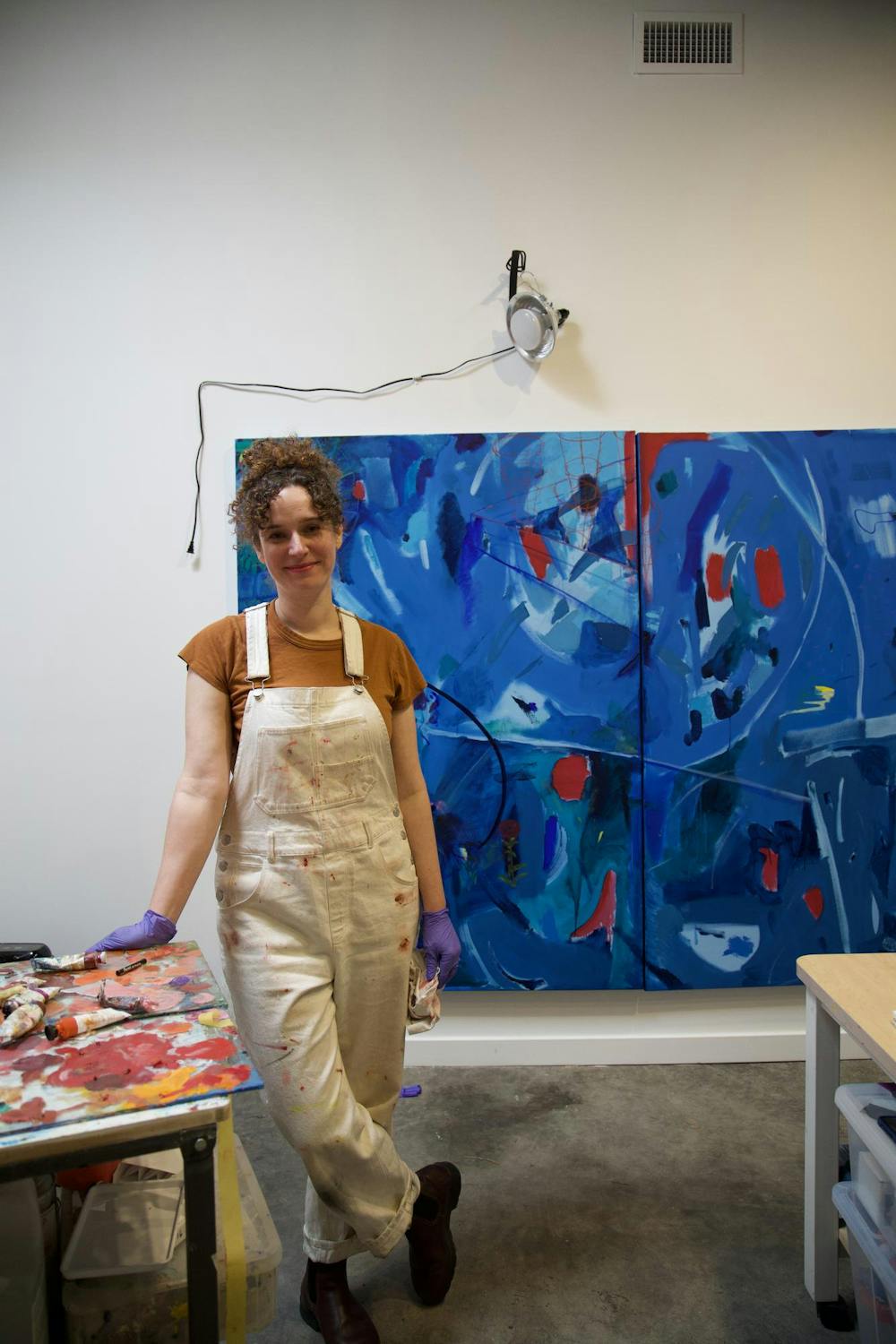
At 5 years old, Anna Wehrwein encountered something so violent, so vivid, so visceral that it changed her forever. Wandering the corridors of the Museum of Fine Arts, Boston, she stumbled upon a painting of the severed head of John the Baptist. Staring at the scene, Wehrwein was horrified, startled and yet intrigued. She was utterly captivated by the medium — a fascination that she maintains to this day.
“What it solidified really early on was that painting was really powerful,” Wehrwein said. “That it could convey a story and emotion in a really powerful way.”
Now, an assistant professor of visual arts at Emory University and a practicing artist, Wehrwein remains “obsessed with paint.” In addition to her frightening confrontation with the beheading, Wehrwein encountered the material throughout her childhood. In her Boston home, which overflowed with art books, painting was not merely tolerated but encouraged. While many children slip into sleep counting fluffy sheep, Wehrwein stared at the lines of a subway scene above her bed that her mother, Pam Ozaroff, painted. As Wehrwein’s eyes wandered across the brush strokes and colliding colors, she wandered into dreams. In adolescence, art-making remained a priority: she took art courses, attended creative summer camps and completed pre-college programs.
Wehrwein completed an undergraduate degree at the University of Wisconsin-Madison, pursuing a double major in English and creative writing and studio art. Throughout her time in college, she found herself increasingly drawn to painting.
“Painting was where my ideas were synthesizing better and where I was enjoying spending my time,” Wehrwein said.
Following her graduation, Wehrwein worked in the publishing industry but felt unsatisfied splitting her time between her professional and artistic endeavors. After two years working a nine-to-five, Wehrwein knew she had to make a change and pursue painting full-time. So she packed her things and headed south to complete a master's degree in drawing and painting at the University of Tennessee. In her second year at the University, Wehrwein led undergraduate art classes. Through this experience, Wehrwein found strong mentors, an inspiring peer group and a new passion — teaching.
“That synthesized everything for me in terms of what I wanted to do and the type of work I wanted to be making,” Wehrwein said. “And what it meant to be an artist and also an educator.”
Wehrwein went on to instruct drawing and painting classes at the University of Missouri, where she altered her painting practice. During her time, she taught a course that interrogated the priorities and principles of abstraction. Although she initially assumed her students needed help understanding the complex topic, she found herself learning along the way. The “feedback loop” between professor and pupil encouraged Wehrwein to reevaluate her methods and aesthetic interests. Soon, Wehrwein’s own work began to shift: unexpected flatness invaded her canvases as the class questioned the construction of space. The rules changed, and Wehrwein began building imagery in response to abstract elements, specifically the fragility of perspective. Although she had always been fascinated by the properties of paint, she became enamored with the act of mark making, bringing the brush to the canvas and relishing in the bare physicality of the action.
“The metric of when something works, or when I’m satisfied, is not ‘Does it look like the thing?’” Wehrwein said. “If the mark making is interesting, then that’s good.”
In her oil painting “Shoreline” (2024), two men rest atop a picnic blanket by the marsh. One man leans on his elbows, poring over the pages of a book. The other rests his head upon the reader’s back, gazing up at the sky. Blue floods the scene, enveloping the subjects in a tender, yet cool, embrace. And the two men? They are not strangers Wehrwein happened upon, but her friends and fellow artists.
“I don’t stage any images,” Wehrwein said. “They’re always scenes that are candid, intimate, personal.”
Wehrwein advocates for dialogue among artists — both in personal and professional relationships. In 2021, she co-founded stop-gap projects, an artist-led gallery in Columbia, Mo. and the culmination of her dedication to fostering connections across the art world. When Wehrwein rented a studio with an attached storefront, she and her collaborators felt they had struck gold. Within a month, the storefront became a gallery space for local and non-local artists. Over four years, Wehrwein and her friends curated shows of various media, from sculpture to prints. For the group, there was “no such thing as a bad idea,” but there was a very important rule: the owners would not show their own work.
“It wasn’t a platform for us,” Wehrwein said. “It was how we could connect with other artists and give our attention to them.”
The gallery closed earlier this year but continues as a nomadic project. However, Wehrwein is not concerned with the organization's longevity. For her and her companions, the gallery did not need to “be forever to be worth it.”
Although Wehrwein’s work did not appear in stop-gap projects, she has exhibited at galleries across the country, including Philadelphia, New York and Missouri. From expansive canvases to contained drawings, Wehrwein creates work to leave the studio.
“The thing I always love about, it’s the hardest part, is getting ready for that final sharing with the public,” Wehrwein said. “But you always learn something back.”
Although Wehrwein is now a teacher, she will always be a student. Wehrwein learns and unlearns, marks and steps back, intuits and interprets. On her studio table rests a mountain of books on exhibitions and artists, from the works of Milton Avery to Mildred Thompson. She speaks of her influences like phantoms holding her wrist as she paints.
“Sometimes it’s really conscious,” Wehrwein said. “Sometimes it’s just like they’re in the room with you and you don’t even know it.”
Like the spirits that flit about her studio, color haunts — or more so taunts — Wehrwein. It exhilarates her. It eludes her. It drives her. Color is at the “heart” of her work.
“Color doesn’t exist on its own,” Wehrwein said. “It’s contextual. It is affected by what’s around it. And that way, it’s incredibly unstable.”
In her painting “Planting (a sunset),” a woman kneels at the edge of a bin wearing gardening gloves. The ground and the trees, her hair and her skin retain traces of yellow and green. In “Reader (big fan)” (2024), brown, orange, red and green clash, collide and complement each other in an oppressively warm domestic scene. In “Watering (Care Ethics)” (2023), a vibrant blue washes over a sitting man on the patio, just before a small garden.
The colors are realistic but not representational. Warmth seeps in where it should not, while cold clutches scenes of care. While painting, her best days are those when she surprises herself.
The shock that Wehrwein’s work elicits is far removed from that of a beheaded skull, yet it is no less captivating. As Wehrwein travels from the studio to the classroom, she brings much more than paint-smeared overalls, she brings all her phantom fascinations — friends and frustrations alike.
Catherine Goodman (26C) is the Managing Editor of Arts & Life and Editorial Board. She is a double major in English and Art History. She plans to pursue arts and culture journalism, with a special interest in criticism and feature writing. When she isn't listening to music or writing her column, you can find her baking specialty cakes or playing with her dog, Apollo.


